Key station of the Hairatan–Mazar-i-Sharif railway resumes operation
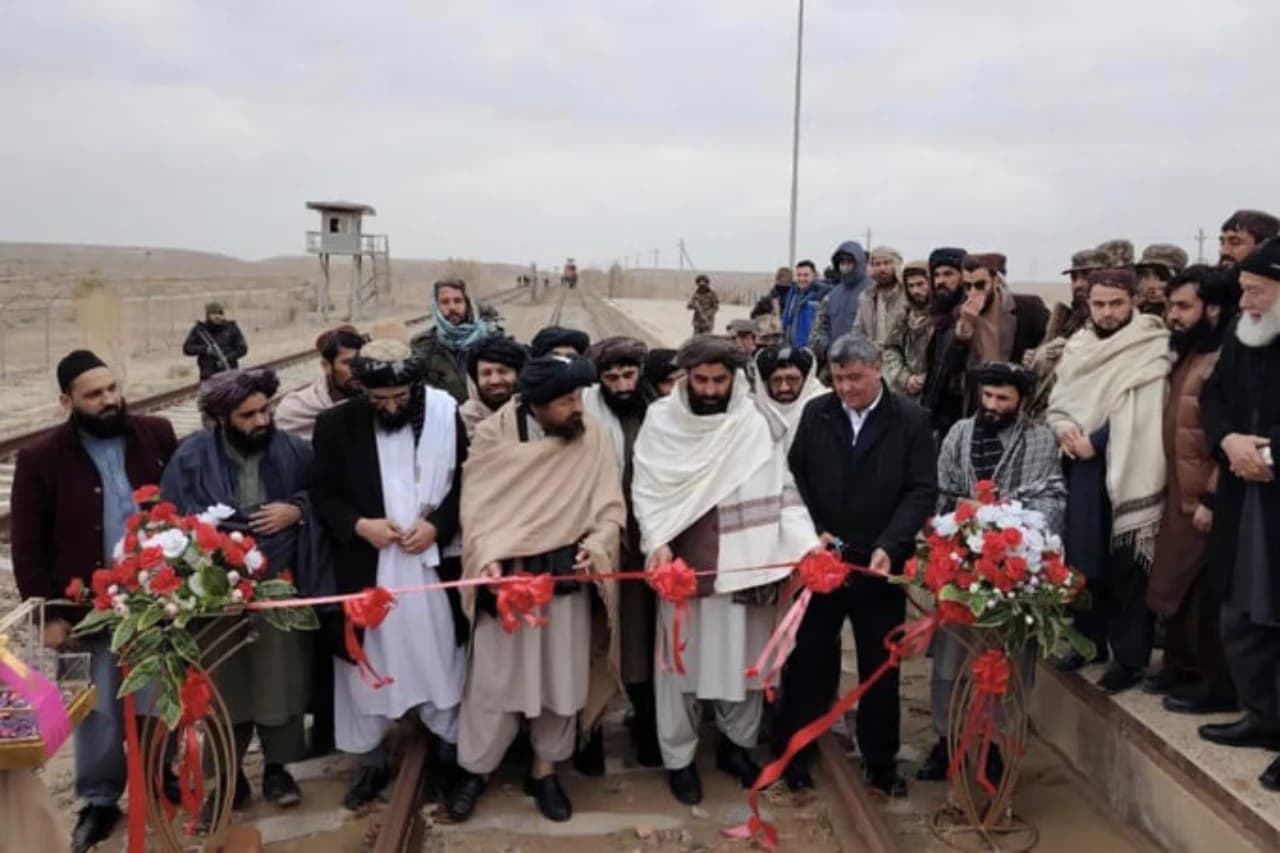
Photo: Press service of Uzbekistan Railways
A major step has been taken toward developing strategic transport corridors connecting Central and South Asia. Following large-scale modernization and reconstruction, the fifth station of the Hairatan–Mazar-i-Sharif railway line has officially resumed operations.
As a symbol of the successful completion of this historic project, a large commercial freight train ceremonially arrived at the renovated station complex for the first time. This will serve to elevate trade relations between the two neighboring countries to a new level.
Prospects for a visa-free system and gratitude to Tashkent
Mullah Abdul Ghani Baradar, Deputy Prime Minister for Economic Affairs of the interim government of Afghanistan, attended the opening ceremony of the renovated station and delivered a speech. In his address, he expressed special gratitude to the Uzbek side for its selfless assistance and friendly cooperation in rebuilding Afghanistan. He also called on local and foreign investors to contribute more actively to the country's economic development.
Mullah Abdul Ghani Baradar emphasized that official Kabul is highly interested in further strengthening multifaceted bilateral relations with Tashkent. Currently, prospects for maximizing the ease and simplification of the mutual travel system for citizens of the two neighboring countries are being seriously considered.
“The number of mutual visits between Uzbekistan and Afghanistan continues to grow rapidly. We are confident that in the future, a special agreement will be reached between the two countries that will not require passports or visas from citizens,” the Deputy Prime Minister stated.
Railways extending to Herat and Kandahar
Afghanistan's Minister of Public Works, Mohammad Isa Sani, announced that in cooperation with Uzbek specialists, large-scale projects are being systematically continued to build the massive Hairatan–Herat railway line with a total length of 657 kilometers. Furthermore, in order to further expand transport coverage, the technical and economic feasibility study (TEFS) for the 878-kilometer Herat–Kandahar railway network project is also being actively financed by the state.
Furthermore, in order to further expand transport coverage, the 878-kilometer Herat–Kandahar railway network project's technical and economic feasibility study is also being actively financed by the state.
Modern infrastructure and the new look of the Naibabad station
Located near the Maulana Jalaluddin Muhammad Balkhi International Airport, this station has high technical capacity. It is capable of easily receiving and processing more than 50 large wagons in just two stages.
Within the framework of the global project, the following large-scale upgrades were carried out in the area:
Administrative and service buildings were fully overhauled;
Power supply and heating systems were modernized based on the latest standards;
The entire infrastructure was updated, and a new centralized, powerful substation was built;
Night lighting and high-precision continuous video surveillance devices were installed along a 75-kilometer stretch of the railway.
Zufar Narzullayev, Chairman of the Board of Uzbekistan Railways, noted that as part of this construction work, the administrative buildings of the Naibabad–Mazar-i-Sharif station were fundamentally renovated, equipped with the latest digital technical equipment, and a new centralized auxiliary station was successfully launched. This will serve to ensure safe and rapid freight transport in the region.
In your opinion, how would the introduction of a full visa-free regime between Uzbekistan and Afghanistan, where passports and visas are not required, affect the security and economy of the two countries in the future?