









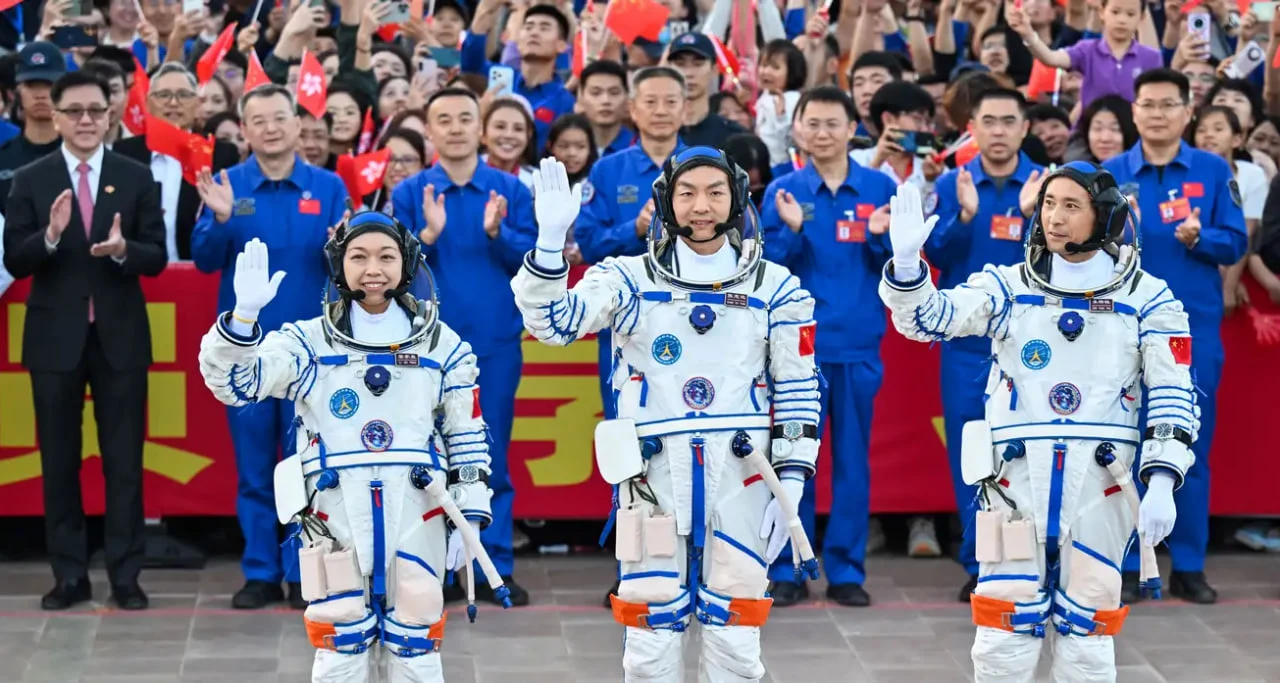
Another massive and exciting event has taken place in the world of space technology. The Shenzhou-23 manned spacecraft, carrying three brave Chinese astronauts (taikonauts), has successfully docked with the country's celestial pride, the Tiangong orbital station. This meeting in the vastness of space marks a new victory for humanity in conquering the cosmos.
According to an official statement by the China Manned Space Agency, the modern spacecraft safely docked with the Tiangong complex at 02:45 Beijing time on May 25.
Meet the new heroes of the celestial caravan!
The crew of the Shenzhou-23 consists of the following heroes, each possessing unique experience and skills:
Zhu Yangzhu — mission commander and experienced flight engineer;
Zhang Zhiyuan — skilled pilot;
Li Jiayin — specialist in cargo and special scientific research.
This cohesive team will replace the previous crew members who have been working tirelessly at the orbital station since October 2025 and will continue a series of unique experiments in space.
Human Reproduction in Space — From Dream to Reality
During the upcoming scientific mission, the taikonauts will carefully study how the human body adapts to weightlessness and long-term space environments. The main focus will be on researching the negative effects of cosmic radiation, the decrease (weakening) of bone tissue density in the human body, and the psychological stress caused by long-term isolation.
Interesting news: In May of this year, a collection of special cells very close to artificial embryos — blastoids — were delivered to the Tiangong station. Now, scientists will use these cells to scientifically test the possibilities for the human race to live and reproduce in open space in the future.
An Important Foundation for the Moon Journey
This flight also stands out with a unique new record in the history of China's space program. One of the crew members will remain and work at the celestial station for nearly a year. This is twice as long as China's previous traditional space missions.
According to industry experts, these crucial and unique medical-biological studies will serve as the most important foundation for China's long-term and massive program to land the first human on the Moon by 2030. We continue to monitor the development of space travel!
Read “Zamin” on Telegram!