


Shavkat Mirziyoyev has outlined big plans for the creative economy
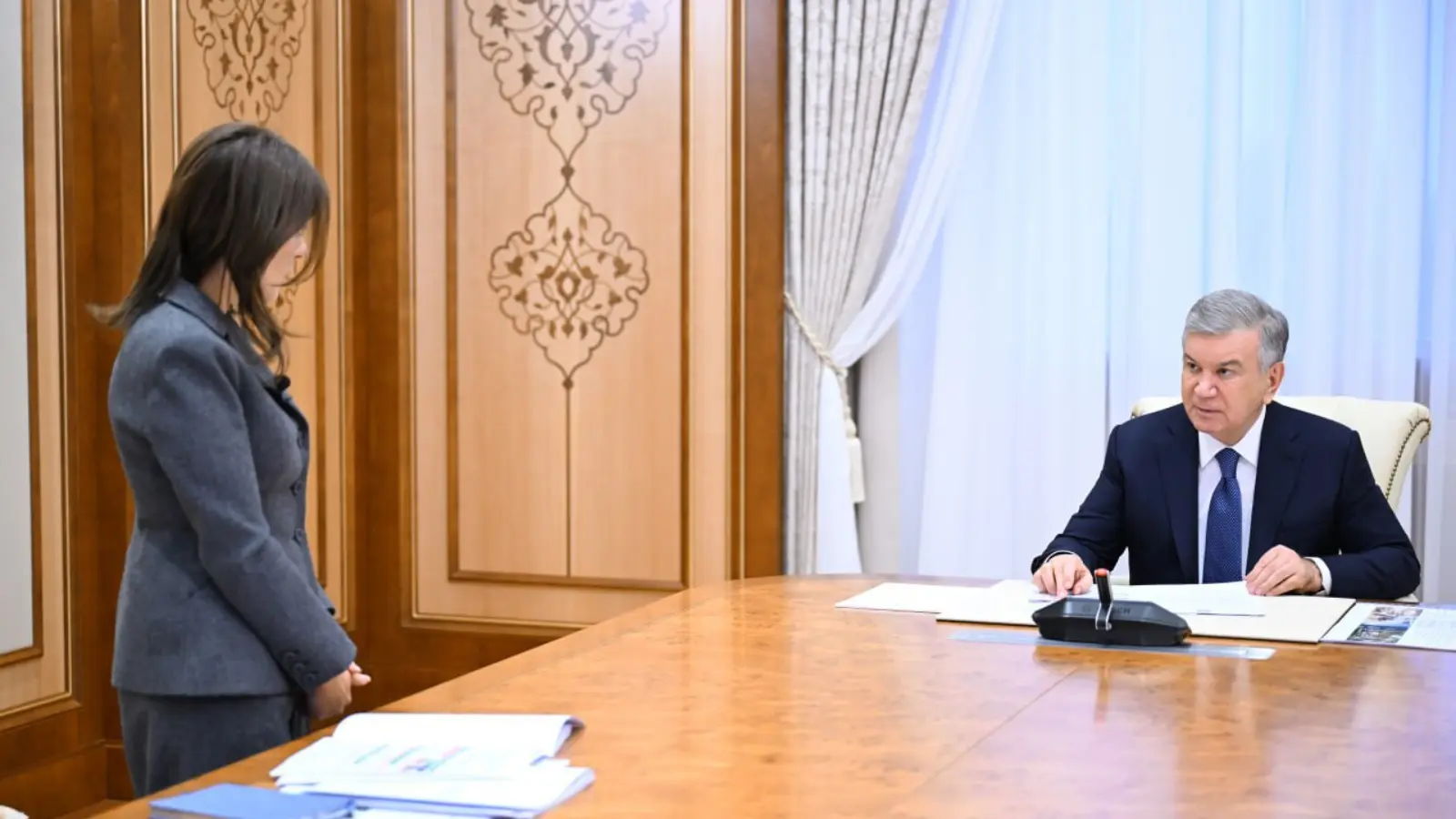
President Shavkat Mirziyoyev got acquainted with the presentation dedicated to the development of the creative economy, improving the infrastructure of cultural institutions and creating new creative spaces. Several major initiatives were discussed at once: the creation of the National Restoration Institute, the restoration of the Bibikhanym Mosque in Samarkand, as well as the renovation of the Turkistan Summer Amphitheater were considered.
An important point was emphasized at the meeting: more than 60 percent of the country's population is young people. The digital infrastructure is developing rapidly, and the cultural heritage is very rich. These factors can become a solid basis for a "big leap" in the creative sphere. The goals are also clearly set: by 2030, the share of the creative economy in GDP will reach 5 percent, that is, 145 trillion soums, exports will reach 1 billion dollars, and the number of people employed in the sector will increase by 500 thousand.
The presentation provided a detailed review of the concept of the Creative Industry Park, which will be located in Tashkent. According to the project, a green park and art objects, the Tashkent School of the International Programming Network, a book cafe, sports fields, creative pavilions, a coworking center and offices will be created here. In addition, it is planned to build film and video production facilities, a recording studio, a creative industry campus, as well as a hotel for young people and creative people. The project is planned to be implemented on a public-private partnership basis.
In addition, there are plans to create creative parks in the New Tashkent region and the city of Nukus. New Tashkent will house rental spaces, studios, media and conference halls, commercial and service facilities for residents. In Nukus, the existing pavilion in Istiklol Park will be reconstructed and turned into a multifunctional public and cultural center.
The most notable aspect of the Nukus project is that it is planned to house the national pavilion of Uzbekistan at EXPO-2025 and build a modern library next to it. That is, it is not just about buildings - it is about the intellectual environment, cultural movement and points of interest that will attract a new audience.
The meeting also critically analyzed the activities of cultural centers. It was noted that there are more than 800 cultural centers in the republic, more than half of which are in need of renovation. The most painful issue is that many centers are still stuck in the old way of working, mainly limited to festive events.
For this reason, a pilot project has been prepared to modernize cultural centers. It will include 4 centers in Tashkent, Kokand, Bukhara and Samarkand. The first center is being established on the basis of the Gulshan Cultural Center in Tashkent. It is planned to open clubs, workshops, studios and circles in various areas, based on the chain of “culture - education - leisure - dialogue”.
Another important initiative is the plan to establish a Higher School of Traditional Arts in Tashkent based on the experience of the Royal Foundation School of Great Britain. This higher school will offer bachelor's and master's programs in pottery and bricklaying, landscape decoration, woodcarving, architectural calligraphy, geometric and biomorphic patterns. Education will be conducted in English, and specialists will be trained on a two-year program. According to the plan, it is planned to reach a capacity of 50 personnel per year in 2027, and 80 by 2031.
The presentation also discussed the establishment of the National Restoration Institute, the restoration of the Bibikhanym Mosque in Samarkand, and the renovation of the Turkistan Summer Amphitheater, and emphasized the need to carry out the design and restoration processes in full coordination with UNESCO.
The Head of State emphasized that the development of the creative economy is of strategic importance not only in cultural terms, but also in economic terms, and gave instructions on ensuring the quality implementation of the identified projects.
In short, these initiatives are not separate projects far from each other - they are connected by one line: opportunities for young people, a new environment for cities, a new driver for the economy, and a careful and modern approach to cultural heritage. Now the main thing is that the plans become a "working" field in life, not on paper.



Comments 0
…