





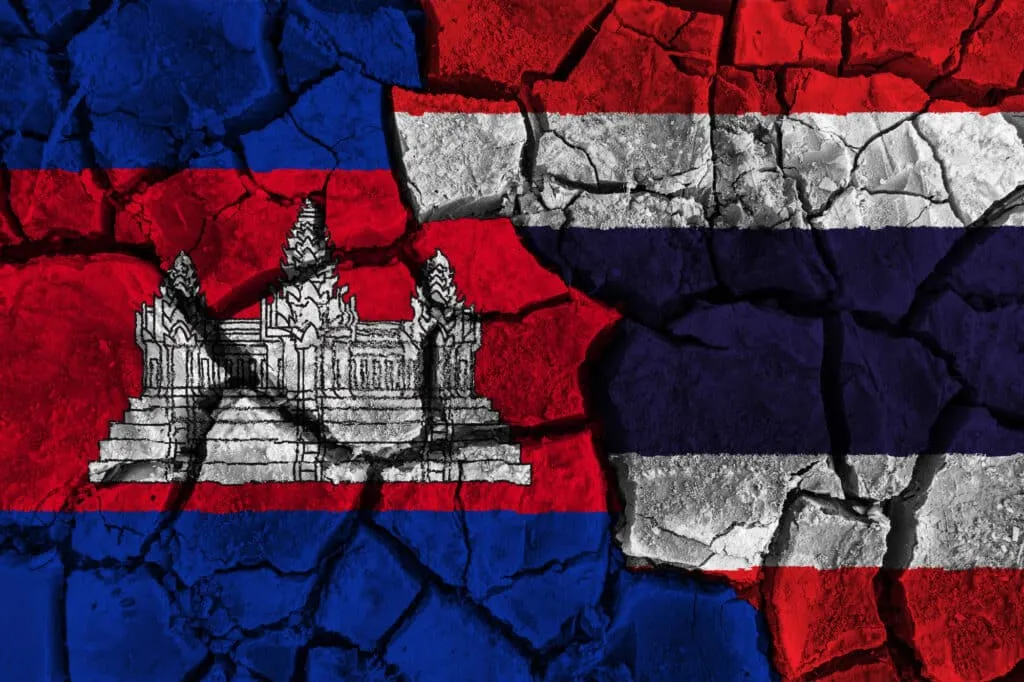
Military clashes in the border area between Thailand and Cambodia have intensified once again. Historical disputes, economic interests, and personal rivalries among the political elites are fueling the resurgence of this conflict.
At the center of the dispute lies the Preah Vihear temple complex, known as Phra Viharn in Thailand. The temple complex was built by the Khmer people between the 9th and 12th centuries.
Initially dedicated to the Hindu god Shiva, the temple later became a stronghold of Buddhism. Although the complex was constructed by the Khmer, it was annexed into what is now Thailand (formerly Siam) multiple times throughout history.
Beginning in the 15th century, Siamese forces began seizing weakened Cambodian territories due to its internal conflicts. In 1863, King Norodom of Cambodia requested France to establish a protectorate.
Several years later, the Kingdom of Siam relinquished its claims over certain territories, including Preah Vihear, in favor of Cambodia. A map drawn by France in 1907 identified Preah Vihear as part of Cambodian territory, which was initially accepted by Thailand.
However, in 1941, during World War II, Thai forces occupied the territory. After the war, the area briefly returned to French control, but in 1954, Thailand reoccupied it.
Cambodia brought the issue to the International Court of Justice, which ruled in 1962 that Preah Vihear belonged to Cambodia. In 2008, Cambodia submitted an application to UNESCO to include Preah Vihear on the World Heritage List.
Initially, Thailand supported this move, but under pressure from opposition forces, it reversed its decision. This escalation heightened nationalistic sentiments in both countries, leading to new clashes in the border region.
Both sides deployed military forces along the border, deepening the conflict. In recent years, the dispute has expanded beyond territorial issues to include matters like economic tensions and cybercrime.
In June 2025, Thai Prime Minister Paethongtarn Shinawatra referred to the neighboring Cambodian town of Poipet as a hub for online fraud. The Cambodian government denied these allegations, claiming the roots of the crimes originated in Thailand.
However, international organizations have provided data supporting Thailand’s claims. Reports suggest that fraud operations in Cambodia are allegedly supported by its government and political system.
Between 100,000 and 150,000 people are reportedly exploited under forced conditions in these operations. This system is estimated to generate an annual revenue of $12.5 billion, with high-ranking government officials allegedly benefiting from it.
Thailand’s crackdown on these centers poses financial and reputational challenges for Cambodia’s political system. Additionally, personal disputes among the political elites of Thailand and Cambodia are exacerbating the conflict.
In 2025, Cambodian leader Hun Sen made public a recording of a phone conversation with Thai Prime Minister Paethongtarn, further escalating tensions and causing a political crisis within Thailand.
Hun Sen’s move worsened relations between the two nations and deepened divisions among their political elites. Today, the Preah Vihear temple not only stands as a historic site but also as a symbol of the disputes between these two nations. A long-term resolution to the conflict has yet to emerge.
Read “Zamin” on Telegram!