


LHAASO discovers new cosmic particle accelerator in Cassiopeia constellation
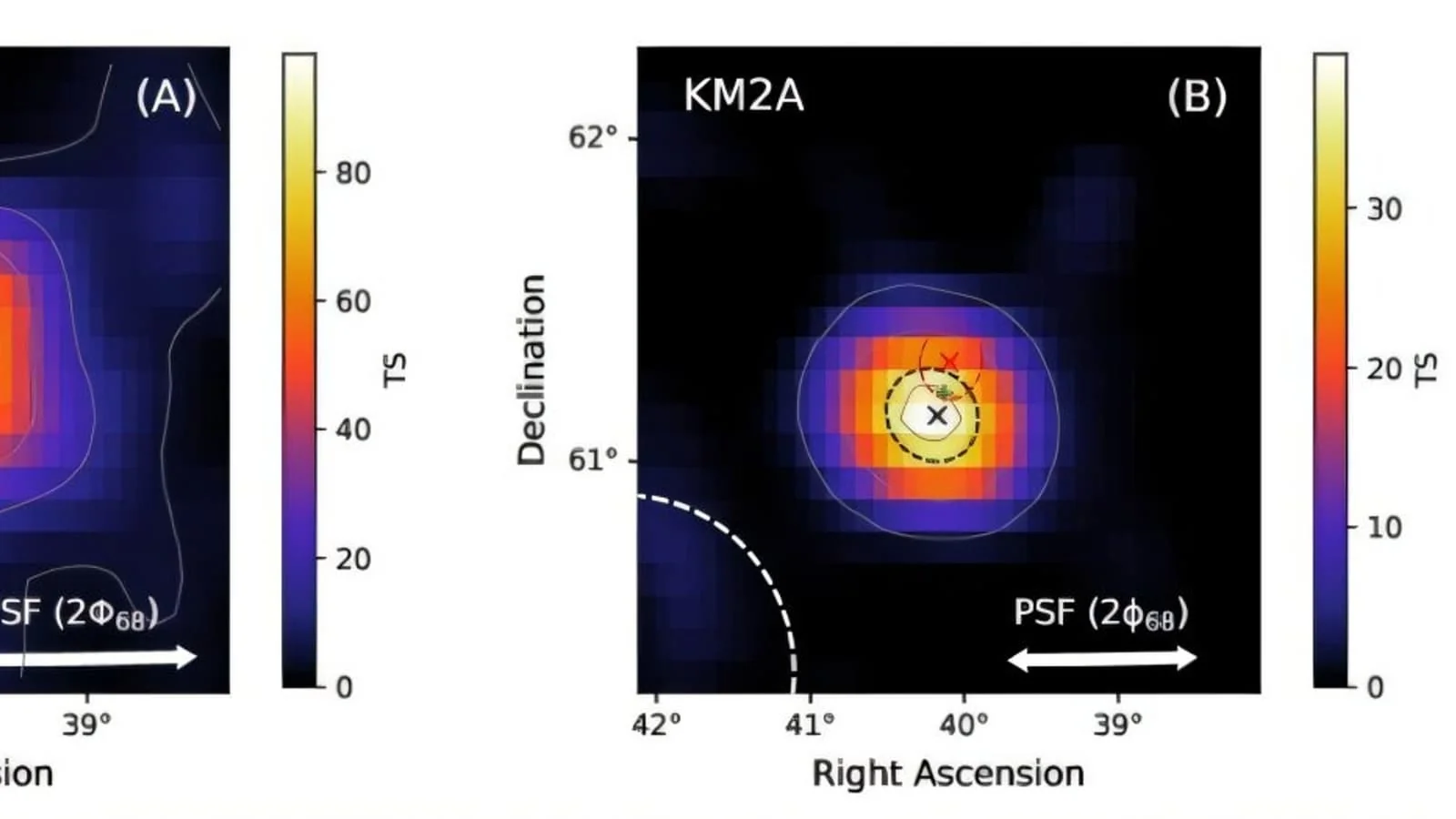
An international team of scientists, using the world's most sensitive high-altitude LHAASO observatory, has recorded ultra-high-energy gamma radiation from the LS I +61° 303 system in the Cassiopeia constellation. This discovery brings the object closer to the status of a rare natural 'galactic Pevatron' capable of accelerating particles to the petaelectronvolt level. This is reported by Ixbt.com reports .
The system is located 6,500 light-years away and consists of a massive Be-star surrounded by a gas disk and a compact neutron star. Every 26.5 days, the neutron star crosses its companion's gas disk, turning the system into a giant cosmic laboratory. Photons with energies above 100 TeV recorded by LHAASO show that the system acts as a 'proton cannon' accelerating protons to near the speed of light.
Researchers from the Institute of High Energy Physics (IHEP) of the Chinese Academy of Sciences, in collaboration with scientists from Russia, Germany, and Thailand, used a detector complex located at an altitude of 4,410 meters. This signal, with a statistical significance of 9.2σ, completely rules out the possibility of error.
Scientists identified an unusual anomaly: the most powerful photons are observed in the phase where the stars are at their maximum distance from each other. This suggests the existence of an additional accelerator outside the system, in the region where stellar winds collide. This discovery confirms that compact binary star systems are one of the main sources of ultra-high-energy cosmic rays in our galaxy.



Comments 0
…