


Unusually Small Radio Ring Discovered in a Galaxy Group
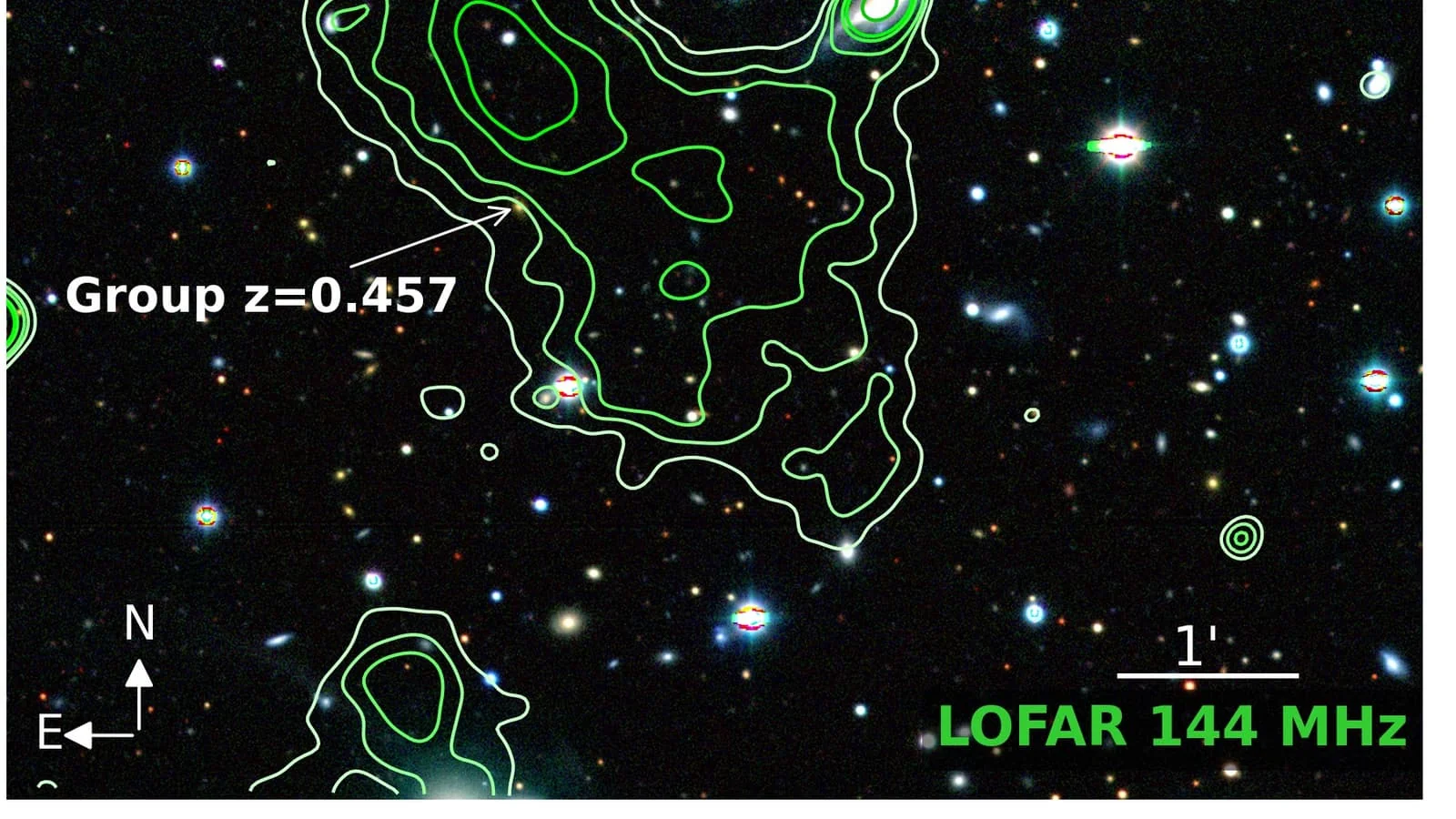
An international research team led by scientists from the Italian National Institute for Astrophysics (INAF) has identified a rare radio source named J1248+4826. This object belongs to the class of "Odd Radio Circles" (ORCs), with a central ring measuring only 30 kiloparsecs. This figure is 5 times smaller than the typical size of similar structures. This is reported by Ixbt.com reports.
Data obtained using the LOFAR radio telescope showed that this structure is not the result of black hole activity or a supernova explosion. Scientists believe these are traces of "fossil plasma" ejected by galaxies millions of years ago, which began to glow again under external pressure.
Researchers combined data from the Spitzer Space Telescope and the DESI project to determine that this ring is located in a dynamic group of 11 galaxies. While radio rings usually have a massive star system at their center, this time a galaxy was observed pushed to the edge of the ring. This means that powerful shock waves played a significant role in the formation of the structure.
According to calculations by Alison L. Coil and her colleagues, a shock wave with a Mach number between 2.0 and 3.3 collided with an ancient plasma bubble, forming a vortex ring. This process is similar to the formation of a smoke ring under the influence of an air blast and occurs in the intergalactic medium.
This discovery confirms the existence of a "selection effect" in astronomy: until now, scientists have only observed giant radio rings. In the future, once the SKA (Square Kilometre Array) radio telescope is launched, such compact structures will become an important tool for measuring gas density and gravitational forces in the universe.



Comments 0
…