


The Universe turned into a laboratory: carbon constants measured with new precision
In the world of fundamental science, physicists have traditionally measured atomic properties in terrestrial laboratories, while astronomers used this data to study the structure of the universe. However, in some cases, ground-based instruments fall short against the complex processes of nature. An international team of researchers has turned the universe itself into a giant measuring device, successfully calibrating the fundamental constants of carbon with a precision unattainable by terrestrial laboratories. This is reported by Ixbt.com reports .
At the center of the study is ionized carbon. It is a key tool for studying star formation and galactic motion. However, the main isotope of carbon creates an "optical fog" effect in star-forming regions, which complicates observations for telescopes. To overcome this obstacle, scientists decided to use a rare carbon isotope, but this required precise knowledge of its spectral lines.
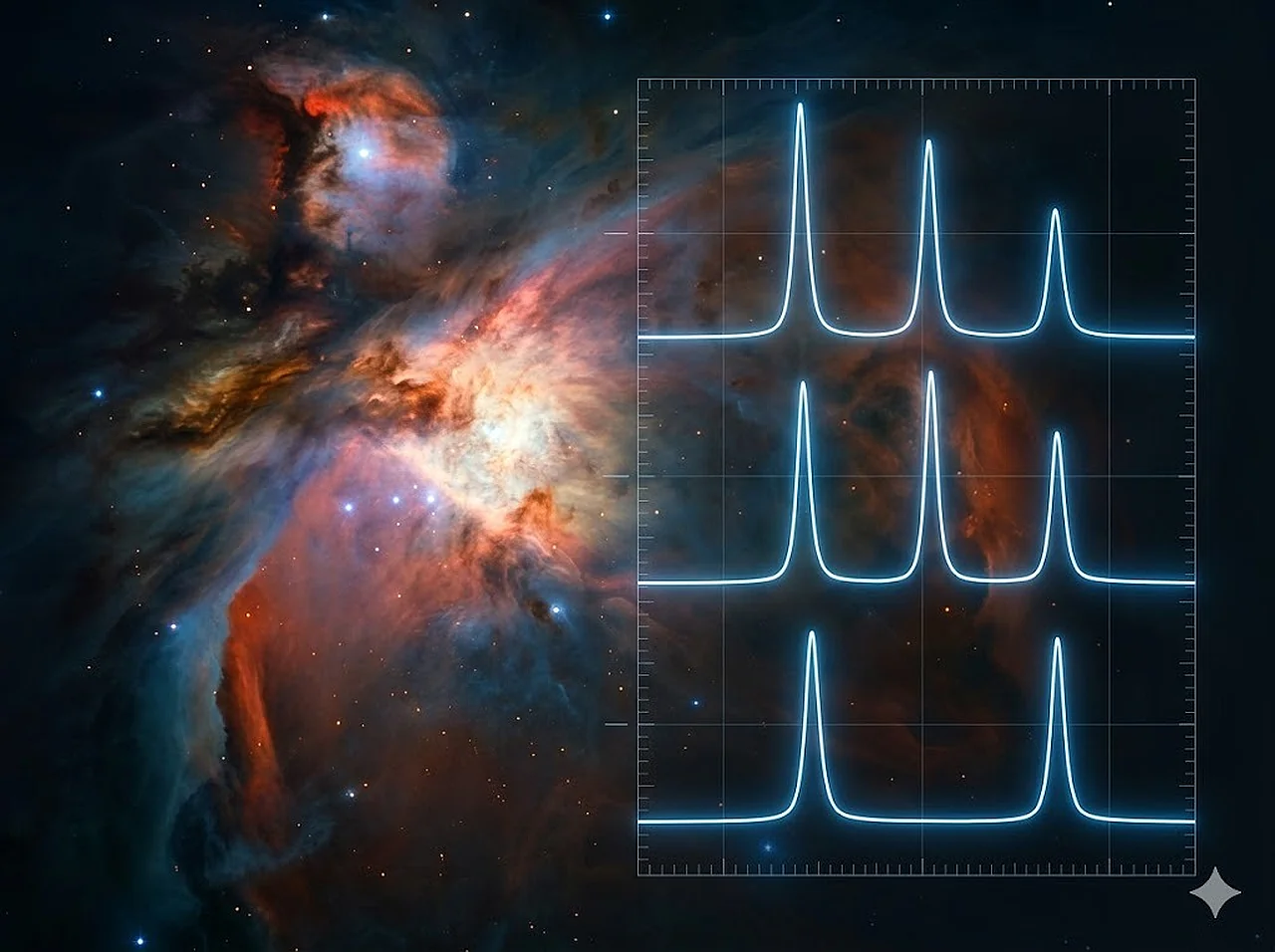
Since measuring carbon ions under terrestrial conditions is extremely complex, scientists used the SOFIA stratospheric observatory. This telescope, mounted on a Boeing 747, operates at an altitude of 13 kilometers, free from atmospheric interference. Using the upGREAT receiver developed by German scientists, regions in the Orion constellation were observed, and three spectral lines of the carbon isotope were recorded with precision for the first time.
The interstellar medium in space provided perfect conditions that cannot be replicated in vacuum chambers on Earth. By using mathematical filtering and analyzing Doppler shifts, scientists determined new values for the atom's magnetic-dipole constants. The results obtained proved to be significantly more accurate than all theoretical calculations and laboratory simulations conducted over the last 40 years.


Comments 0
…