


There are more Earth-like planets in space than usual
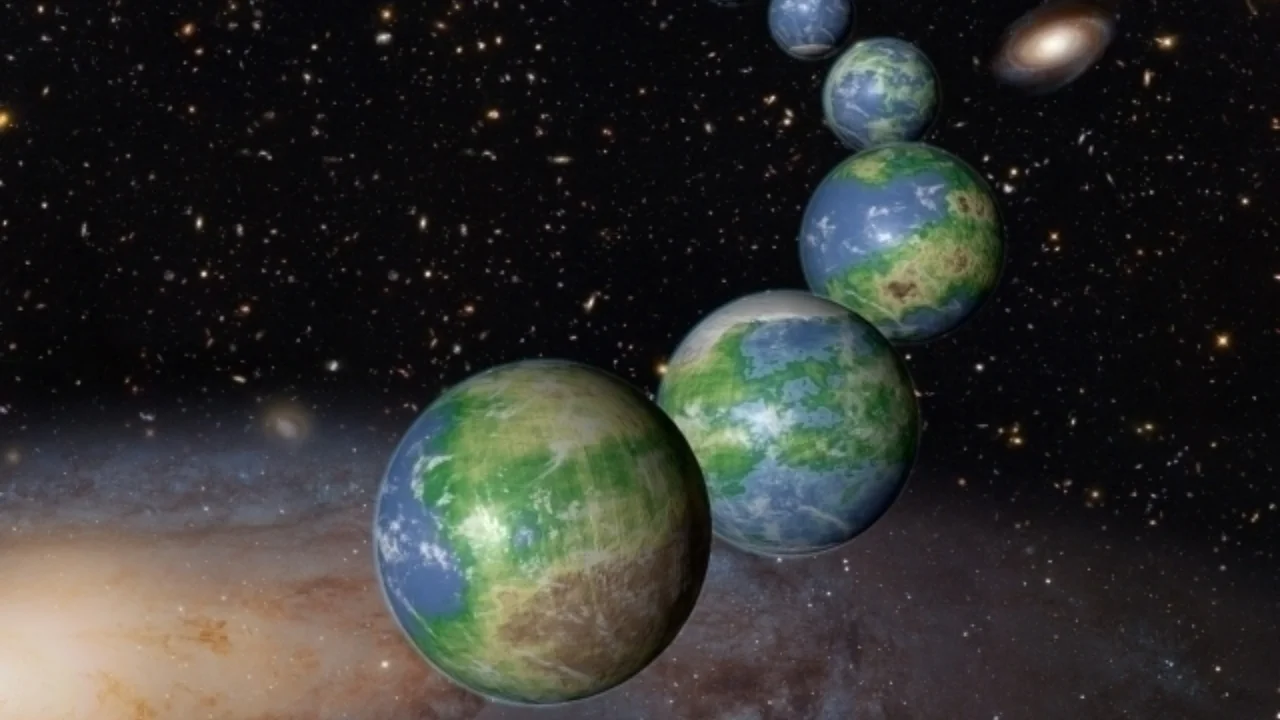
It became clear that Earth-like, dry, and rocky planets are not just a rare occurrence. A new scientific study published in Science Advances showed that there are many more worlds in the universe where life exists and where one can live than we thought.
According to the research results, the formation of planets of this type may be a natural consequence of powerful supernova explosions occurring near young stars. Scientists emphasize that Earth and other Earth-like planets were formed mainly from planetesimals consisting of a mixture of ice and rock. But for these bodies to become planets, they first had to lose a large portion of their internal water - they had to go through the process of "drying up."
The heat generated by the decay of short-lived radioactive isotopes, especially aluminum-26, played a decisive role in this process. The discovery of these same isotopes in meteorites confirms its existence in the early stages of the Solar System.
If a supernova explodes too close - it destroys the system. Which mechanism worked then?
According to the previous theory, such radioactive materials could only enter the protoplanetary disk through a recent supernova explosion. But the problem is that the explosion must be very close to deliver the necessary amount of substance, but in this case it will practically destroy the entire disc.
Re Savaada, a scientist at the University of Tokyo, and his team proposed a new explanation - a "diving mechanism." According to it, the supernova exploded at a safe distance of approximately 3.2 light-years from the Solar System. The explosion accelerated the particles, transforming them into a stream of cosmic rays.
As a result, radioactive materials entered the protoplanetary disk in two ways:
- isotopes such as iron-60 directly through dust particles;
- aluminum-26 was formed by the collision of cosmic rays with stable atoms inside the disk itself. This mechanism fully corresponds to the elemental composition found in meteorites.
Researchers estimate that at least 10-50 percent of Sun-like stars may have formed in similar radioactive environments. This means that planets with little water but dry and rocky - potentially suitable for life - are quite widespread in the galaxy.


Comments 0
…