

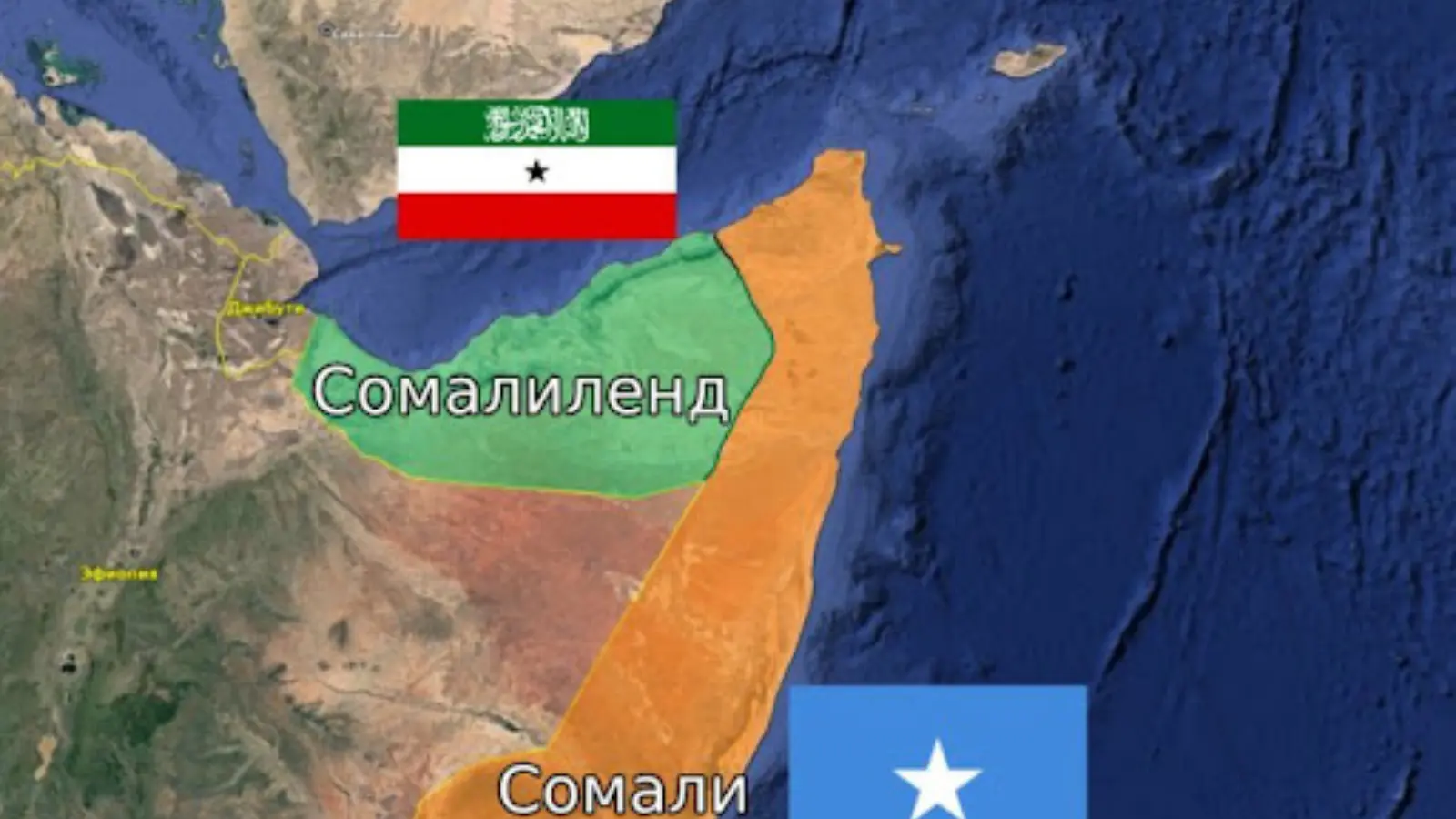
On December 26, Israel recognized the independence of Somaliland—the part of Somalia that has effectively not been subordinate to the central government in Mogadishu since 1991. What this decision is based on, how Somaliland and the international community reacted, and how the move could affect big politics in the Horn of Africa have become topics of expert debate. This was reported by kursiv.uz. reports .
According to Lyudmila Samarskaya, a researcher at the Center for Middle East Studies within the Russian Academy of Sciences, Tel Aviv’s move fits the logic of expanding the “Abraham Accords.” She says that at a time when the process has slowed somewhat, bringing an additional actor into the circle of partners—even a quasi-state—can be presented by Israel as an important achievement, at least symbolically.
Samarskaya notes that Somaliland’s geography also matters to Israel. The republic is located in the Horn of Africa on the Gulf of Aden coast, relatively close to Yemen, where the Houthis (“Ansar Allah”) are active. This factor may interest Tel Aviv from a logistics, intelligence, or security standpoint.
At the same time, the expert points out that opening overseas military bases is not a typical practice for Israel. However, it is noteworthy that Somaliland already hosts a UAE base—one of Israel’s key partners.
Another interpretation is that recognizing Somaliland can also be viewed in the context of strategic competition with Turkey. Ankara is increasing its influence in the region and has a military base in southern Somalia. Samarskaya describes this as strategic rivalry rather than direct military confrontation.
Israel’s decision triggered an unusually broad and geographically diverse wave of criticism internationally. The Somali government called Somaliland an “integral, indivisible, and inalienable” part of the country. The Foreign Ministry said it would not allow mechanisms to emerge that could lead to foreign military bases or indirectly draw the country into conflicts and alter the regional balance of power.
Other regional players also reacted sharply: Turkey, Egypt, Saudi Arabia, and Djibouti stressed that recognizing Somaliland is a “dangerous precedent” that could encourage separatist sentiments even beyond the Horn of Africa.
Even Israel’s main allies preferred to keep their distance from Tel Aviv on this issue. Donald Trump, despite close personal and business ties with Israeli Prime Minister Benjamin Netanyahu, dismissed the possibility of U.S. recognition of Somaliland with a brief “no.”
The head of the African Union Commission, which brings together about 50 countries, reaffirmed commitment to the principle of the inviolability of borders formed after decolonization. The UN took a similar stance, calling recognition of Somaliland contrary to international law and to resolutions reinforcing Somalia’s sovereignty.
One of the few parties to openly support Israel’s decision was Taiwan. In a statement, its Foreign Ministry said Taiwan, Israel, and Somaliland are like-minded democratic partners sharing common values such as “democracy, freedom, and the rule of law.”
Within Somaliland itself, reactions were mixed, says Michael Walls, a University College London professor and expert on political development and socio-economic processes in Horn of Africa countries. In his view, the practical impact of recognition is limited, but its symbolic effect has been strong.
According to Walls, many see this as the logical culmination of 34 years of efforts and hope others will follow Israel in recognizing Somaliland. Domestically, the decision has, at least for a time, united different political forces. However, the expert cautions that this unity may not last long.
The expert emphasizes that a significant part of Somaliland society views Israel cautiously, even with suspicion, and that these sentiments have intensified against the backdrop of the war and destruction in Gaza. In particular, although officials projected the Israeli flag onto one of the central buildings in Hargeisa, the celebrations were held with almost no Israeli symbols, which drew attention.
Walls believes the next developments will be decisive: if other countries do not follow Israel’s lead, the initial enthusiasm may fade and Somaliland’s domestic political life could return to its previous state.
At the regional level, Ethiopia is mentioned as one of the potential beneficiaries of recognition. After Eritrea seceded in 1993, Ethiopia lost its only access to the Red Sea and was forced to conduct nearly 90% of its foreign trade through Djibouti. That is why Addis Ababa is interested in the Berbera port controlled by Somaliland.
In January last year, Ethiopia and Somaliland signed a memorandum of understanding: under it, Ethiopia could recognize Somaliland’s independence in exchange for access to Berbera. However, it was later reported that Addis Ababa stepped back from the issue due to foreign-policy pressure.
Walls assesses that Israel’s recognition of Somaliland could make it easier for Ethiopia to deepen ties with Hargeisa. Earlier, Ethiopia was seen as a likely second country to recognize Somaliland, but that position now looks less clear. Still, the situation could serve as a reason to push for an official transit agreement to use Berbera as an alternative to Djibouti.
The expert adds that this scenario could also benefit the UAE. Given that Somaliland has openly expressed its intention to join the “Abraham Accords,” the Emirates—as a participant in the accords—may use the moment to reaffirm its support once again.
Read “Zamin” on Telegram!