


Einstein Probe reveals the secret of a cosmic explosion
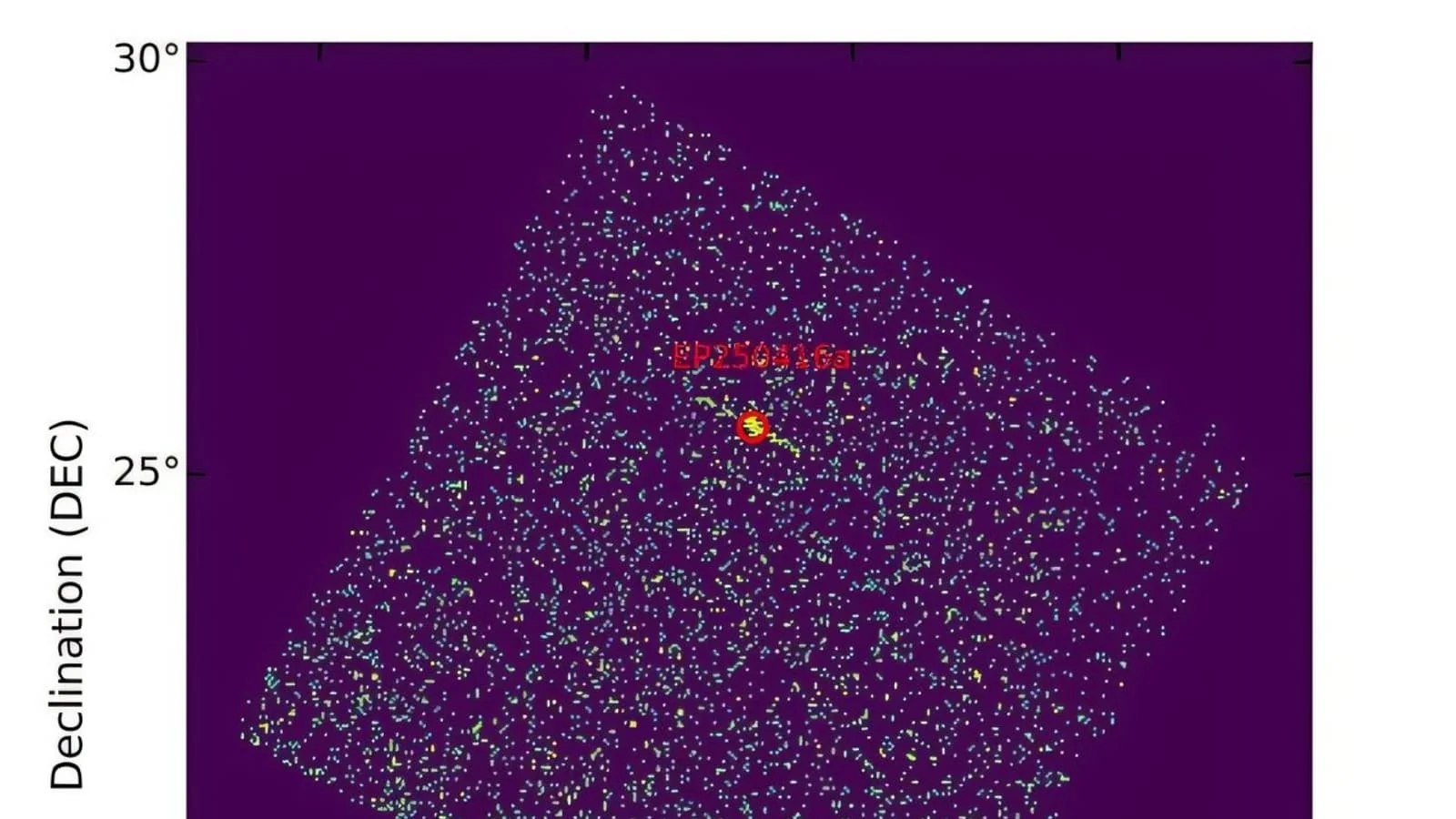
An international group of astrophysicists has studied the unique EP250416a gamma-ray burst recorded on April 16, 2025, as part of the Einstein Probe mission. This event, caused by a massive stellar collapse in a galaxy approximately 6.4 billion parsecs away, was classified as a "dark gamma-ray burst." Although it emitted powerful energy in X-ray and gamma ranges, it remained almost invisible to optical telescopes. This was reported by Ixbt.com reports .
Analyses showed that the extremely high concentration of dust in the galaxy attenuated visible light hundreds of times, creating one of the densest "smoke screens" in the universe. Specialists from the Ioffe Institute of Physics and Technology also participated in the study, confirming the nature of the explosion using precise gamma-spectroscopy. With the help of the Einstein Probe and the Gemini South telescope in Chile, scientists managed to observe a rare phenomenon called a "jet break."
Detected by the seventeenth day, this effect allowed for the calculation of the explosion's geometry. It turned out that EP250416a, unlike typical bursts, had a radiation cone with a width of more than 10 degrees. This means the kinetic energy of the explosion was significantly higher than initially estimated.
Modeling using Monte Carlo algorithms showed that the explosion's "central engine"—a newborn black hole or magnetar—continued to supply energy to the shock wave for another 8 hours after the collapse. This discovery is an important step in understanding stellar evolution and proves the effectiveness of the Einstein Probe mission in studying hidden cosmic events behind dust clouds.



Comments 0
…