


Astronomers Observe Rotation of Protoplanetary Disk Around AB Aurigae for the First Time
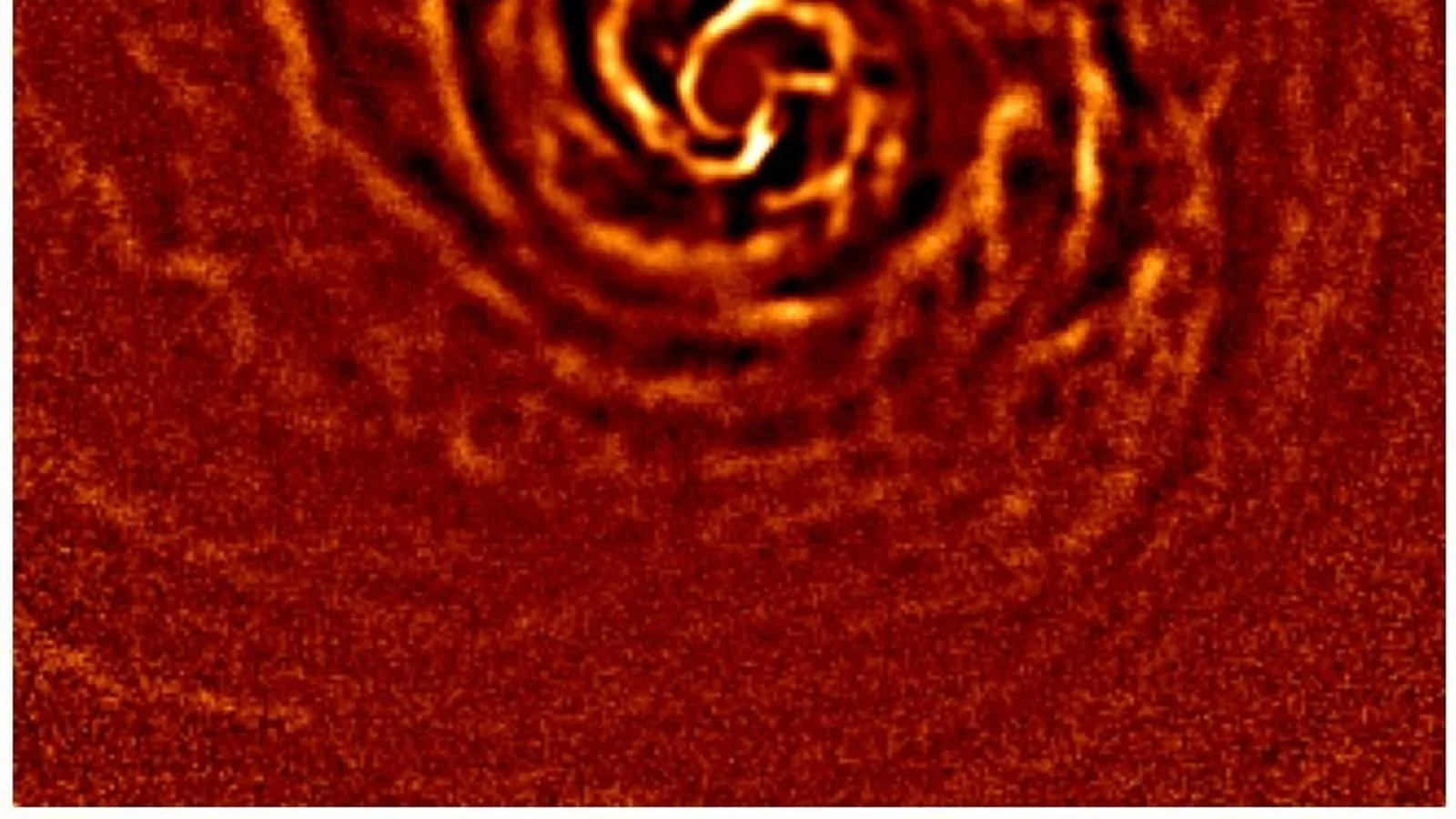
Astronomers have successfully directly observed the rotation of the protoplanetary disk around the young star AB Aurigae for the first time. This work, conducted by researchers from the French National Centre for Scientific Research (CNRS) and the University of Bordeaux, utilized the SPHERE (Spectro-Polarimetric High-contrast Exoplanet REsearch) high-contrast infrared instrument installed on the Very Large Telescope at the ESO European Southern Observatory in Chile. Ixbt.com reports .
Protoplanetary disks are rotating clouds of gas and dust surrounding young stars, where planets form. The disk around AB Aurigae has long been considered the most important "laboratory" for studying such processes. New observations confirmed that the overall rotation of the disk complies with gravitational laws, but it was found that the movement of matter in certain regions differs from expectations. Such anomalies are associated with the influence of massive objects in the formation process—protoplanets.
The SPHERE instrument made it possible to observe the movement of the disk structure by recording the infrared radiation of dust particles. This data complements results previously obtained by the Hubble Space Telescope and the ALMA (Atacama Large Millimeter/submillimeter Array) ground-based radio telescopes. AB Aurigae is a young variable star approximately 4–5 million years old, currently in the early stages of planetary system formation.
Previous observations indicated the presence of at least one forming gas giant in the disk—the object AB Aurigae b. It is located at a distance of 93 astronomical units from the star and may have a mass nine times that of Jupiter. The Hubble Telescope monitored its movement along the orbit over the years, confirming that the object is a planet. Additionally, additional dense regions and spiral structures where other planets could form have been identified in the disk.
According to researchers, SPHERE analyses also revealed accretion zones where matter is actively accumulating. Shadows on the disk surface and non-uniform movements indicate the presence of hidden objects or dense dust clouds. This discovery proves that the dynamics of planetary system formation are more complex than classical models suggest.


Comments 0
…