


Superconducting Aircraft Engine Passes Initial Tests
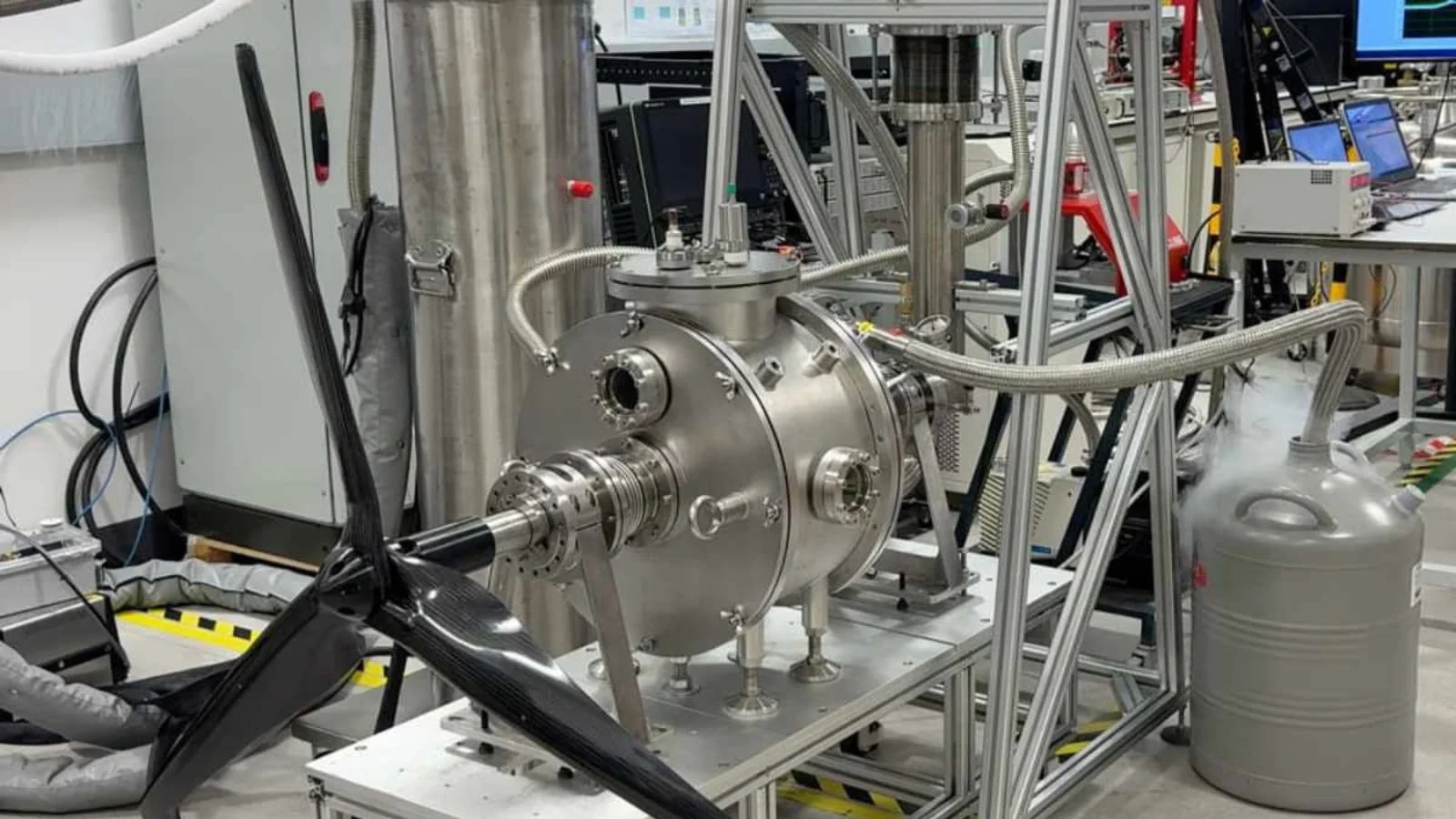
Researchers at the University of Strathclyde in Glasgow (Scotland) announced a significant step towards "green" aviation: they created and successfully tested a working prototype of a fully superconducting aviation electric motor with a power of 100 kW. The project is being implemented within the ZEST (Zero Emissions for Sustainable Transport) program with the support of Airbus and is considered one of the key technologies for future electric passenger aircraft. About this Ixbt.com reports .
The main challenge in electrifying aviation is weight and heat dissipation. Copper windings in traditional electric motors overheat as power increases, making the structure heavier. In aviation, every extra kilogram directly affects flight range and efficiency. Superconducting motors allow overcoming this limitation: when cooled to extremely low temperatures, the material loses electrical resistance, resulting in current flow without losses and virtually no heating. This allows significantly increasing motor power without increasing weight.
Professor Min Zhang's team abandoned the classical method requiring liquid helium temperatures and used "high-temperature" superconductors operating at temperatures from 20 to 77 K (-253…-196 °C). The prototype uses windings with minimal losses, a brushless system, and an integrated cryogenic cooling system that operates during rotor rotation. Essentially, this motor is a compact cryogenic electromechanical module combining power and cooling systems.
This technology is perfectly compatible with hydrogen aviation promoted by Airbus. The company considers liquid hydrogen the main fuel for carbon-neutral aircraft. In such a scheme, hydrogen can serve not only as an energy source but also as a refrigerant for cooling superconductors. This simplifies the architecture of future aircraft and increases the overall efficiency of the system.
For now, this is only a proof of concept — a 100-kilowatt motor is not enough to lift a passenger liner. However, its stable operation confirmed the viability of the concept. The next step is scaling the technology to the megawatt level required for commercial aviation. Currently, companies such as Hinetics, HyFlux, Toshiba, and Raytheon are also actively researching in this direction.


Comments 0
…