


Climate Models of Exoplanets TRAPPIST-1e and TRAPPIST-1f Released
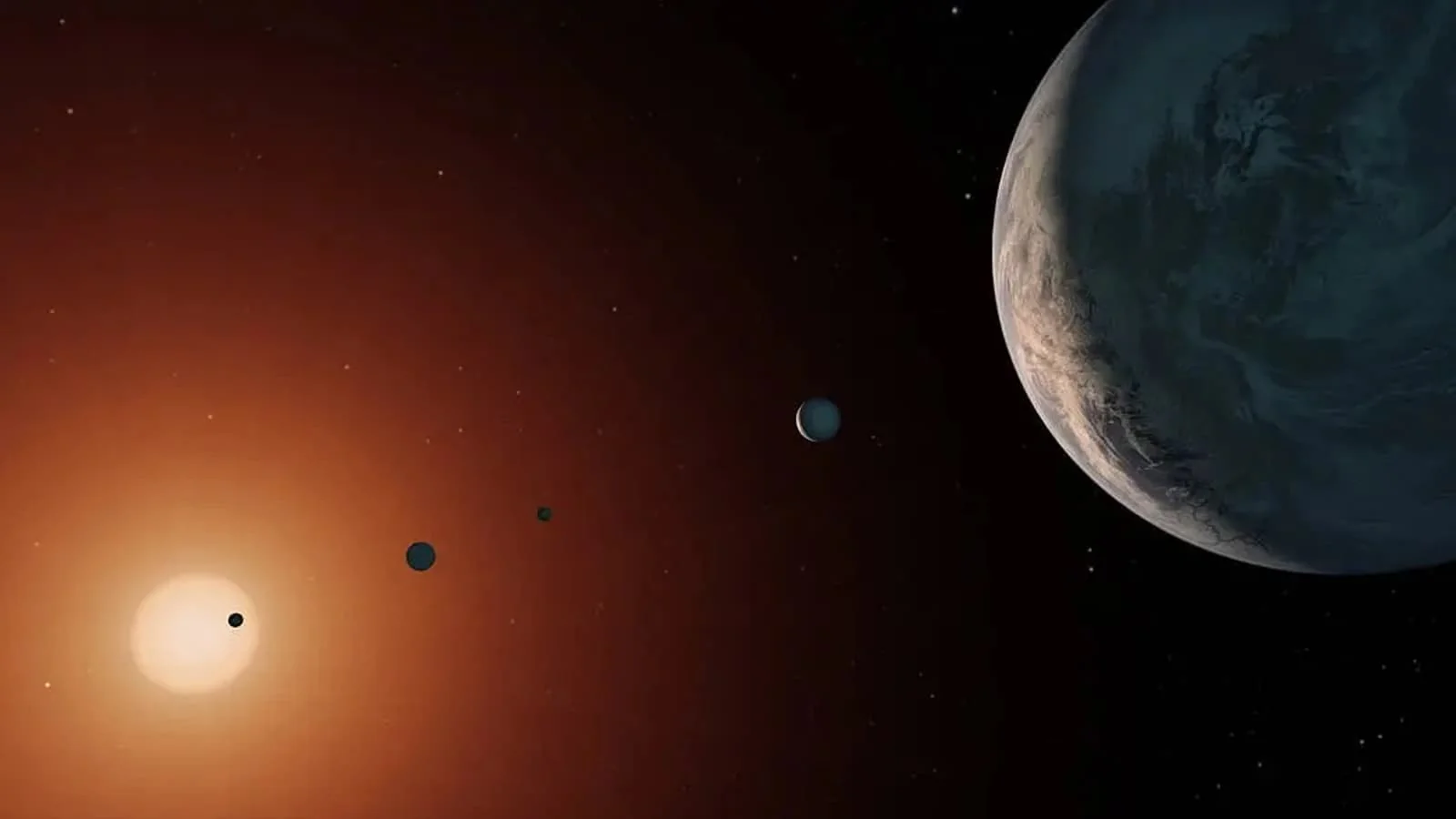
Astronomers have modeled the climate of the two most discussed exoplanets in the TRAPPIST-1 system, located approximately 41 light-years from Earth — TRAPPIST-1e and TRAPPIST-1f. These planets are considered prime candidates for having conditions suitable for life, but their physical environment remains uncertain. Since both planets are very close to their star, they are tidally locked, meaning one side faces the star in "eternal day" while the other is in "eternal night." According to Ixbt.com reports .
Jacob Haqq-Misra, an astrophysicist at Blue Marble Space, used a modified HEXTOR model in this study. This model allows for rapid analysis of thousands of different climate scenarios. The researcher performed nearly 6,300 simulations by varying stellar radiation flux and atmospheric carbon dioxide (CO2) pressure. This helped to more accurately assess the thermal regimes of the exoplanets.
According to the results, the most likely scenario for TRAPPIST-1e is a "cool" climate on the dayside. The planet's surface may be ice-free only if CO2 pressure rises to 0.1 bar. At lower levels, the planet remains in a frozen state. TRAPPIST-1f showed a much colder regime: in most cases, it is completely covered in snow and ice, requiring greenhouse gas pressures above 1 bar to melt.
The author emphasizes that the HEXTOR model does not provide a final conclusion on the habitability of the planets. Its main task is to filter out the most promising scenarios from thousands of configurations. Later, this data will be examined in detail using more complex climate models and telescopes.


Comments 0
…