


How the human brain evolves from chaos into a perfect system
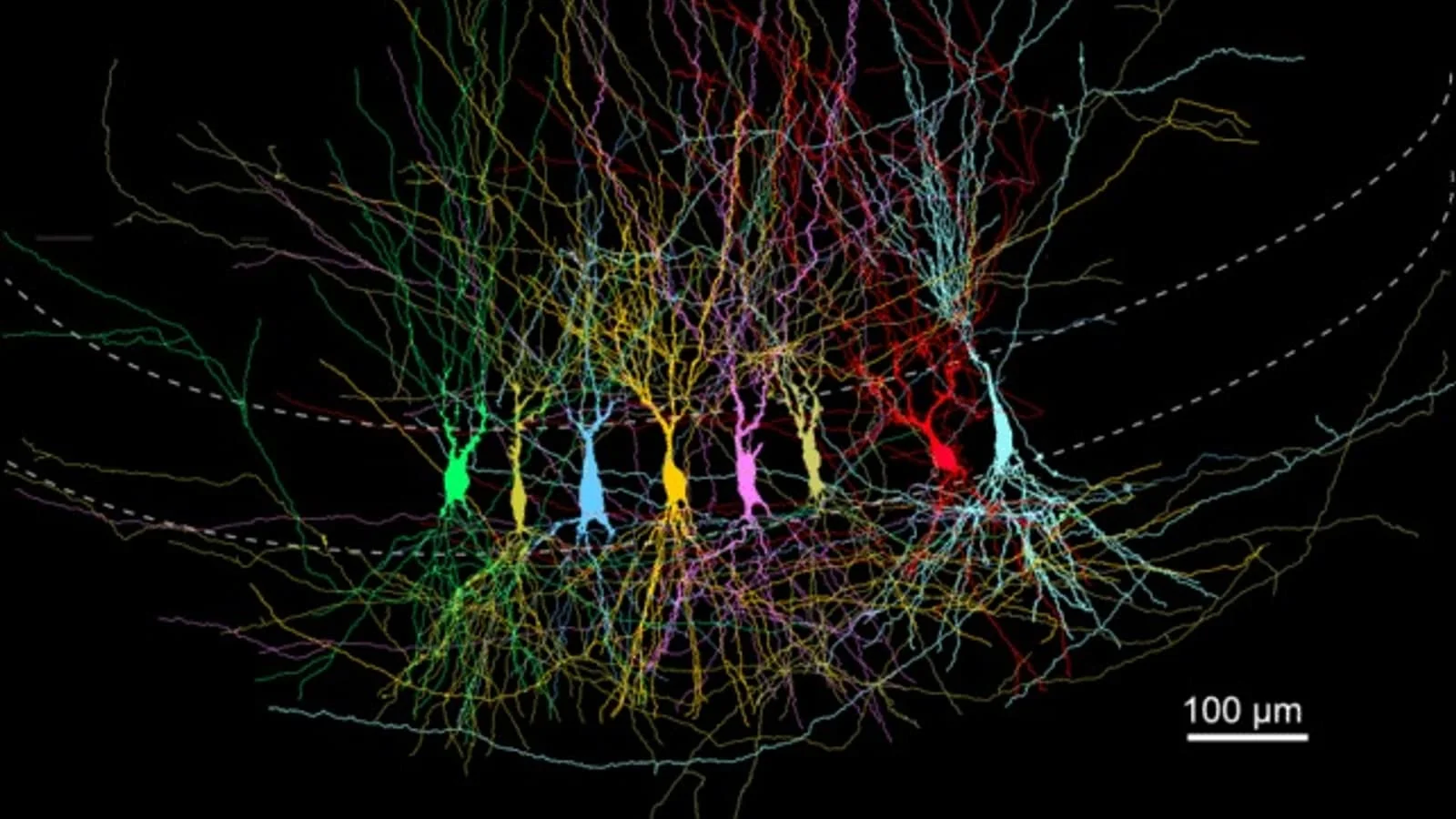
For a long time, scientists have debated whether the brain's complex structure is an innate trait or a product of life experience. A research team led by Professor Peter Jonas has proven that memory architecture is not a gift at birth, but the result of fine-tuning and optimization. To study this process, scientists used one of the most complex methods in neurophysiology: multicellular patch-clamp technology. This is reported by Ixbt.com .
Researcher Victor Vargas-Barroso analyzed the "dialogue" within a micro-network by simultaneously observing eight living neurons in the CA3 hippocampal region of the brain. Experiments showed that in infants, the brain is not a "blank slate," but rather "loaded" with excessive and chaotic connections. Initially, neurons respond to any weak signal, but over time, the system undergoes a "pruning" process.
The adult brain becomes much more selective: activating a neuron now requires not just a single random impulse, but a synchronous signal from multiple sources. It is precisely this "adult" structure that allows the brain to reconstruct incomplete memory fragments and recognize complex patterns. Mathematical models confirmed that the transition from dense chaos to a sparse structure dramatically improves the quality of data storage and processing.
This discovery shows that the brain does not simply grow in volume, but actively reconstructs its logical circuitry under the influence of the outside world. The research serves as an important foundation for understanding memory-related neuro-conditions and age-related changes. Now, scientists know for sure that "correct" memory is not just a collection of neurons, but the result of the fine refinement of internal connections.



Comments 0
…