


European salary map: which country has the highest income?

The beginning of the year, especially January, is one of the most vibrant periods in the labor market. Many specialists think about changing jobs in order to implement their personal plans for the new year, professional growth, or increase income. At the same time, companies will also review their personnel policies and budgets for the first quarter. Undoubtedly, one of the most decisive factors in this process remains the amount of wages.
The salary landscape in Europe is very diverse. They differ sharply not only by industry, but also by country. According to data provided by Euronews and Eurostat, the average annual salary per employee in the European Union is 39,808 euros. This figure is a general indicator, and the real situation has very large differences between countries.
The highest average annual salary was recorded in Luxembourg - 82,969 euros. This indicator shows a very large difference compared to Bulgaria, the country with the lowest salary. The average annual salary in Bulgaria is 15,387 euros. Simply put, the average salary in Luxembourg is 5.4 times higher than in Bulgaria.
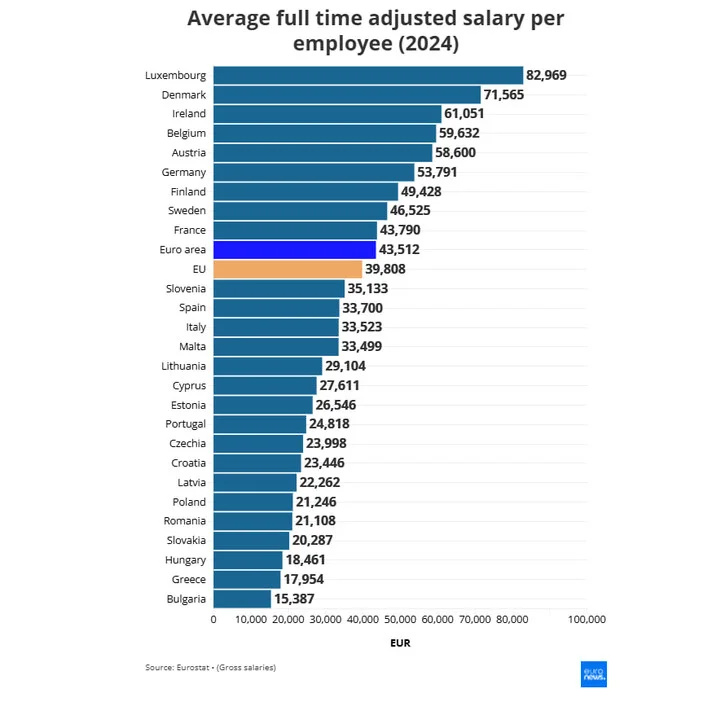
In five other European countries, besides Luxembourg, the average annual salary has exceeded 50,000 euros. They are: Denmark, Ireland, Belgium, Austria, and Germany. These countries are mainly located in the territory of Western and Northern Europe, and the share of sectors with a stable economy, high labor productivity, and high added value is significant.
At the bottom of the ranking are countries with an average salary of less than 20 thousand euros. These are Bulgaria, Greece, and Hungary. The structure of the economy, production efficiency, and the limited share of high-income sectors in these countries have a direct impact on wages.
According to ILO economist Julia de Lazzari, such large differences in wages are due to several key factors. Among them, the overall structure of the country's economy, the level of labor productivity, and the share of high value-added sectors in the economy, such as IT, finance, and high technologies, are of decisive importance.
In countries where agriculture, textiles, or basic services are predominant, wages are usually lower. At the same time, the strength or weakness of trade unions, the system of collective bargaining, and legislation on minimum wages also have a serious impact on the level of wages.
According to experts, if the growth rates observed over the past five years are maintained, the average annual salary in the European Union may reach 41,600 euros by 2026. However, this growth will not be the same in all countries, and differences are expected to persist to some extent.
In short, in the European labor market, wages will remain one of the main factors of choice for a long time. The question of which country to work in depends not only on salary, but also on economic stability, social guarantees, and opportunities for professional development.



Comments 0
…