


A new record in aviation: an airplane landed on the roof of a moving train
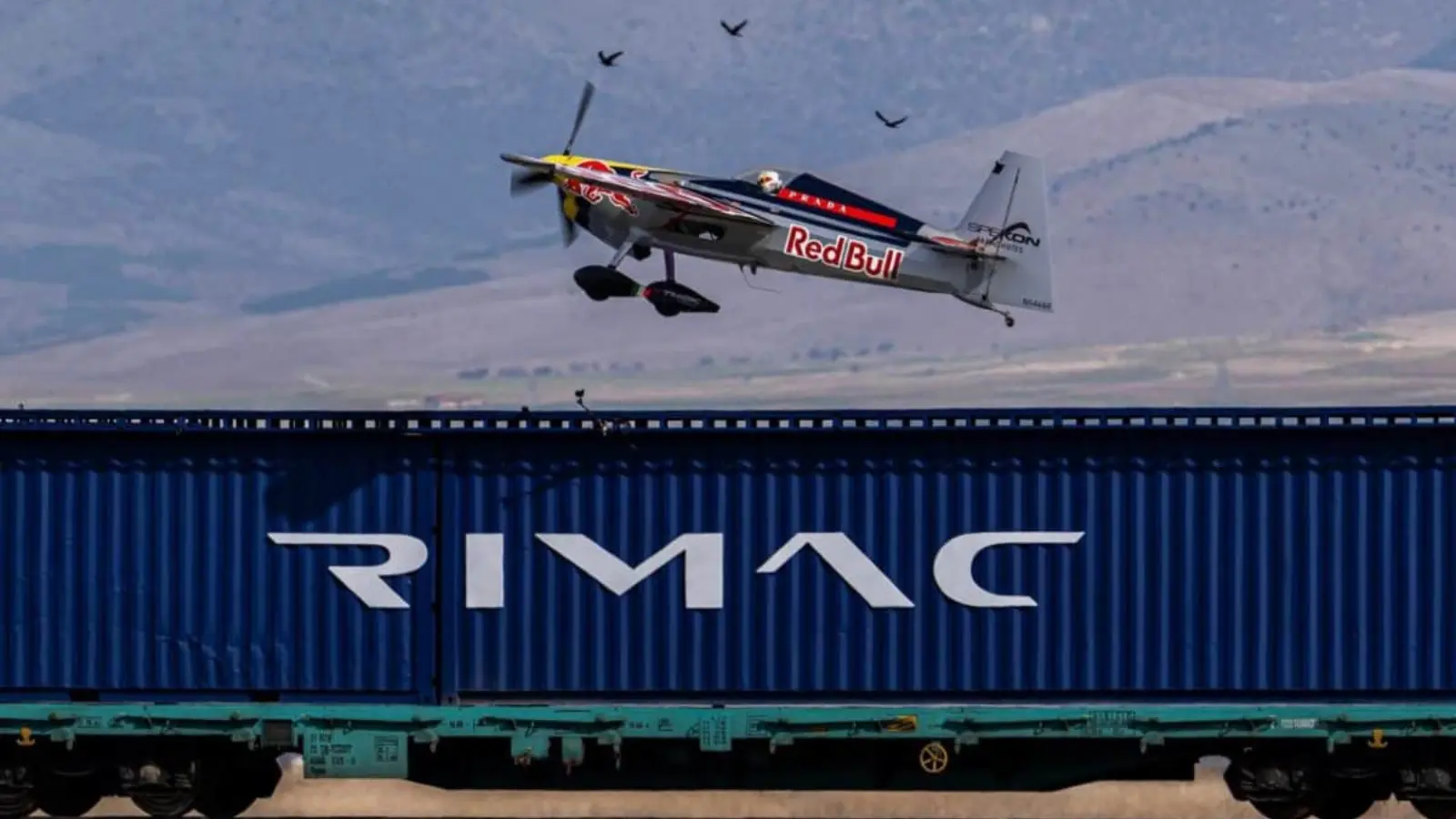
In the almost century-long history of aviation, no one had ever undertaken such a maneuver. Thousands of "shows" have been seen in the sky, various records have been set, but landing an airplane on the roof of a moving train already sounds like "fantasy." However, this time the science fiction turned into real life: the project was named Train Landing, and on February 15, 2026, a historic flight took place near the Turkish city of Afonkarahisar.
For the record flight, pilot Costa Zivko used an Edge 540 aircraft. This is a single-seat, "sharp" sport aircraft with a 400-horsepower engine, capable of flying and maneuvering. At the most crucial moment, the plane accurately touched the roof of the train car, and the landing was almost a "millimeter." And the trick didn't end there: the pilot regained speed almost continuously and again ascended from the train roof into the air.
The difficulty of this maneuver lies not only in getting on the train. To move synchronously with the train, Costa had to reduce speed to approximately 87 kilometers per hour. This is a very delicate limit for a sports aircraft: if the speed decreases slightly - stability may be lost, if it increases slightly - the risk of "passing" the roof of the carriage increases. Moreover, it was necessary to reach the ideal trajectory: the roof of the car almost left no room for error, a moment's delay or a single turn - and everything was ruined.
What makes maneuvering even more difficult is the limited visibility. The angle attack during landing, the dynamics of movement, and quick decisions at low altitudes demanded great coolness from the pilot. The entire sequence - from approach to landing and takeoff - lasted about 50 seconds. In this short time, the trick was performed on a section of almost 2.5 kilometers.
Interestingly, this is not a "one-day idea." Work on preparing the project began in 2024. A team of Red Bull engineers and pilots conducted dozens of simulations, performed aerodynamic calculations, and worked down to the smallest detail to reduce the risk of errors. Even on a moving platform in Croatia, some elements are practiced separately. The final stage was the most "critical" part: ideal coordination in conditions of turbulence created by the train, filigree control of the aircraft, and simultaneous maintenance of speed-equilibrium were required.
Therefore, it wouldn't be right to consider this stunt merely a show for spectators. This is an event where the highest level of flight precision, human reaction, and engineering capabilities meet at the same point. In short, it's not just another "roller" in the sky - it's a new sign for aviation history.



Comments 0
…