


Suspicion arose over 21 tonnes of antibiotics: cargo worth 7.3 billion soums seized
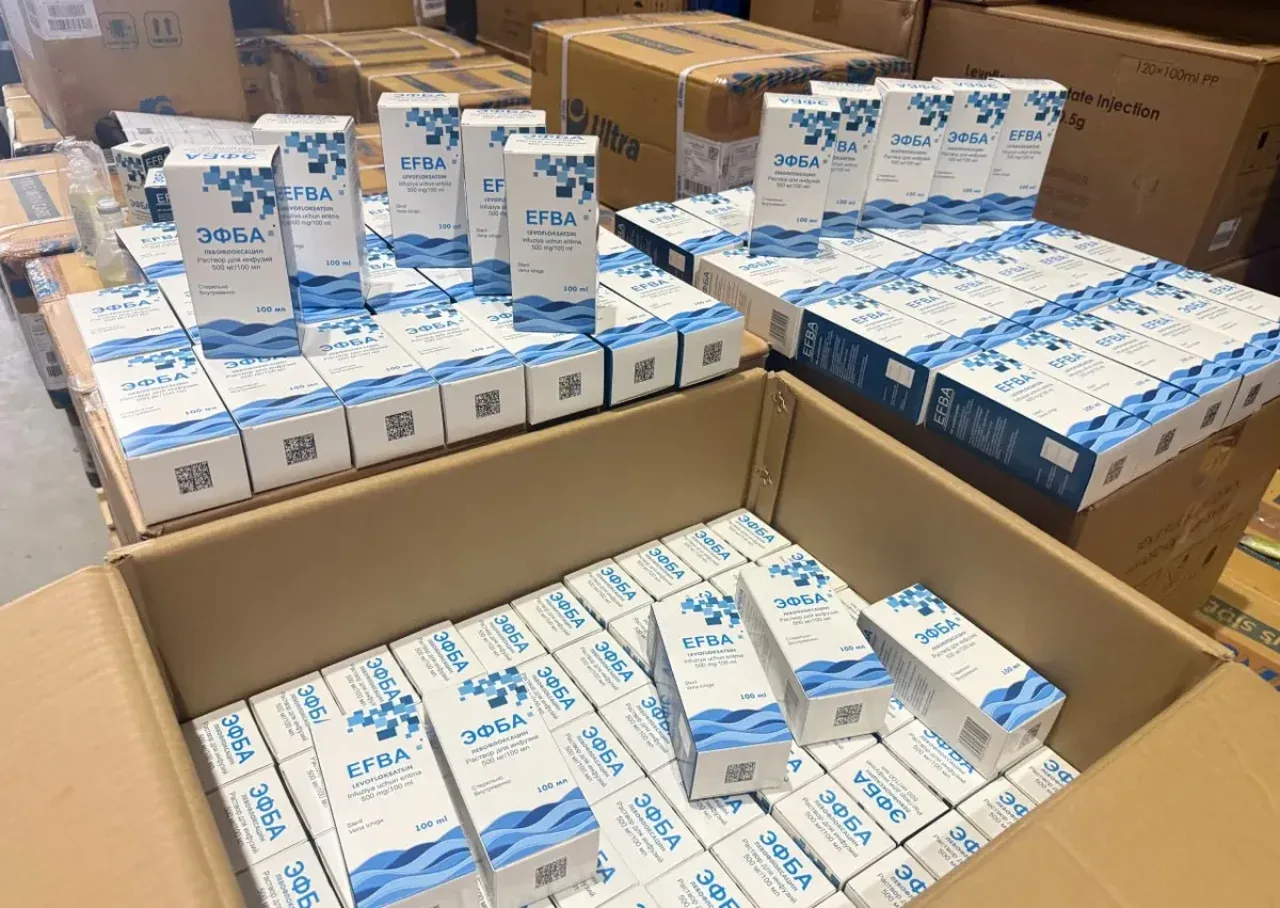
A serious discrepancy was discovered during customs inspection of more than 21 tonnes of «Efba» infusion medicine imported from China into Tashkent. The documents stated that the medicine was manufactured in India, but the packaging and labels on the cargo contained no information about the manufacturing company or country of origin.
According to the customs authorities’ preliminary version, the importers presented a sample of the genuine medicine to obtain a certificate of conformity and then planned to clear a large consignment of unknown origin using that document. The cargo, valued at more than 7.3 billion soums, was placed in temporary storage, and a criminal case was opened over the incident.
India in the documents, no information on the packaging
The violation was identified at the “Air Cargo” foreign economic activity customs post of the “Tashkent-Aero” specialized customs complex.
The customs cargo declaration listed India as the country of manufacture of more than 21 tonnes of «Efba» medicine. However, when the goods were directly inspected, two key pieces of information were missing from the packaging and labels:
the name of the manufacturing country;
the name of the company that produced the medicine.
The absence of such information on a medicine makes it difficult to verify its origin, production conditions, batch and quality control. However, this fact alone does not conclusively prove that the goods are counterfeit — a legal assessment will be made based on the results of laboratory testing, document checks and an investigation into the production chain.
Where is genuine «Efba» manufactured?
According to publicly available pharmaceutical information, «Efba» is listed as an infusion solution for intravenous administration containing 500 mg/100 ml of levofloxacin.
The register states that its manufacturer is India’s Pharma Impex Laboratories Pvt. Ltd., and that the medicine is an antimicrobial agent belonging to the fluoroquinolone group.
For this reason, the absence of information about India or the manufacturing company on the packaging of the inspected cargo created a serious discrepancy between the declaration and the goods.
Information | What should be indicated for the genuine medicine | Status of the inspected cargo |
|---|---|---|
Trade name | «Efba» | Present |
Active substance | Levofloxacin | Recorded in the report as «Efba» |
Manufacturing country | India | Not indicated on the packaging |
Manufacturer | Pharma Impex Laboratories | Not indicated on the packaging |
Certificate of conformity | Must correspond to the specific product and batch | Reportedly obtained using a genuine sample |
How was the certificate obtained?
According to the report provided, the cargo owners submitted genuine «Efba» medicine manufactured in India as a sample in order to obtain a certificate of conformity from the Pharmaceutical Products Safety Center.
According to the customs authorities’ version, the certificate was subsequently intended to be used to import more than 21 tonnes of products of unknown origin.
A certificate of conformity is a document confirming that a product meets established requirements. In Uzbekistan, information on whether a medicine’s batch has been entered in the state register and on the certificate issued for it can be checked through the electronic system of the Pharmaceutical Products Safety Center.
However, if a certificate is obtained on the basis of one medicine sample and is actually applied to a product from another manufacturer or with a different composition, the document cannot guarantee the medicine’s quality.
What is contained in the 21-tonne cargo must be determined
The most important task facing the investigation and experts is to determine the actual composition of these infusion solutions.
Specialists will presumably examine the following indicators:
whether the solution contains levofloxacin;
whether the amount of active substance corresponds to the stated dosage;
the sterility of the medicine;
the presence of harmful impurities or other substances;
the vials and packaging conditions;
batch numbers and expiry dates;
the actual manufacturer of the product;
whether the medicine in the cargo is identical to the sample submitted for certification.
Without a laboratory conclusion, it is impossible to give a definitive answer to whether the liquid in the cargo is levofloxacin at all, whether it has the required concentration or whether it is safe for medical use.
Why is counterfeit infusion antibiotics dangerous?
Levofloxacin, the active substance in «Efba», is a fluoroquinolone antibiotic used against bacteria. In infusion form, it is administered directly into a vein, so requirements regarding the medicine’s composition, dosage and sterility are especially important.
Levofloxacin itself is a medicine that must be used under a doctor’s supervision and can cause serious adverse effects affecting the tendons, nervous system and central nervous system. Its use requires consideration of the patient’s diagnosis, age, other illnesses and medications being taken.
If the medicine is counterfeit or does not meet quality requirements, the risks are even greater:
it may contain no active substance at all;
the dosage may be lower or higher than indicated;
the solution may not be sterile;
unknown impurities may enter the body;
the infection may go untreated and worsen;
conditions may arise for the development of antibiotic resistance.
The World Health Organization emphasizes that counterfeit and substandard medicines can cause poisoning, treatment failure and worsening of illness due to incorrect dosages, toxic impurities or microbial contamination. Poor-quality antibiotics can also exacerbate the problem of resistance to antimicrobial medicines.
The greatest danger is the medicine being administered into a vein
Unlike a tablet, an infusion solution enters the body directly through a blood vessel. Therefore, if its sterility has been compromised, the patient may develop serious infectious complications.
If the amount of active substance is too low, the antibiotic will not fully suppress the infection. If the dosage is excessive, the risk of adverse effects increases. If another liquid or an unknown substance has been used instead of the medicine, it is difficult to assess the consequences in advance.
In this regard, stopping the cargo during customs control may have prevented potentially dangerous products from reaching hospitals and pharmacies. However, whether the product is actually counterfeit will be determined after the expert examination and investigation are completed.
Where was the cargo worth 7.3 billion soums intended to go?
According to preliminary calculations, the total value of the medicines placed in temporary storage exceeds 7.3 billion soums.
However, the publicly released report did not provide the following important details:
the total number of vials in the cargo;
the company in whose name the product arrived;
which medical institutions or distributors were intended to receive the product;
when and in whose name the certificate was issued;
whether similar consignments had been imported before this cargo;
the laboratory’s preliminary conclusion.
During the investigation, the actions of the individuals who ordered the medicine, submitted the sample for certification and prepared the customs documents are expected to be examined separately.
A criminal case has been opened
A criminal case was opened over the incident, and investigative proceedings have begun. It has not been disclosed under which article the case was opened, whether there are suspects or what preventive measures have been applied against them.
The investigation will need to determine:
the certificate acquisition process;
the origin of the genuine sample submitted;
the manufacturer of the product shipped from China;
how inaccurate information was entered into the customs declaration;
the actual composition of the medicines;
the potential sales and distribution chain
Individuals who may be mentioned in connection with the case will be considered guilty only on the basis of a court verdict that has entered into legal force.
How can a patient check whether a medicine is genuine?
Counterfeit products can sometimes look very similar to genuine medicines and are difficult to distinguish by appearance. The WHO recommends that patients purchase medicines only from licensed and reliable sources, and inform medical professionals about suspicious packaging or labels, or cases in which the medicine is not working.
When purchasing medicine, it is necessary to pay attention to the following:
the packaging should be intact and of good quality;
the manufacturer’s name and country should be indicated;
the batch number and expiry date should not be erased;
the information on the vial and outer box should correspond;
instructions should be included;
the medicine’s certificate of conformity should be checked;
antibiotics should not be used without a doctor’s recommendation.
In particular, intravenous antibiotics must not be purchased or used without medical supervision.
An attempt to import an entire consignment using one sample
The most serious aspect of this case is not only the large volume of the cargo. If the customs authorities’ preliminary version is confirmed, a genuine medicine sample was used to obtain a quality assurance document, while an attempt was made to import a different product under the same certificate.
This violates the most important principle of the certification system: the sample tested and the batch released onto the market must be identical.
If more than 21 tonnes of infusion antibiotics had entered circulation, the risk would not have been limited to one or two patients. Therefore, the results of the laboratory examination, information about where the cargo was intended to go and whether this scheme had been used before are of particular importance to the public.
Do you think a separate sample should be taken from every large imported consignment of medicines and subjected to laboratory testing? Leave your opinion in the comments and share the article with your acquaintances on Telegram or other social networks!



Comments 0
…