


James Webb telescope detects methane in interstellar comet 3I/ATLAS
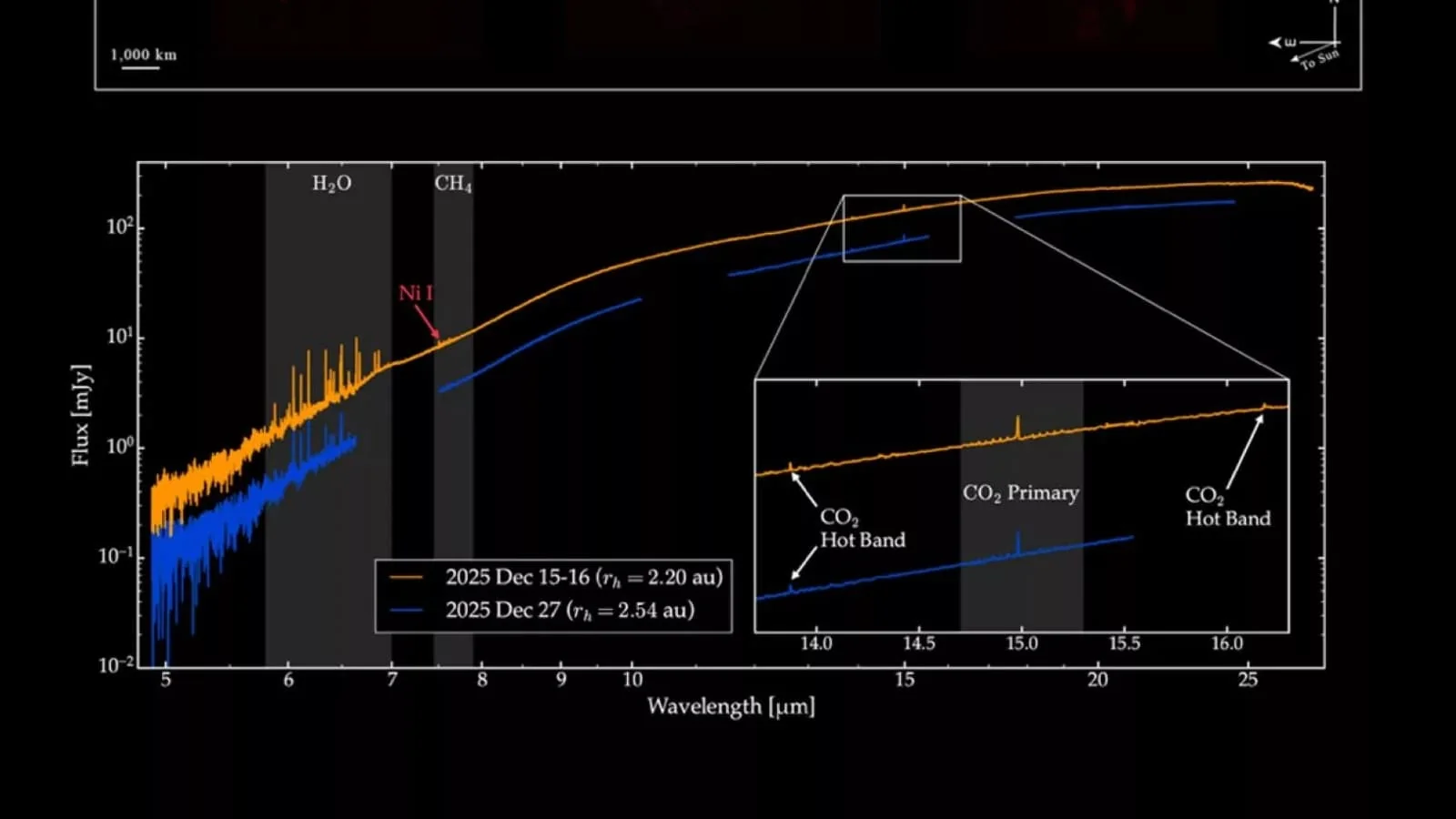
The James Webb Space Telescope has for the first time directly detected methane gas in the interstellar comet 3I/ATLAS. Observations show that the chemical composition of this object differs significantly from most comets in the Solar System and reflects conditions during the formation of other planetary systems. This was reported by Ixbt.com reports .
Researchers used the telescope's MIRI (Mid-Infrared Instrument). Observations were conducted in December 2023, as the comet passed its closest point to the Sun and was moving away at a distance of 329–379 million kilometers. The discovery of methane is crucial for astronomers, as this gas tends to sublimate rapidly from its icy state.
Scientists hypothesize that most of the methane in 3I/ATLAS remained hidden beneath the surface of the nucleus for a long time and began to release only after solar heat reached deeper layers. It was also confirmed that the carbon dioxide (CO2) content in the comet is significantly higher than water vapor.
Combined with the previously identified high nitrogen concentration, these data indicate that the object formed in an environment completely different from our planetary system. Essentially, 3I/ATLAS preserves a chemical 'seal' of another star system from billions of years ago.
To date, astronomers have managed to study only two interstellar comets in detail: 2I/Borisov, discovered in 2019, and this 3I/ATLAS. The capabilities of the James Webb telescope allow for the analysis of such unique objects with a precision that was impossible just a few years ago.


Comments 0
…