


A 5-minute journey in Tashkent has been cut to 2:45: new route (video)
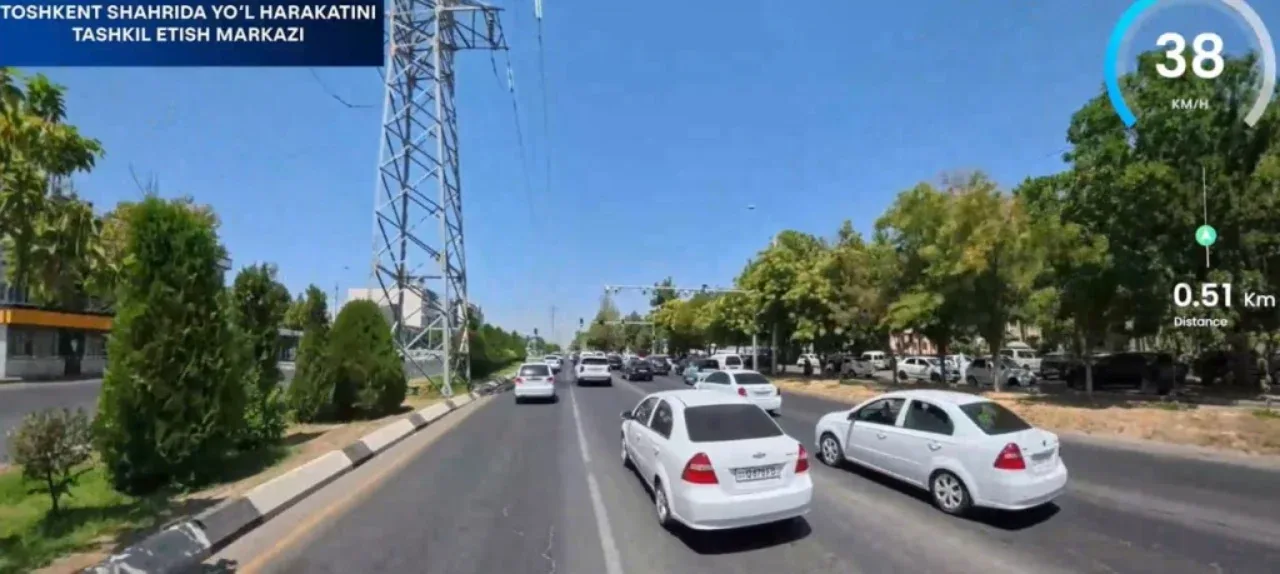
The “Yashil to‘lqin” system, based on coordinating traffic lights to operate in sync, has been launched on another busy route in Tashkent. Travel time along the section of the Small Ring Road from Bog‘ibuston Street to the “Chilonzor” metro station has been almost halved.
Previously, it took an average of five minutes to cover this distance, but after the traffic lights were coordinated, the figure fell to 2 minutes and 45 seconds. If drivers maintain the designated speed, they can pass through several intersections in succession on green lights.
Five traffic lights operate in a single sequence
The new route covers a 1.7-kilometer section of the Small Ring Road. Experts synchronized the operating times of five traffic lights located between Bog‘ibuston Street and the “Chilonzor” metro station to match the traffic flow.
The system operates around the clock in both directions. Unlike the previous route, this is not a temporary mode designed only for morning or evening rush hours.
According to calculations, time spent on the road has been reduced by 45 percent. At first glance, a two-minute difference may not seem like a major result. However, given that thousands of cars use this route every day, the total amount of time and fuel saved will be considerable.
Fewer stops at red lights also reduce engine idling time. In addition to improving road capacity, this could have a positive impact on fuel consumption and the amount of exhaust emissions.
How should you use the “Yashil to‘lqin”?
The system delivers its full effect not when drivers travel at any speed they choose, but only when they follow the calculated speed range.
The Road Traffic Organization Center recommends maintaining a speed of 40–60 kilometers per hour on this route. After a car passes through the first intersection on a green light, it will reach the subsequent traffic lights at the designated times.
Excessive acceleration may bring a driver to the next red light too early. If they drive too slowly, the green phase may end. Therefore, the essence of the system is not to “drive faster,” but to keep traffic moving at an even and steady pace.
Sudden acceleration, frequent lane changes or overtaking other cars near an intersection disrupt the overall rhythm of the “Yashil to‘lqin.” One driver’s haste may ultimately slow down the entire flow — traffic lights respond not to nerves, but to calculations.
What results were recorded on the first route?
The first route of the “Yashil to‘lqin” system in Tashkent was launched on Buyuk Ipak yo‘li Street. It covered 13 intersections along a 4-kilometer section from the “To‘ra Buva” mosque to Salom Street.
According to official data, travel time toward the city center decreased from 8.5 minutes to 6 minutes, while in the opposite direction it fell from 10 minutes to 8 minutes. On the first route, the system operates toward the center in the morning and in the reverse direction in the evening.
It was also reported that at speeds of 40–60 kilometers per hour, drivers can pass through the intersections there with almost no stops. Following the results on Buyuk Ipak yo‘li, calculations began on extending the system to other streets.
With the launch of the second route, the total length of roads covered by the “Yashil to‘lqin” system in Tashkent has now reached 5.7 kilometers. The number of synchronized intersections stands at 18.
The transport system around “Chilonzor” is being upgraded
In recent months, work has also been carried out to upgrade transport infrastructure around the Small Ring Road and the “Chilonzor” metro station.
A new bus-stop complex has been installed near the metro, while pedestrian paths, curbs and tactile indicators have been reorganized. These measures are aimed at reorganizing traffic flows in the area not only from the perspective of cars, but also of public transport and pedestrians.
The arrival of the “Yashil to‘lqin” in this particular area was the next stage of these changes. However, the system’s effectiveness does not depend solely on the traffic-light program. Improper parking, blocking intersections, failing to follow road markings or allowing passengers to board and exit in an unorganized manner can slow traffic down again.
Which streets are next?
Specialists at the Road Traffic Organization Center continue to study traffic flows in order to introduce the “Yashil to‘lqin” on other routes in Tashkent as well.
Such a system cannot be installed on every street simply by copying the same program. The distance between intersections, the number of cars, turns, pedestrian flows, bus movements and congestion at different times of day must all be calculated separately.
That is why the “Yashil to‘lqin” is considered one of the relatively inexpensive ways to speed up traffic without building new roads. But it is not a miracle solution that will eliminate all congestion. Results become noticeable only when smart traffic lights, correct road signs, public transport and driver discipline work together.
The results of the first two routes in Tashkent show that sometimes, before widening a road, simply making traffic lights “communicate” with one another may be enough. Leave your opinion in the comments and share the article with your acquaintances and friends on Telegram or other social networks!



Comments 0
…