


UFC tournament held at the White House cost the promotion $30 million
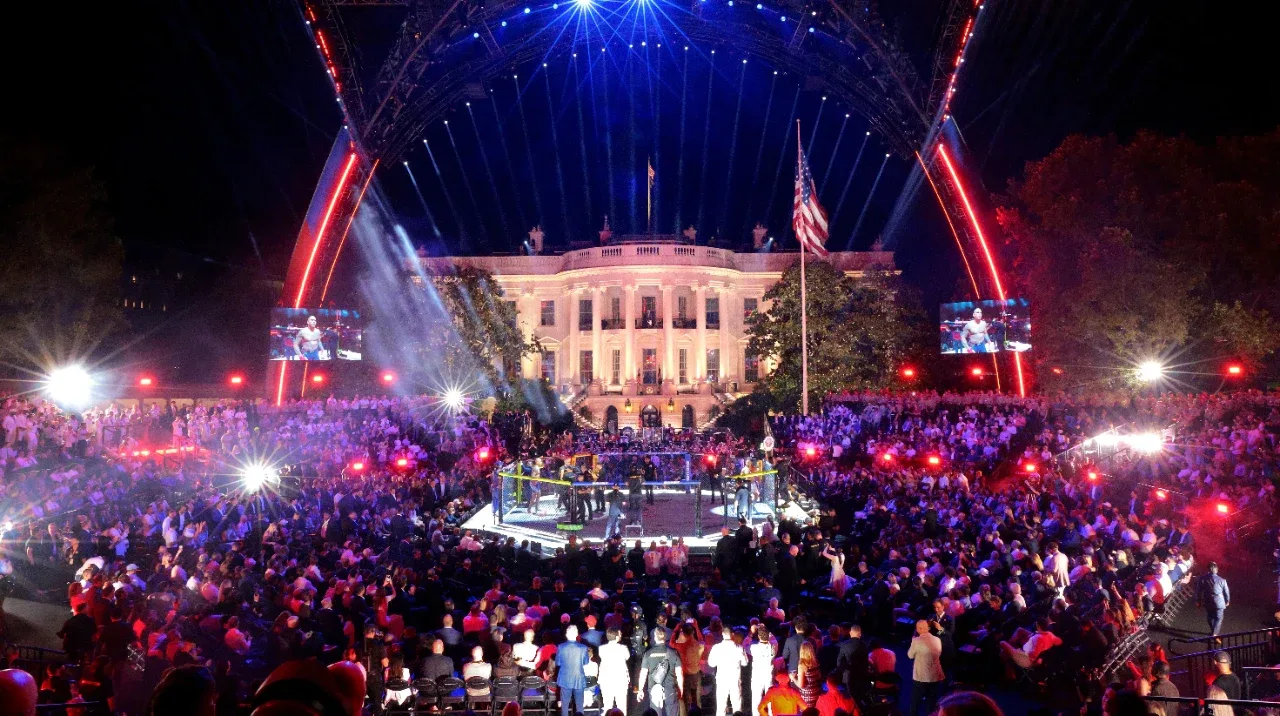
One of the most high-profile events in UFC history proved costly for the company. As a result of the UFC Freedom 250 tournament held on the grounds of the White House in Washington, the promotion suffered an estimated $30 million financial loss.
TKO Group Holdings, which owns UFC, said in its second-quarter report that the event’s production and organizational costs were significantly higher than those of regular tournaments. Nevertheless, Freedom 250 brought the company a record audience, billions of media impressions and new partnership agreements.
Why weren’t the tickets sold?
The UFC Freedom 250 tournament was held on June 14, 2026, on the South Lawn of the White House in Washington. The event was part of a special sports program organized to mark the 250th anniversary of US independence.
Unlike regular UFC tournaments, tickets for Freedom 250 were not put on general sale. As a result, the company missed out on a significant portion of its traditional box-office and hospitality revenue.
According to TKO Chief Financial Officer Andrew Schleimer, the funds spent on the event were significantly higher than the cost of a typical UFC night. The company recouped part of the expenses through global sponsorship and marketing agreements, but this was not enough to make Freedom 250 profitable.
“Because tickets were not sold, no box-office revenue was recorded from the event. As expected, Freedom 250 generated a loss of approximately $30 million,” the TKO chief financial officer said.
How much did the tournament cost in total?
Before the event, UFC head Dana White said that approximately $60 million would be spent to organize Freedom 250.
This amount was several times higher than the budget of a regular UFC tournament. The major expenses included building a temporary arena on the White House grounds, creating infrastructure that met security requirements, television production, athlete compensation and organizing a two-day fan festival.
However, not all of the $60 million budget became a net loss. Agreements with Crypto.com, RAM and other partners covered a significant portion of the expenses. As a result, the promotion’s final financial loss remained at approximately $30 million.
Therefore, it would be incorrect to write that “UFC lost $60 million.” That was the total projected cost of organizing the event, while the net loss was nearly half that amount.
Freedom 250 reduced UFC’s margin
According to TKO’s official financial report, UFC revenue in the second quarter of 2026 rose 29 percent year over year to $535.7 million.
UFC’s adjusted EBITDA also increased 15 percent to $280.4 million. However, the business’s profitability margin declined from 59 percent to 52 percent. TKO noted that this decline was entirely related to the financial nature of the Freedom 250 tournament.
The tournament affected UFC’s finances in two ways at the same time:
— increased sponsorship and marketing revenue;
— reduced ticket revenue while sharply increasing production costs.
According to TKO’s report, UFC’s marketing and partnership revenue increased by $59 million in the second quarter. One of the main drivers of this growth was precisely the tournament at the White House. However, the event’s costs remained higher than the additional revenue it generated.
Did the $30 million loss push TKO into crisis?
Although Freedom 250 ended in a loss as a standalone event, TKO Group closed the second quarter with strong financial results.
The company’s total quarterly revenue rose 18 percent to $1.547 billion. Net income reached $303.9 million. Following these results, TKO also raised its revenue and adjusted EBITDA forecasts for 2026.
Thus, the $30 million loss had a significant impact on UFC’s margin but did not undermine TKO’s overall financial stability.
The company views Freedom 250 not as an ordinary commercial tournament, but as a one-off major marketing project designed to bring the UFC brand to a broader audience.
Does the record audience justify the loss?
According to UFC, approximately 34 million people watched the Freedom 250 tournament worldwide. The average audience in the US was 7 million, making the event the most-watched UFC night in the country’s history.
According to the promotion’s estimates, the tournament generated nearly 64 billion media impressions across television, the internet and social media. Their equivalent advertising value was estimated at $1.1 billion.
However, this amount is not actual revenue deposited into UFC’s bank account. Media value is an estimated marketing metric indicating how much it would cost to purchase advertising exposure on the same scale as the coverage and impressions generated by the event.
For this reason, it is difficult to measure Freedom 250’s true impact solely by its financial results in one quarter. If the tournament brings new sponsors, more subscribers and more lucrative media agreements in the future, the $30 million loss could justify itself as a long-term investment.
Why won’t Dana White hold another tournament like this?
After Freedom 250 concluded, Dana White expressed his satisfaction with the event but acknowledged that holding it again would be financially almost impossible.
He called the tournament at the White House one of the most complex and expensive projects in UFC history. The company had to coordinate unprecedented levels of security operations with the White House administration, the Secret Service and other government agencies.
In this respect, Freedom 250 was a paradoxical event for UFC: financially unprofitable, yet historic in terms of audience reach and brand prestige.
UFC lost $30 million, but it drew the attention of the entire world to the Octagon. The main question now is how much real revenue this attention will generate in the coming years. Leave your opinion in the comments and share the article with sports fans on Telegram or other social networks!



Comments 0
…