


Revolution in Solar Astronomy: 6mm Optics to Transform Space Exploration
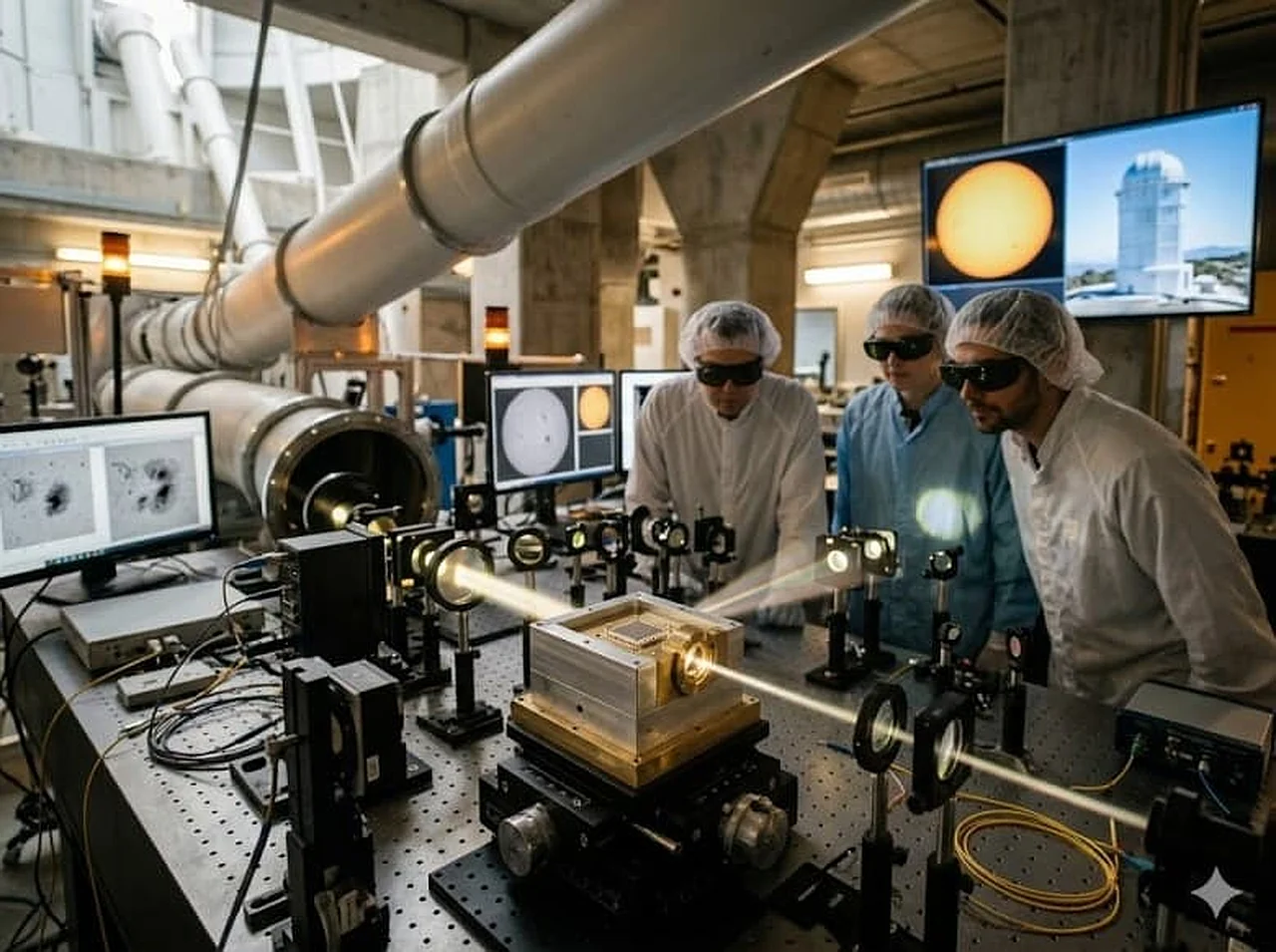
Engineers from the University of California, San Diego, in collaboration with BAE Systems, have developed a miniature optical technology expected to usher in a new era of solar astronomy. This component, measuring just 6 millimeters, features an ultra-complex metasurface structure that could completely change how the Sun is observed in future space missions. According to Ixbt.com, unlike traditional optical systems, this invention allows for the manipulation of light on a nanoscale. This is reported by Ixbt.com news reports.
The basis of the new development is a polarization grating with a metasurface. This structure is capable of simultaneously splitting the vibration direction of light waves, i.e., polarization, into several states. Measuring polarization is critical in solar physics, as this indicator is used to reconstruct the structure of the Sun's magnetic fields. These magnetic fields are directly linked to powerful solar flares and plasma ejections that can damage communication systems, satellites, and power grids on Earth.
Solution to Problems in Traditional Systems
Currently, existing solar telescopes measure different components of polarization sequentially. That is, to form a single image, it is necessary to change the state of the optical element and capture several frames. This process creates serious problems in space: even slight vibrations of the apparatus can cause image shifts and data blurring. The complex stabilization systems installed to eliminate such errors are sometimes more expensive than the optics themselves.The new metasurface fundamentally solves this problem. It splits incoming light into several polarization channels simultaneously. As a result, all necessary data are collected in a single frame without any moving parts. Lead researcher Noah Rubin noted that this is one of the first instances where metasurface technology has moved from a laboratory prototype to a real astronomical system validated for space application.
The new technology was tested on a specially assembled solar telescope in collaboration with the National Center for Atmospheric Research (NCAR). During experiments, the system successfully recorded the magnetic fields of sunspots. The results were found to have the same accuracy as data from major orbital observatories such as NASA's Solar Dynamics Observatory.
Space Durability and Future Prospects
As part of the project, the metasurface underwent rigorous testing not only for optical precision but also for durability. The device successfully passed tests simulating vibrations and temperature changes during launch and operation in space. This enables its integration into space missions in the coming years.Practical tests of the system were conducted at the Dunn Solar Telescope in New Mexico. There, sunlight reflects from a mirror on a 41-meter tower and is directed 69 meters down to an underground laboratory. At the end of this massive chain, a tiny module of just a few millimeters performs all the primary scientific work. This invention is expected to be a significant step in predicting solar storms and protecting Earth from cosmic hazards.


Comments 0
…