


Why Water Beads on Teflon and Spreads on Glass: Scientists Find Molecular Cause
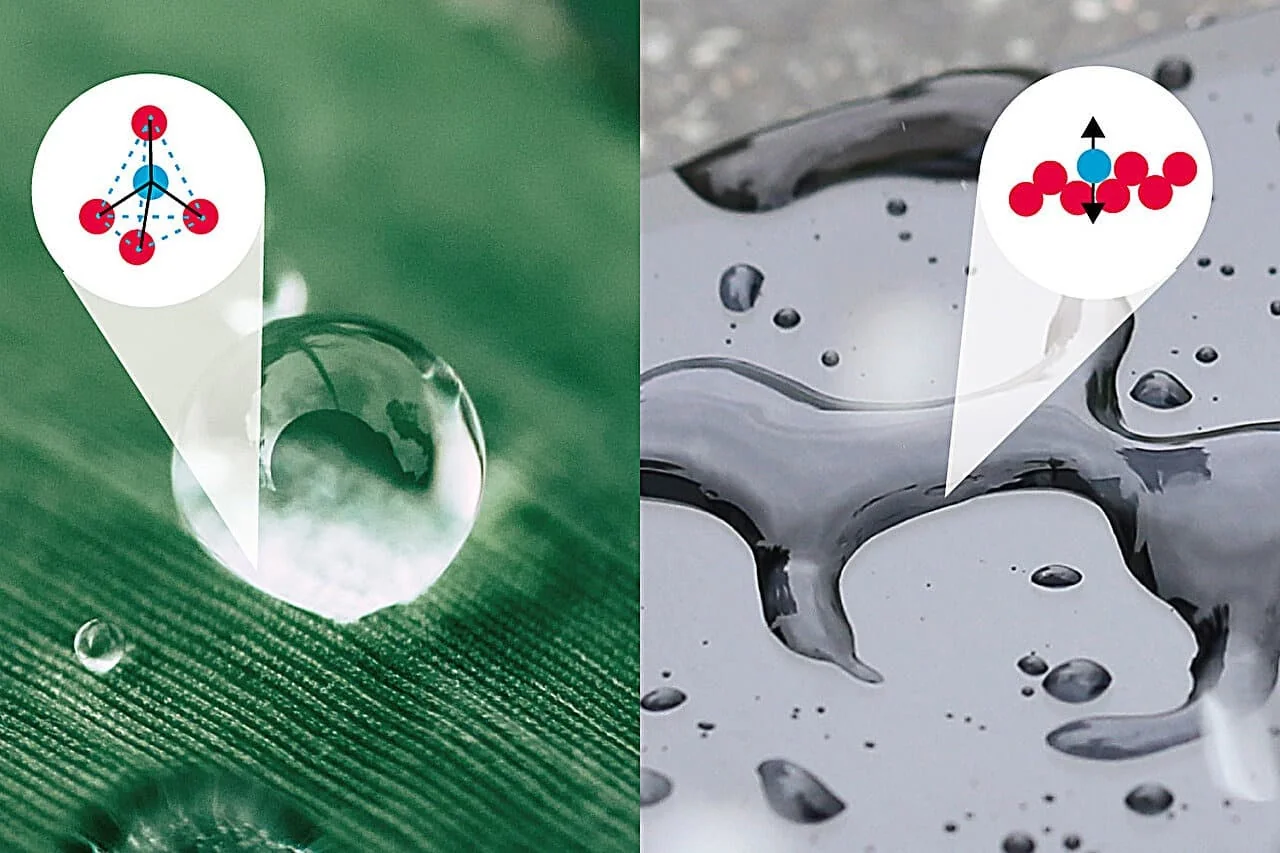
Researchers from the Institute of Industrial Sciences at the University of Tokyo have solved a decades-old puzzle regarding the behavior of water droplets on various surfaces. A new study published in the journal Nature Physics explains the nanoscale movement of water at a molecular level. This discovery fundamentally clarifies why water forms beads on hydrophobic surfaces like Teflon and spreads into a thin layer on hydrophilic surfaces like glass. This is reported by Ixbt.com news reports.
Typically, the interaction of a liquid with a surface is explained by the laws of classical physics. However, when it comes to ultra-small droplets on the nanometer scale, traditional theories do not always yield the expected results. Physicists have long struggled to understand why the line tension force — a force significant only at the nanoscale — changes its sign (direction) during the process of complete surface wetting.
The Role of Hydrogen Bonds
A group led by the study's lead author, Mohd Moid, conducted computer simulations using molecular dynamics. It was found that in liquid water, hydrogen bonds form a local tetrahedral structure, where each water molecule temporarily bonds with four neighbors. Scientists observed exactly how the alteration of this structure affects the spreading of water on a surface.According to the research results, when a surface is fully wetted, this tetrahedral structure at the droplet boundary is disrupted. This specific condition causes the change in the sign of the line tension. In other words, the internal order among water molecules proved to be the key factor determining how quickly and widely water spreads across a surface.
A Factor More Important Than Chemical Composition
Interestingly, the researchers also conducted experiments on a two-layer of ice on a hydrophilic (water-attracting) surface. It was found that although the chemical properties of the surface tend to attract water, such an ice layer does not spread. This implies that the local structural arrangement of water can have a stronger influence than the chemical composition of the material.This discovery is not merely of theoretical importance. Understanding this delicate balance between a liquid and a solid surface is expected to revolutionize several practical fields. In particular, this data will be widely used in cooling systems for microelectronics devices, liquid movement in biological systems, and the creation of a new generation of waterproof materials.
Nature Physics notes that the structure of the internal liquid layer has been recognized as one of the most important factors determining the degree of wetting. Now, engineers and scientists can consider not only the chemical coating of surfaces when designing them, but also the geometric arrangement of water molecules upon contact with that surface.


Comments 0
…