


Expecting a Child in Space: How Science Plans to Overcome Biological Barriers
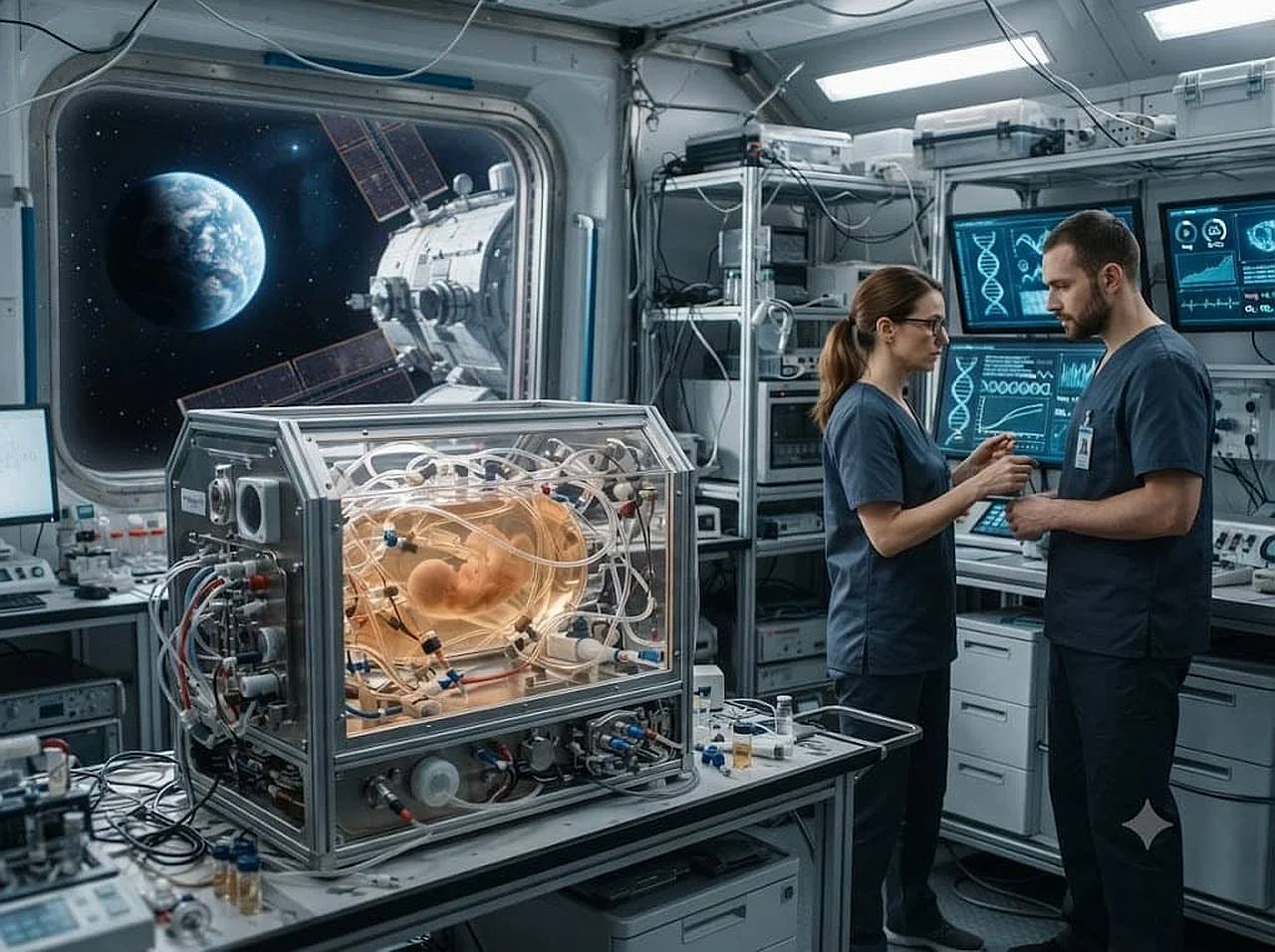
Over the past 60 years of human spaceflight, humanity has been studying the biological limits that could determine whether a child can be born in orbit. The latest comprehensive analytical review published by scientists at the Echoes of the Cosmos Institute has shown how complex reproduction and the continuation of the species beyond Earth’s atmosphere could be. Since no pregnancy has ever been recorded in space, all scientific conclusions are based on experiments involving guinea pigs, rats, and mice. Ixbt.com reports .
It turns out that artificial insemination can technically be performed in microgravity—among mice, the success rate was close to that observed on Earth, reaching 84 percent. However, systemic failures begin afterward. Blastocyst formation slows, the proportion of successful implantations drops sharply, and the number of live births is several times lower than on Earth. In experiments conducted aboard the SJ-10 satellite in 2016, mouse embryos developed, but they exhibited massive DNA damage and global hypomethylation. Cosmic radiation is considered the main cause, with an exposure level of 0,15 milligrey per day.
The Effects of Radiation and Microgravity
According to ixbt.com, cosmic radiation seriously damages reproductive cells. High-energy heavy ions—HZE particles—cause DNA fragmentation and oxidative stress in sperm cells. In female animals, the ovarian reserve is rapidly depleted, while mitochondrial dysfunction disrupts oocyte maturation. In the absence of a gravity vector, the spindle loses its orientation, increasing the number of aneuploid egg cells with abnormal chromosome sets.Even if fertilization is successful, microgravity disrupts the mechanics of pregnancy. In weightlessness, the mother’s cardiovascular system loses plasma volume and vascular tone. Normal pregnancy, however, requires a sharp expansion of blood flow to supply the placenta. Natural pregnancy is therefore associated with an unacceptably high risk from its earliest stages.
Technological Solutions to the Problem
To overcome this difficult situation, researchers are considering three main technological scenarios. The first focuses on modifying the environment, including rotating orbital stations that restore 1 g of gravity. The second is a cybernetic medicine and closed-system concept known as SRAET (Synthetic Reproductive Adaptive Enhancement Technology). The third involves directly modifying human biology through somatic and germline genetic engineering.The SRAET concept stands out as the most developed system. It is not simply an artificial womb, but a hermetically sealed incubator equipped with radiation sensors, variable-density materials—hydrogenated boron nitride nanotubes—and water shielding. Inside the system, microfluidic chips contain a biomimetic pathway that replicates the biochemistry of the fallopian tube and uterus, creating an artificial amniotic-fluid environment.
The data show that adults rapidly degrade in weightlessness—bones lose density and the heart atrophies. Embryos and fetuses, however, have a high degree of adaptability. The SRAET system aims to use this plasticity to adapt the developing organism through controlled stressors. Nevertheless, experts stress that none of these components is currently ready for clinical use, while CRISPR editing is prohibited. This infrastructure is the first conceptual step toward making the birth of a healthy child on Mars a real objective rather than science fiction.


Comments 0
…