


Life in a Tent, Online Exams: Gazan Girl Refuses to Give Up Her Dream
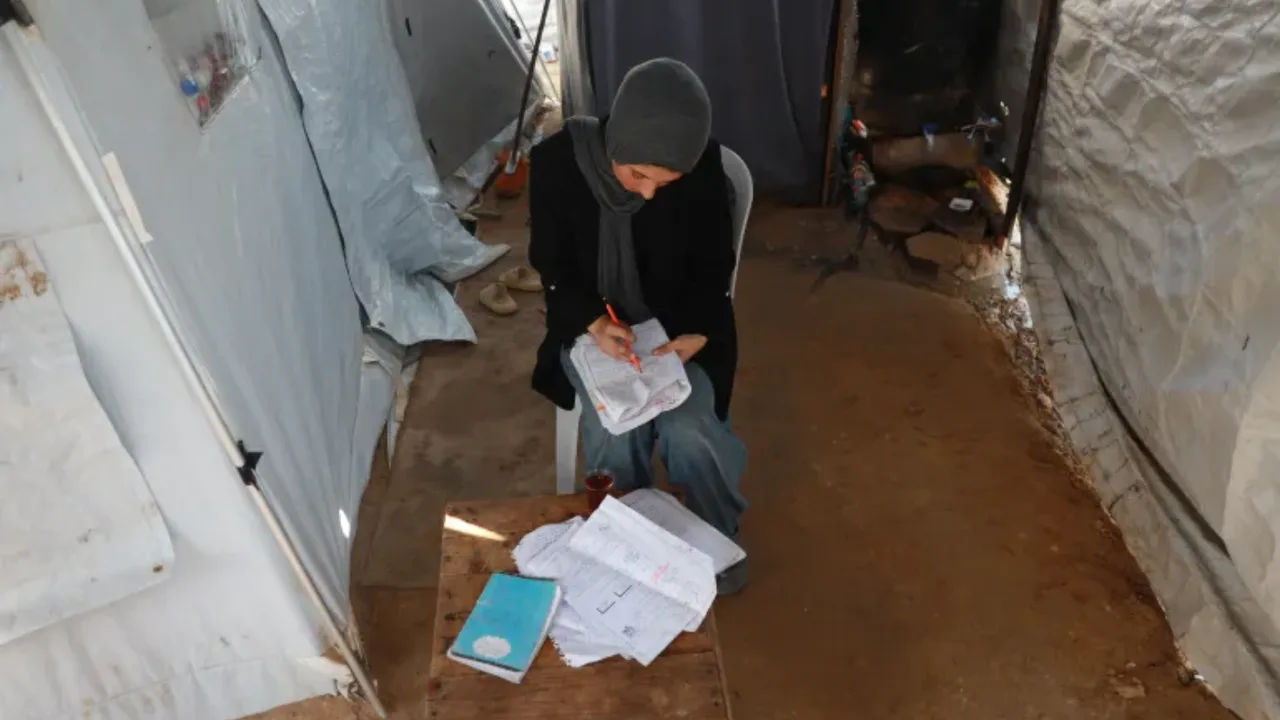
Although life in the Gaza Strip has been derailed by war, thousands of young people continue to fight for their education and future. One of them is 18-year-old Dana Shabat, who, despite dire conditions, must walk a long distance every day to take her high school graduation exams.
For Dana, this week is one of the most important periods of her life. She is taking the Tawjihi (graduation) exams, which are crucial for finishing school. Dana has always been one of the most gifted students. Her grade point average has never fallen below 99 percent. Nevertheless, she does not hide the fact that she is experiencing great anxiety before the exams.
She says these exams will determine her future. For now, Dana is torn between choosing medicine, finance, or business administration. However, she dreams of achieving high results, winning a scholarship to study abroad, and building a new future after the hardships she has endured in Gaza.
Dana has witnessed the war that has been ongoing for over two and a half years. In one of the attacks in May 2024, she survived, but her mother, Lina, was killed. Thousands of Palestinians have been victims since the war began, and Dana has felt the heavy consequences of that tragedy along with her family.
She previously lived in Beit Hanoun, in the northern Gaza Strip. However, as a result of the war, the area has been reduced to rubble. Currently, Dana lives with her surviving family members in a tent city in Deir al-Balah.
Because many school buildings in Gaza have been destroyed or turned into temporary shelters for displaced people, Dana continued her education remotely. The school graduation exams were also organized online.
Therefore, the girl wakes up before dawn every day and walks for nearly an hour with her father, Muhanna, to a cafe where the internet works well. Only there is it possible to take the exams.
“I never imagined my most important life milestone would happen like this. Losing three years of education was hard enough. I had to study all the subjects independently. Now, even taking the exam has become another source of worry and pressure,” says Dana.
This year, 37,000 Palestinian students in Gaza are taking the Tawjihi exams. For the first time since the war began, these exams are being held in coordination with the Palestinian Authority in the West Bank. However, while students in the West Bank are taking exams in school buildings as usual, all graduates in Gaza are forced to take them online.
Dana is taking her physics exam today. It is considered one of her most difficult subjects.
“Physics requires very high concentration. I studied it mostly on my own. I mastered some topics with the help of private tutors and YouTube lessons,” she says.
When she arrives at the cafe, dozens of students like Dana have already taken their seats. As soon as the exam starts at 9:00 AM, everyone opens the online platform on their phones and waits for the questions. Each student anxiously checks the internet speed and connection stability. Dana’s father ensures the cafe owner will not cut off the power supply and then waits outside with other parents.
Muhanna, who worked as a chemistry teacher before the war, says he has mobilized all his resources for his daughter’s education.
“I spent all my money so my daughter could successfully pass this important year. Even if it meant giving up other needs in our family, I hired private tutors for her,” he says.
Muhanna painfully recalls that their life was completely different before the war.
“We lived in a beautiful house. We had a stable life. My wife and I tried to provide all the conditions for our daughters. Now, everything is gone. We are living in tents. And the children are going through the most important stage of their lives in conditions that are hard to imagine,” he says.
Muhanna says that Dana and her older sister, Hala, are currently taking care of their three younger sisters—Rama, Sara, and Alma. Three-year-old Alma, who lost her mother during the war, also lost her right eye in an attack.
“Their mother was a very educated woman. She wanted her daughters to focus all their attention only on education. They didn’t even know how to cook well because she wanted them to spend all their time studying. If she were alive today, she would be heartbroken to see her daughters in this state,” says Muhanna.
Two hours later, Dana leaves the exam.
“How did the exam go?” her father asks immediately.
“Everything went well. The questions were fair. This time, the internet worked well, too. The connection didn’t drop like in the previous exam,” Dana replies.
Upon returning to the tent, she is greeted by her sisters, neighbors, and relatives. Everyone is curious about how her exam went. But Dana doesn't even have time to rest. To prepare for the next exam, she takes her phone and her father’s phone to a charging point. The constant lack of electricity is another problem in her life.
Nevertheless, Dana has not lost her confidence in the future. She aims to be a person who benefits society, to learn several languages, and to achieve high results in whatever field she chooses.
Her biggest dream is to live a safe life and fulfill her mother’s dreams.
“I hope that our suffering in the tents will end one day. And I will become a successful person, just as my mother dreamed,” says Dana.


Comments 0
…