


Another Threat Grows During Disasters in China: AI Fake Videos
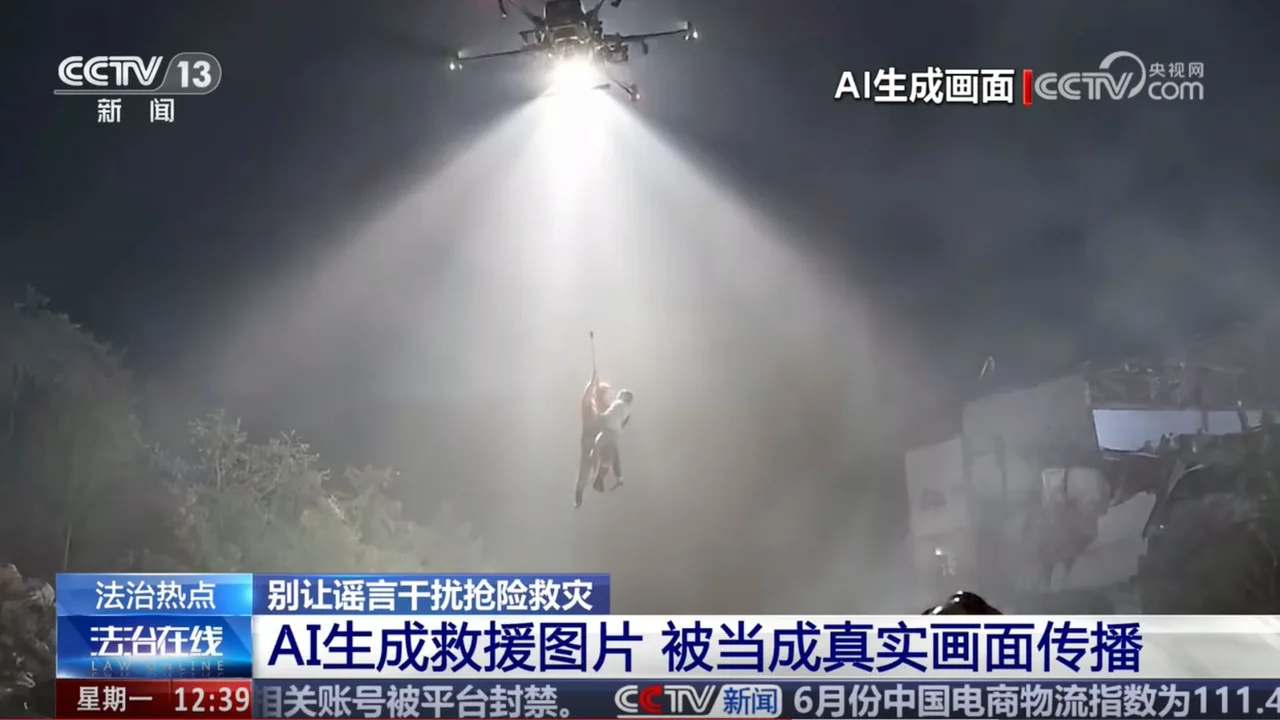
In recent months, as China struggles with natural disasters, the country has been facing another serious problem: the widespread proliferation of fake videos created using artificial intelligence (AI). The situation following Typhoon Prapiroon, which reached the country over the weekend, has made this issue even more urgent.
In the wake of severe storms and floods, numerous misleading photos and videos spread across social media. Among them were fake images showing bodies floating in water, videos depicting flooding in areas that were actually unaffected, and deliberately falsified footage of rescue operations.
The spread of false videos about power outages in certain regions caused panic among the population, prompting people to mass-purchase emergency supplies.
In some cases, fake videos were created using real events as a base. For instance, in early July, following a flood in Hancheng, Guangxi Province, hundreds of snakes escaped from a specialized breeding farm. After this incident, fabricated images were circulated on social media claiming that crocodiles had also been released into the river.
As large-scale evacuation and complex rescue operations continue, the government wants to avoid escalating panic among the public. Officials note that AI technologies, into which China is investing billions of dollars, are now turning into tools in the hands of certain individuals to mislead the public.
According to Xuan Zhixuan, a head of the internet security department at the Zhejiang Provincial Police, many content creators aim to gather more subscribers through sensational news about disasters. In their view, the more sensational or exaggerated the content, the more views and likes it can generate. Therefore, some deliberately falsify information to grab people's attention.
In recent weeks, a series of measures has been taken against individuals who produced fake news and videos. Some are expected to face criminal charges, while others have been subjected to fines or administrative penalties.
Experts warn that AI-driven disinformation could reach unprecedented levels. Chen Bin, a professor at the Central Party School of the Communist Party, pointed out that artificial intelligence has dramatically lowered the technical barriers to producing fake information. Special knowledge is no longer required—simple prompts can generate convincing yet entirely fake text, images, audio, and video in a short time.
Gao Fupin, a professor at East China University of Political Science and Law, believes various factors motivate the spread of such materials. While some treat it as a joke, others act for personal gain or to boost internet traffic. Another category aims to induce fear and instability in society.
He noted that some internet users think they can remain anonymous or undetected in the online space. In reality, law enforcement agencies are actively monitoring such cases.
Experts have also proposed adding special watermarks to AI-generated content. However, the problem is that these labels can later be edited and easily removed.
Xu Xiaoke, a professor at Beijing Normal University, emphasized the need to further strengthen geolocation, timestamp, and image source verification systems. At the same time, he noted that currently, technologies for detecting AI-generated materials are lagging behind the technologies used to create them.
According to him, this process resembles an endless "cat and mouse game." Therefore, it is wrong to assume that technology itself will detect all fake materials with the press of a single button.
Meanwhile, the Chinese government continues to heavily invest in the AI sector to transform the country into a leading technological power. In 2017, AI was declared the core driving force of the country's development. Today, according to state news agencies, over 6,000 artificial intelligence companies operate in the country.
Professor Xu believes that under these conditions, China must build a reliable information infrastructure. This system should include official warning platforms, emergency interfaces, and prompt information sources for the media.
However, in some cases, the fact that official sources themselves downplayed disaster information has led to a decline in public trust. For example, in July, regarding a major crack in the wall of the Lulan Dam near Nanning, local journalists were advised to cover it as an "opening" or "gap" rather than a "breach." Subsequently, at least 26 people died as a result of this disaster.
This is not the first instance. In 2021, local officials in Henan Province were accused of concealing or downplaying information regarding 139 deceased citizens.
Experts believe that such incidents are precisely what undermine public trust and provide malicious actors with the opportunity to easily spread misinformation.
At the same time, police are urging the public to rely only on official and verified sources during emergencies. Gao Kai, a representative of the Ningbo Public Security Bureau, stated that disaster reports with unknown sources should be treated with skepticism and that people should rely on official data.
He stated that the internet is not a lawless zone. Law enforcement agencies are continuously monitoring social media, especially short-video platforms, through specialized units and will take strict action against violators.
The Cyberspace Administration of China also announced on July 23 the launch of a nationwide crackdown on fake news related to floods and other disasters. Particular attention is being paid to fabricated statistics, edited videos, staged events, passing off historical footage as new occurrences, and fake statements made in the name of officials. Social media platforms have also been instructed to conduct stricter content reviews.
According to Professor Gao Fupin, the most effective solution to the problem is educating the public in information literacy and strictly enforcing legislation. He noted that AI itself is not the danger—the main issue is the purposes for which people use it.
However, Professor Chen Bin holds a different view. He argues that artificial intelligence technologies are developing much faster than the legal framework. As new legal questions arise, AI-driven disinformation may remain a serious problem for a long time.
Peter Pang, a lawyer operating in Shanghai and Washington, emphasized that not only individuals who create fake materials but also companies that develop AI software and the platforms that distribute them should be held legally accountable.
According to expert conclusions, in the future, topics concerning elections, public health, armed conflicts, natural disasters, and other issues affecting public life could become the most vulnerable areas for AI-assisted misinformation. Therefore, governments and internet platforms must prepare in advance rather than after the problem spreads.


Comments 0
…