


James Webb Space Telescope Debunks Dyson Sphere Hopes
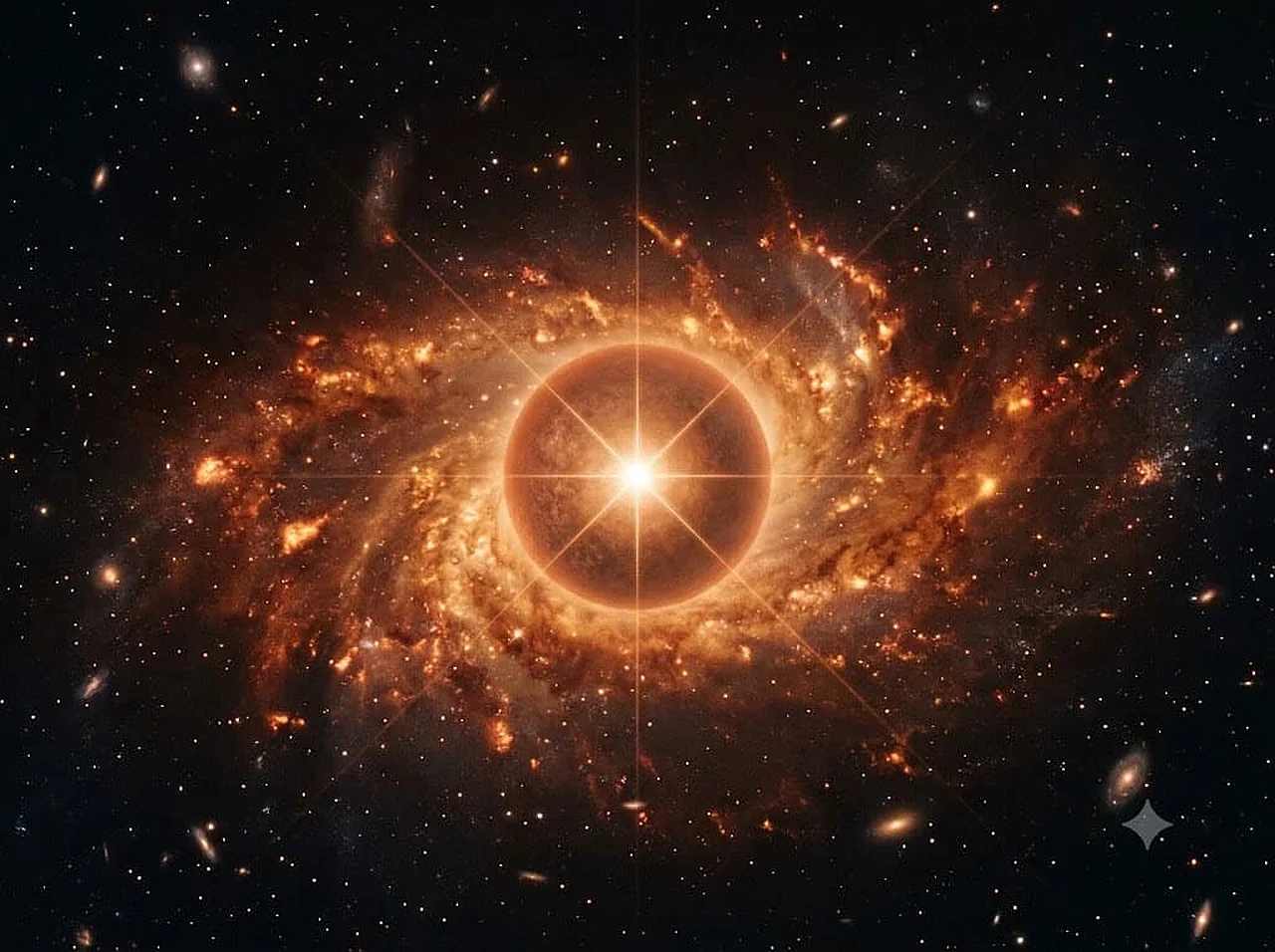
According to ixbt.com, astronomers using the space telescope have proven that hypothetical megastructures capturing stellar energy—Dyson spheres—do not exist around two highly promising objects. In the fourth phase of Project Hephaistos, researchers found that the excess infrared radiation, resembling waste heat from alien technologies, actually originates from background galaxies of celestial bodies. This is reported by Ixbt.com. reports .
Earlier, the Wide-field Infrared Survey Explorer (WISE) telescope had recorded an anomalous infrared heat excess in two cool red dwarf stars due to its low angular resolution. The Hephaistos team had selected these stars out of five million objects, based on the principle of thermodynamics that any megastructure absorbing light must re-emit it as infrared radiation.
Causes of the optical illusion
As a result of the blurring of WISE telescope images, the star and galaxy merged into a single source, creating an optical illusion regarding the existence of technological markers. However, the Mid-Infrared Instrument (MIRI) aboard the James Webb Space Telescope (JWST) showed in high resolution that the infrared flux was being emitted not by the stars themselves, but by objects located approximately 1 arcsecond away from them.Regarding candidate D, the background object turned out to be a rare galaxy belonging to the Hot Dust-Obscured Galaxy (Hot DOG) type. Its spectrum showed a redshift of approximately 0.922 due to the expansion of the Universe. The active center of this galaxy, heated by a supermassive black hole, heated colossal dust clouds up to 92 Kelvin, producing the signature signal.
Candidate E and complex background structures
The situation with candidate E turned out to be even more complex: its background object is a dust-covered, actively star-forming galaxy with a redshift of approximately 0.410. Here, the dust was heated up to 67 Kelvin, and one of the galaxy's bright knots matched the star's position almost perfectly, completely absorbing its light at 10 and 15 micrometer wavelengths.To separate the star's own flux from the mixed signals, astrophysicists had to analyze JWST's diffraction spikes—the long rays that give stars their famous spiky appearance in telescope images. Although traces of an alien civilization were not confirmed, this study provided astronomy with a rigorous method to filter out cosmic noise.
In future searches for Dyson spheres, it is proposed to analyze center shifts between optical and infrared data at an initial stage and to use radio interferometry to exclude background galaxies. The identified systems are also of great value for extragalactic astronomy, as M-dwarfs located close to luminous infrared galaxies could serve as natural guide stars for future ground-based observatories like the Extremely Large Telescope (ELT).


Comments 0
…