


Astronomers Detect the First Jet from an Intermediate-Mass Black Hole
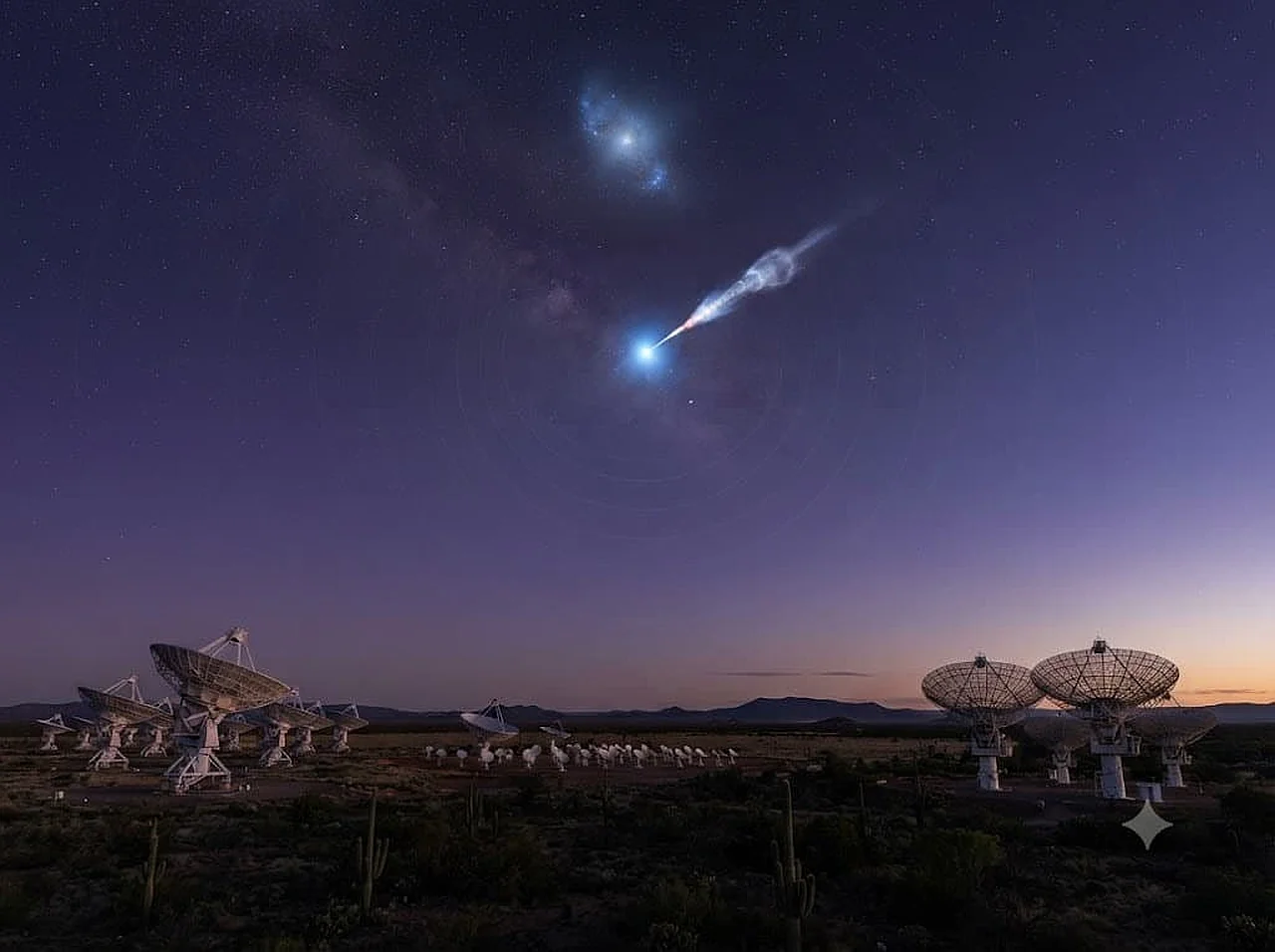
Chinese astronomers and their international collaborators have recorded a rare event for the first time in the history of space research: a jet (a flow of relativistic particles) produced by an intermediate-mass black hole. According to ixbt.com, an optical transient called AT2019ijn was first detected on May 31, 2019, using the ZTF system. The discovery proves that similarly powerful processes occur in other types of cosmic objects, not only around supermassive black holes. Ixbt.com reports this. reports this.
According to initial observations, the flare reached an exceptionally high optical peak, with an absolute magnitude of −21.05. However, what surprised specialists was that, unlike ordinary rapidly fading, bright blue transients, this source retained its blue color for nearly 47 days. Its half-life in the optical range was 46.3 days, and even 50 days after the flare, its temperature remained above 15 000 kelvins.
Radio Observations and Unexpected Results
Radio observations conducted during the study fundamentally changed the scientific picture. It turned out that the AT2019ijn event was not visible either in the original 1998 FIRST survey or in VLASS radio observations made 613 days before the optical flare. However, 412 days after the discovery, the VLASS system detected the source, and its brightness continued to increase.The absolute peak of the radio-wave flux was observed precisely on day 641. At this peak, the radio flux density reached 2 × 10³¹ erg/s/Gs. This showed that the source was approximately twice as bright as any fast optical transient or supernova flare over similar timescales.
Model Analysis and Future Observations
An analysis combining data from the VLA, ASKAP, and uGMRT telescopes showed that the radio-frequency emission was produced by the synchrotron mechanism in a shock wave created as the jet collided with the interstellar medium. According to the models, the jet was directed away from Earth, and its initial emission went undetected because of the relativistic beaming effect.Scientists believe that the observed radio peak occurred when the jet began to slow down and its emission expanded into the observer's line-of-sight cone. Studying this rare event will provide an important methodological basis for searching for similar hidden black holes in the future by continuing radio observations after an optical flare with a defined delay.


Comments 0
…