


Korea's Danuri Probe Photographs Falcon 9 Rocket Crash Site on the Moon
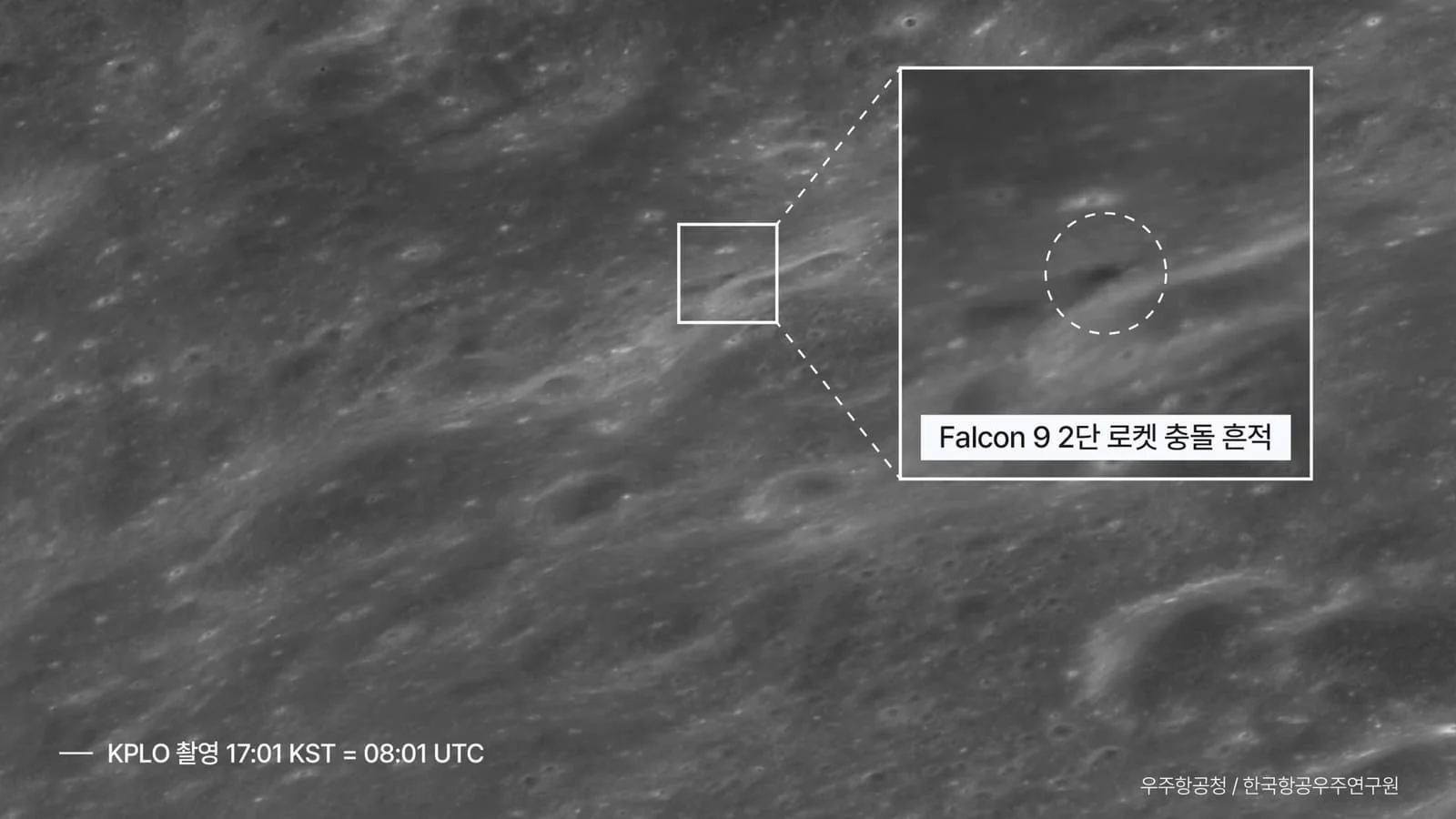
According to the Korea AeroSpace Administration (KASA), South Korea's Danuri lunar probe captured rare footage of the upper stage of a SpaceX Falcon 9 rocket both before and after its impact on the lunar surface. This event is of great significance to global science, allowing researchers for the first time to observe the impact of artificial objects almost in real time. This was reported by Ixbt.com reports .
The collision took place on August 5 of this year near the Einstein crater on the far side of the Moon. To successfully record the event, specialists pre-adjusted the orbit of the Danuri spacecraft. As a result, the spacecraft flew directly over the targeted impact point.
Unique Imaging Process and Scientific Equipment
According to data provided by KASA, the first image was taken approximately 30 minutes before the impact, after which the probe managed to capture another series of seven images following the event. The imaging process was carried out at an altitude of about 340–350 kilometers.The process utilized the LUTI high-resolution camera, capable of providing five meters of detail per pixel. In addition to the main camera, the PolCam wide-angle polarimetric camera also monitored the area. This device is designed to study the properties of lunar soil, allowing for the analysis of surface particle size and the distribution of scattered materials.
Research Results and International Cooperation
Initial analysis confirmed that the rocket's crash altered the lunar topography. In the published comparison images, an elongated dark trace is clearly visible that did not exist before the Falcon 9 stage landed. While new craters left by artificial objects could previously only be detected weeks or months later, this observation was made in science for the first time in a "before and after the crash" format.This successful operation once again confirmed the high precision of Danuri's orbit management and its ability to conduct complex scientific research. In the future, the US Lunar Reconnaissance Orbiter (LRO) is also planned to photograph this area, and the data provided by Danuri will serve as an important basis for joint research conducted with NASA.


Comments 0
…