


Why does the famous village not allow tourists every Sunday
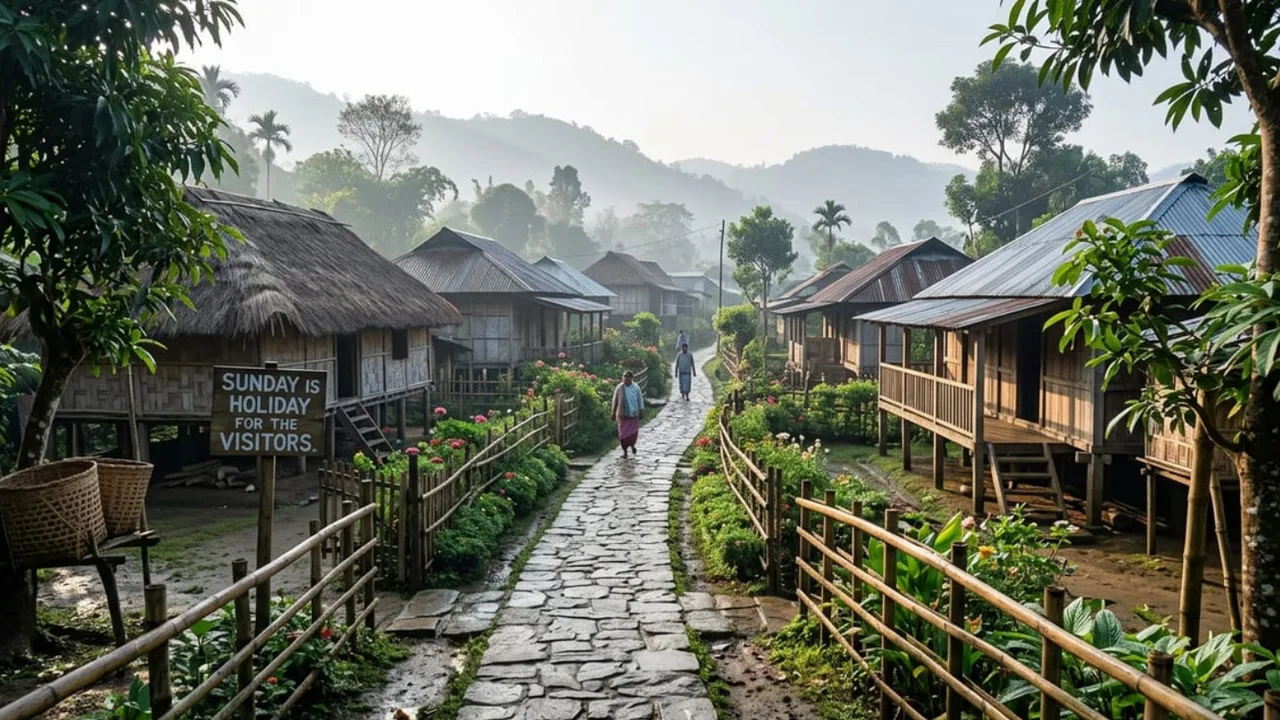
Located in northeast India and famous as 'Asia's cleanest village,' Mawlynnong has been one of the most popular destinations for tourists for many years. Every week, especially on Saturdays, hundreds and sometimes nearly a thousand tourists visit, eager to see the flower-covered streets, the pristine environment, and the local residents' commitment to cleanliness with their own eyes.
However, starting in January 2026, the villagers made an unexpected decision. Now, tourists are not allowed into the village on Sundays. The iron gates installed on the only road leading to the village are closed and monitored by guards. In this way, the locals decided to forgo the income brought by tourists for one day and reserve this day exclusively for themselves.
Tourism changed life, but...
Mawlynnong, located in India's Meghalaya state near the Bangladesh border, gained popularity across the country after being recognized in 2003 by Discover India magazine as 'Asia's cleanest village.'
This title was of great importance for a country like India, where sanitation issues are pressing. In the village, children are taught from a young age to keep the environment clean. They sweep the streets, collect dry leaves, and gather waste every morning before going to school. Biological waste is disposed of separately, and landscaping public spaces has become a simple habit for the locals.
In 2014, when Indian Prime Minister Narendra Modi launched the 'Clean India Mission' program across the country, he cited Mawlynnong as an example for everyone.
After that, interest in the village increased even more. The residents, who previously worked mainly in agriculture, opened guesthouses, cafes, and restaurants, and started selling souvenirs. Tourism became the main source of income for the local economy.
Why are tourists not allowed on Sundays?
Nearly twenty years later, as the number of visitors grew through social media, the village committee decided that it was necessary to restore the balance between tourism and daily life.
The majority of the local population is Christian. Therefore, Sunday is an important day for them, spent in prayer and with family.
Village committee member Preshes Khongdup emphasizes that the main goal of this decision is to preserve the village's cultural identity, values, and the discipline that made it famous.
Local resident Festival Kharrim also supports this decision.
'Now we can go to church and pray in peace. When tourists are here, we are always busy with work,' he says.
Interestingly, even before the ban was introduced, almost all shops and restaurants in the village were closed on Sundays. Only two eateries would remain open. Therefore, there were not enough facilities for tourists anyway.
Prosperity followed tourism
The villagers do not deny the positive aspects of tourism.
Preshes Khongdup says that until 2003, Mawlynnong was not well connected to surrounding villages by good roads. Today, thanks to tourism, many families have managed to build new concrete houses. Previously, most households lived in thatched-roof houses.
The locals even say that almost all families in the village unanimously supported the initiative not to host tourists on Sundays.
Maintaining cleanliness is one of the main goals
Every guest in the village is required to throw waste into special handmade baskets. Warnings such as 'Do not spit, violators will be fined' are also posted on the streets.
However, in recent years, after videos of plastic bottles left by tourists spread on the internet, the locals became seriously concerned about such situations.
Khongdup emphasizes that the residents, who have hosted tourists every day for twenty years, also need a rest.
'We also need a one-day break. If tourists don't come one day a week, we can feel the real village life again,' he says.
Sunday — only for locals
On Sundays, the village landscape changes completely. People heading to church, closed souvenir shops, an empty parking lot, and religious songs echoing from homes give the village a unique, peaceful atmosphere.
Of course, some tourists are unhappy with this decision. They suggest that the ban could be moved to another day of the week. But guests like Professor Vijaya Debnath from New Delhi say they understand the locals' decision.
In her opinion, it is precisely because of such order and responsibility that Mawlynnong maintains its status as 'Asia's cleanest village' to this day.
Despite the implementation of government programs aimed at improving cleanliness in India, Mawlynnong remains a unique example for the whole country. Tourists are welcomed here six days a week. And the seventh day is dedicated to the village's own people, their families, prayers, and peaceful life.


Comments 0
…