


LIGO physicists track black holes from the Big Bang era
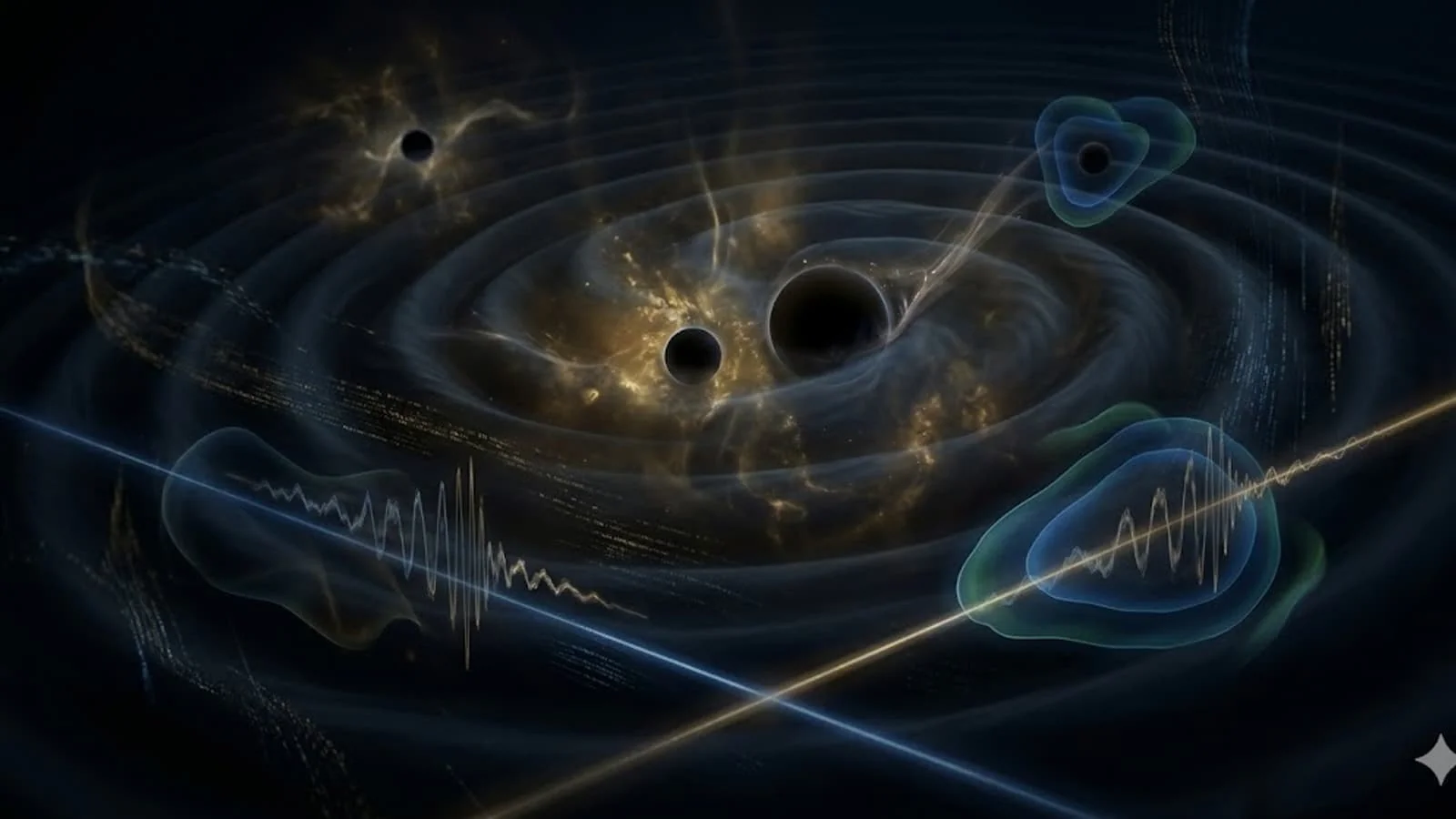
An international team of physicists from the LIGO-Virgo-KAGRA collaboration has presented the most extensive analysis of primordial black holes — hypothetical objects that appeared in the first seconds after the Big Bang. The study is based on results from the O4a observation run, which recorded 85 additional gravitational wave signals. As a result, the total catalog of observations has reached 161 events. This is reported by Ixbt.com reports.
Primordial black holes are considered one of the most exotic candidates for the role of dark matter. Unlike ordinary black holes formed by the collapse of massive stars, they may have emerged from the collapse of high-density regions in the early universe. The presence of several peaks in the mass distribution of the updated catalog, which cannot be explained by standard models of stellar evolution, prompted scientists to investigate whether primordial objects are among these events.
In the initial stage of the analysis, the results looked very promising: the statistical model showed a Bayes factor of ln B ≈ 30.5, which is considered very strong evidence in favor of the hypothesis. However, further checks showed that this effect is not very reliable. It turned out that much of the statistical advantage was caused by a few unusual events in the low-mass range, specifically one controversial merger that is likely a neutron star. Once this event was excluded, the factor dropped to ln B ≈ 1.7.
The final conclusion showed that the new data does not provide reliable evidence that a significant portion of black holes has a primordial origin. Nevertheless, this negative result allowed for the setting of the strictest constraints on the distribution of such objects. Researchers found that in the range of 0.6 to 100 solar masses, primordial black holes can account for only one-hundredth to one-ten-thousandth of dark matter.
Scientists also explored the possibility of much lighter primordial black holes with masses equal to those of large planets (10⁻⁴–10⁻³ solar masses). Although no candidates have been found yet, the sensitivity of modern detectors allows for testing scenarios where such objects could make up to 20 percent of dark matter. As the LIGO-Virgo-KAGRA catalog expands, the study of processes in the early universe will become even more precise.


Comments 0
…