


Meta Unveils Revolutionary Technology: Converting Thoughts to Text Without Surgery
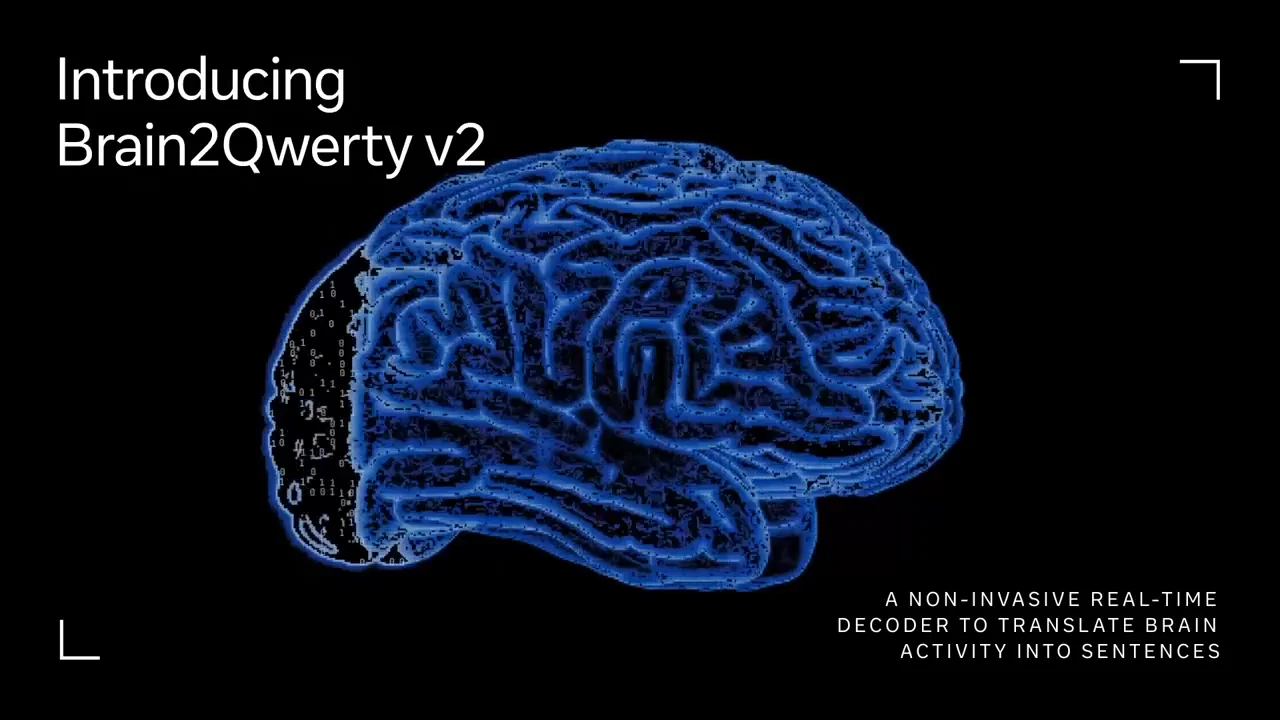
Researchers at Meta have demonstrated a new version of the Brain2Qwerty system, which converts human brain activity into text without surgical intervention, using external scanning devices. This project is one of the most significant steps in the field of neurointerfaces, achieving record accuracy among methods that do not require the implantation of electrodes into the brain. Previously, such high results were believed to be achievable only through complex operations to install implants in the cerebral cortex. This is reported by Ixbt.com news reports.
The Brain2Qwerty v2 project was developed by an international group of specialists led by the Meta AI Brain & AI team. The main innovation of the research is the proof that the effectiveness of neurointerfaces now depends not only on the physical sensitivity of the sensors but also on the data processing power of AI models. According to ixbt.com, the system has learned to extract necessary meanings from extremely noisy and ambiguous signals coming from the brain.
Synergy of AI and Neurophysiology
To train the system, researchers collected the largest dataset for non-invasive speech decoding. Nine volunteers spent 10 hours inside a magnetoencephalography (MEG) device, typing prepared sentences on a keyboard. As a result, a massive corpus of 22,000 sentences synchronized with brain activity was formed. This data allowed the AI to deeply study the connection between brain waves and letters.The uniqueness of the new system is that it does not convert brain signals directly into letters. Instead, Meta specialists used Large Language Models (LLM) further trained on neurophysiological data. The system first translates brain activity into high-level semantic concepts, a specific "meaning space," and then converts them into full sentences. This method helps restore the overall meaning of a sentence even when part of the brain signals are lost.
Results and Future Prospects
The experimental results were much higher than expected. While previous similar methods could recognize words with only 8 percent accuracy, the Brain2Qwerty system reached an average of 61 percent. The most successful participant achieved an accuracy rate of 78 percent. This means that in many cases, the system could read an entire sentence almost without error or with only one mistake.This discovery proposes a new paradigm in the development of neurointerfaces. Dangerous surgical procedures, such as installing chips in the human brain, may no longer be necessary. Instead, the possibility of establishing communication between the brain and computer using safe external scanners and powerful AI algorithms is emerging. According to Meta researchers, the accuracy of the system will increase as the training data grows.
For users and local technology enthusiasts in Uzbekistan, this news could open new horizons in communicating with people with limited mobility or controlling gadgets using only the power of thought. Currently, this technology is being tested in laboratory conditions, but its transition to commercial devices is only a matter of time.


Comments 0
…