


Betelgeuse Turned Out to Be a Binary Star
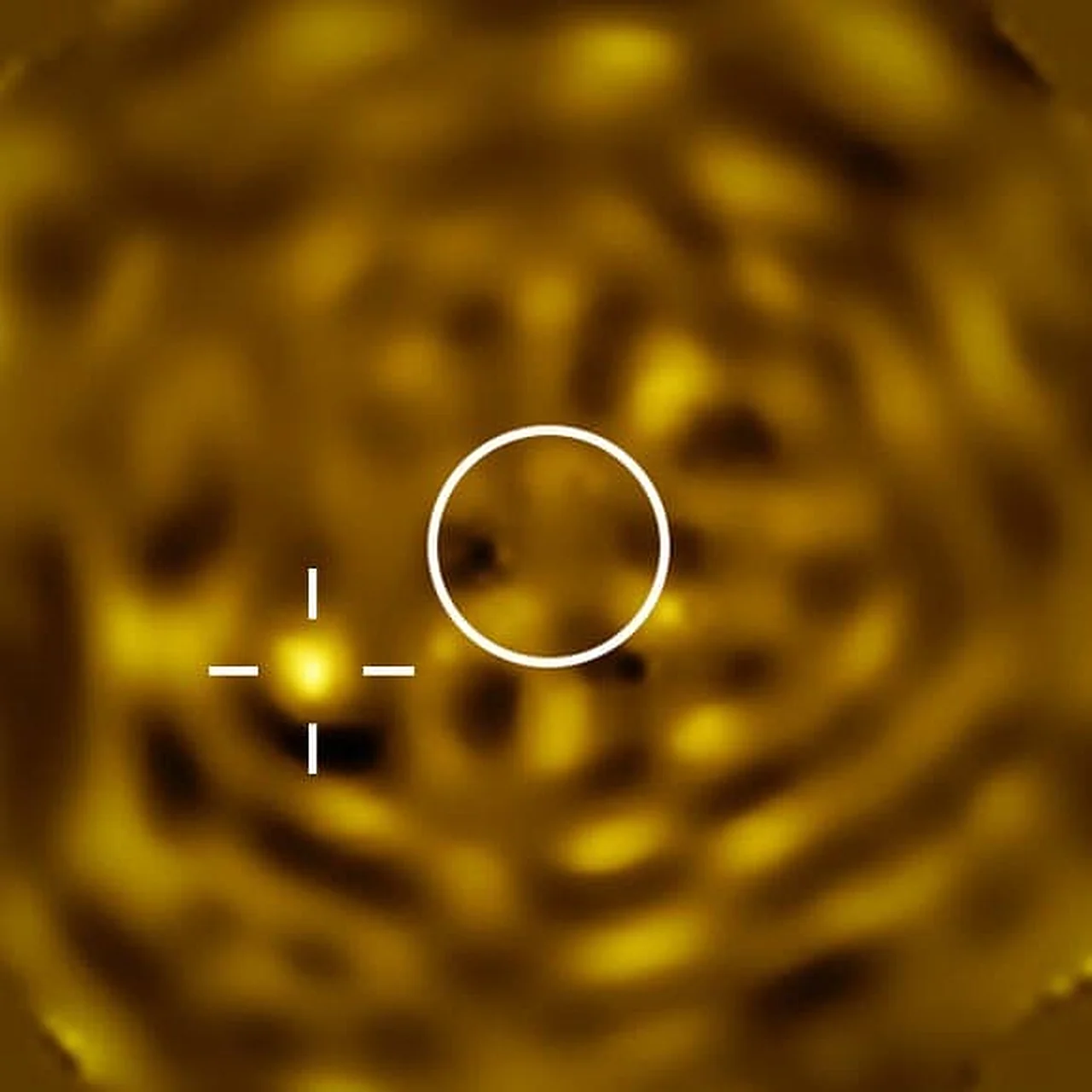
For the first time, astronomers have managed to image the "invisible" companion of Betelgeuse, one of the brightest and best-studied objects in the night sky. An international team of researchers led by Dr. Miguel Montargès from the Paris Observatory discovered a binary star system with a red supergiant, where the companion has a mass equivalent to three Suns. This discovery has become an important step for the scientific community in understanding one of the most mysterious processes in the universe, reports Ixbt.com reports .
According to ixbt.com, a scientific paper published in the journal Astronomy & Astrophysics provides new information about Alpha Orionis, located 724 light-years away from Earth. This red supergiant is approximately 8 million years old, with a radius 1,400 times larger than the Sun and a luminosity 100,000 times greater. The star is nearing the end of its life cycle and will eventually explode as a supernova, shining brightly enough to remain visible even during the day for several weeks.
How was the new companion discovered?
To search for the unknown partner, specialists used the SPHERE-ZIMPOL instrument on the Very Large Telescope (VLT) of the European Southern Observatory. Originally created to search for exoplanets, this extreme adaptive optics system enabled high-contrast imaging. Observations were conducted on December 3 and 6, 2024 — precisely when the companion was predicted to reach its maximum visual separation from the primary star.As a result, scientists recorded a candidate object named Betelgeuse B with a statistical significance of 6.1 sigma. This body is located at an angular distance of 52.32 milliarcseconds from the main star, which corresponds to a projected distance of approximately 8.8 astronomical units. Analyses showed that Betelgeuse B is a typical young main-sequence star with a mass ranging from 2.6 to 3.1 solar masses.
Scientific significance and future plans
The failure of scientists to detect ultraviolet, X-ray, or H-alpha emission confirms that this object is not an early, active protostar. Research lead Dr. Montargès noted with satisfaction that he had worried about a lack of sensitivity, but the star turned out larger than expected and caught their eye. This finding unlocks the mystery of the long-term variability associated with the giant's surface structure and the motion of orbital companions affecting the stellar wind.It is emphasized that the probability of a chance alignment with a background star is currently zero. However, to fully confirm the gravitational binding of the system, another observation will be required after half of the orbital period, once the companion moves to the opposite side of the supergiant.


Comments 0
…