


A Huge 16 MW Wind Turbine Installed at Sea Goes Online in China
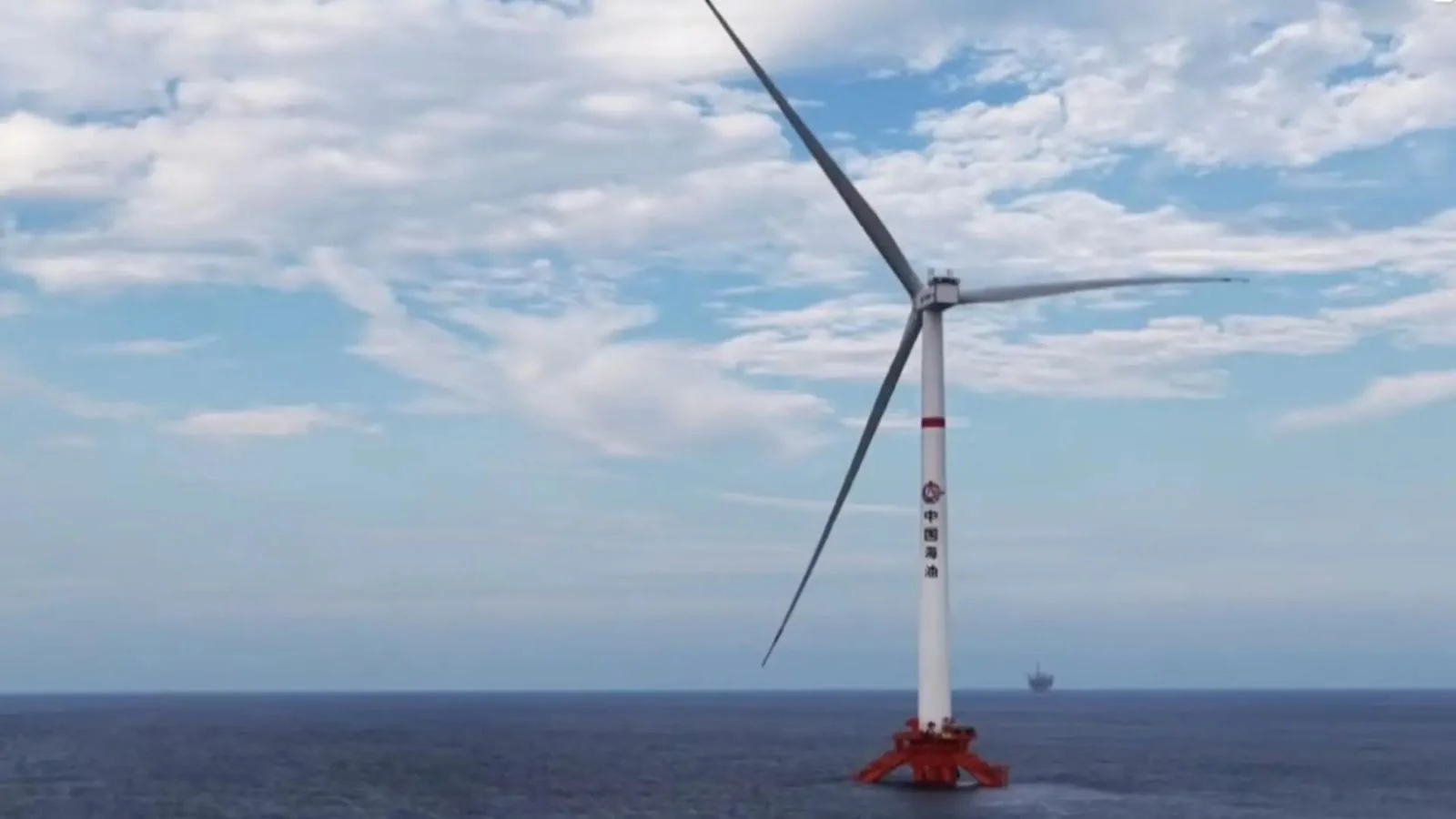
According to Ixbt.com, China’s first floating wind farm has begun operations, with its platform installed on retired supports. The 16 MW Haiyou Anlan facility has been successfully connected to the power system of the Lufeng offshore oil field and is already supplying it with electricity. China National Offshore Oil Corporation (CNOOC), the state-owned company behind the project, said the facility has become the world’s largest TLP-type floating wind installation by single-turbine capacity. This was reported by Ixbt.com reports say.
The new station also set global records among similar facilities for water depth and distance from the coast. The platform is located approximately 200 kilometers southeast of Shenzhen, 136 kilometers offshore, at a depth of nearly 136 meters. The project is designed to operate for 25 years. Its height is roughly equivalent to that of a 110-story building, while it weighs 7,800 tons.
Technical Specifications and Typhoon Resistance
The facility’s blades are so large that their swept area is equivalent to 7.5 football fields. The structure was designed for extreme weather conditions and can withstand powerful Category 17 typhoons. Once it reaches its rated capacity, Haiyou Anlan is expected to generate approximately 54 million kW·soat of electricity annually. All of the power generated will be used directly to meet the needs of the Lufeng oil field.According to CNOOC estimates, the project will save approximately 15,000 cubic meters of fuel annually and reduce carbon dioxide emissions by 35,000 tons. The project’s key feature is its TLP platform. Unlike conventional offshore wind generators, this platform is not supported by a fixed foundation but remains afloat. The structure is held in place by nearly vertical, tensioned tendons connected to anchors on the seabed.
The Prospects of Deep-Sea Energy
Constant tension limits the platform’s movement under the influence of waves and currents. This approach helps reduce steel consumption and the area occupied in the water, while also providing high stability. However, installing a TLP is considerably more complex than installing conventional offshore platforms and requires exceptional precision when deploying anchors and connecting subsea components.Experts view the project as a testing ground for future deep-sea wind farms. Floating platforms above the water make it possible to install powerful turbines farther from the coast, where winds are stronger and more consistent. This is particularly important for China: although the country’s main energy resources are located in the west, its primary consumers are concentrated along the eastern coast. For now, the high cost of such installations remains the main obstacle to their widespread adoption.


Comments 0
…