


Disrupting Ukrainian Drones: Russia Is Painting Trucks Like Zebras
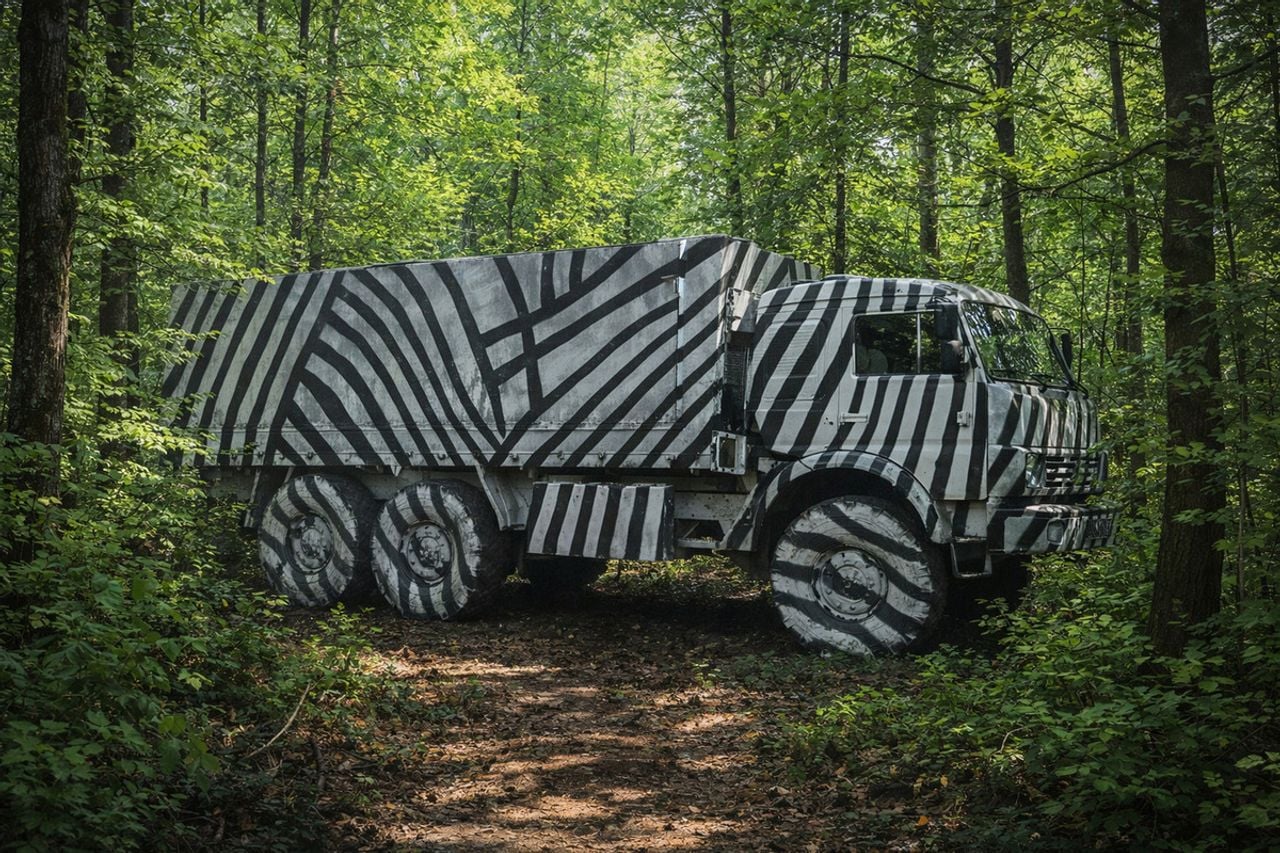
Throughout the history of global military conflicts, new technologies—especially artificial intelligence and unmanned aerial vehicles (drones)—have been generating increasingly innovative methods and tactics. Today, the front line is witnessing a real “battle of wits” not only over weapons, but also over camouflage and ways to deceive AI algorithms. According to Germany’s prestigious Bild publication, Russian forces have begun unexpectedly altering the appearance of their supply vehicles in an effort to protect them from Ukrainian drones.
Photographs circulated by social media users and military bloggers show KamAZ and Ural military trucks, the backbone of the Russian army, abandoning their usual camouflage colors and being painted with black-and-white stripes.
The Strategy of Misleading Artificial Intelligence Algorithms
This unusual and bizarre method is based on a plan to deceive modern technologies. According to military experts, the situation can be explained as follows:
Algorithmic confusion: The most advanced drones used by the Ukrainian army operate on artificial intelligence and identify targets by their technical contours and shape.
The effect of contrasting stripes: The highly contrasting white and black stripes painted on the vehicle’s body could seriously interfere with digital system algorithms correctly identifying the object’s shape and recognizing it as a truck.
However, the effectiveness of such a primitive camouflage technique is the subject of considerable debate in military circles. Modern unmanned systems do not search for targets solely through ordinary optical cameras. They are equipped with powerful thermal imagers and other specialized sensors that can detect heat from a vehicle’s engine from a distance.
Front-Line Reactions and the War for Supplies
Ukraine’s military command responded to the development with considerable irony and determination. Ukrainian officer Mykola Kolesnyk explained the situation as follows:
“They can paint zebras, ostriches, or rhinos on their equipment—whatever they want. We will still identify the target and destroy them.”
At the same time, Ukraine’s armed forces are conducting extensive operations aimed at cutting the Russian army off from its supply and logistics systems. These efforts are being carried out not only along the line of contact, but also in border regions inside Russia.
Weakening Logistics Means Halting the Offensive
The importance of supply chains in military operations is reflected in the following brief analytical table:
Operation Direction | Method of Military Action | Expected Result and Objective |
Logistics and Supplies | Destroying trucks and vehicles carrying fuel and ammunition. | Depriving military units at the front of essential supplies. |
Front Line | Reducing the adversary’s activity by cutting supplies. | A significant reduction in overall offensive operations and pressure. |
Ukraine’s Minister of Digital Transformation, Mykhailo Fedorov, also emphasized the importance of this tactic, stating: “The more extensively and relentlessly Russian military logistics are destroyed, the faster and more significantly their offensive operations at the front will weaken and decline.”
Zamin Analysis: This situation once again proves that modern warfare has become a struggle not only of physical force, but also of advanced technologies and AI algorithms. Painting vehicles in animal-skin patterns may partially confuse drones, but in an era of advanced thermal sensors and radar, this method cannot remain effective for long. Disrupting supply chains at the front could fundamentally change the course of military operations in the near future. We will continue to monitor developments closely.
Follow the most sensational geopolitical events in the global community, analysis of modern military technologies, and the latest international news with us on the Zamin website



Comments 0
…