


A massive 500,000-kilometer explosion occurred on the Sun — what awaits Earth?
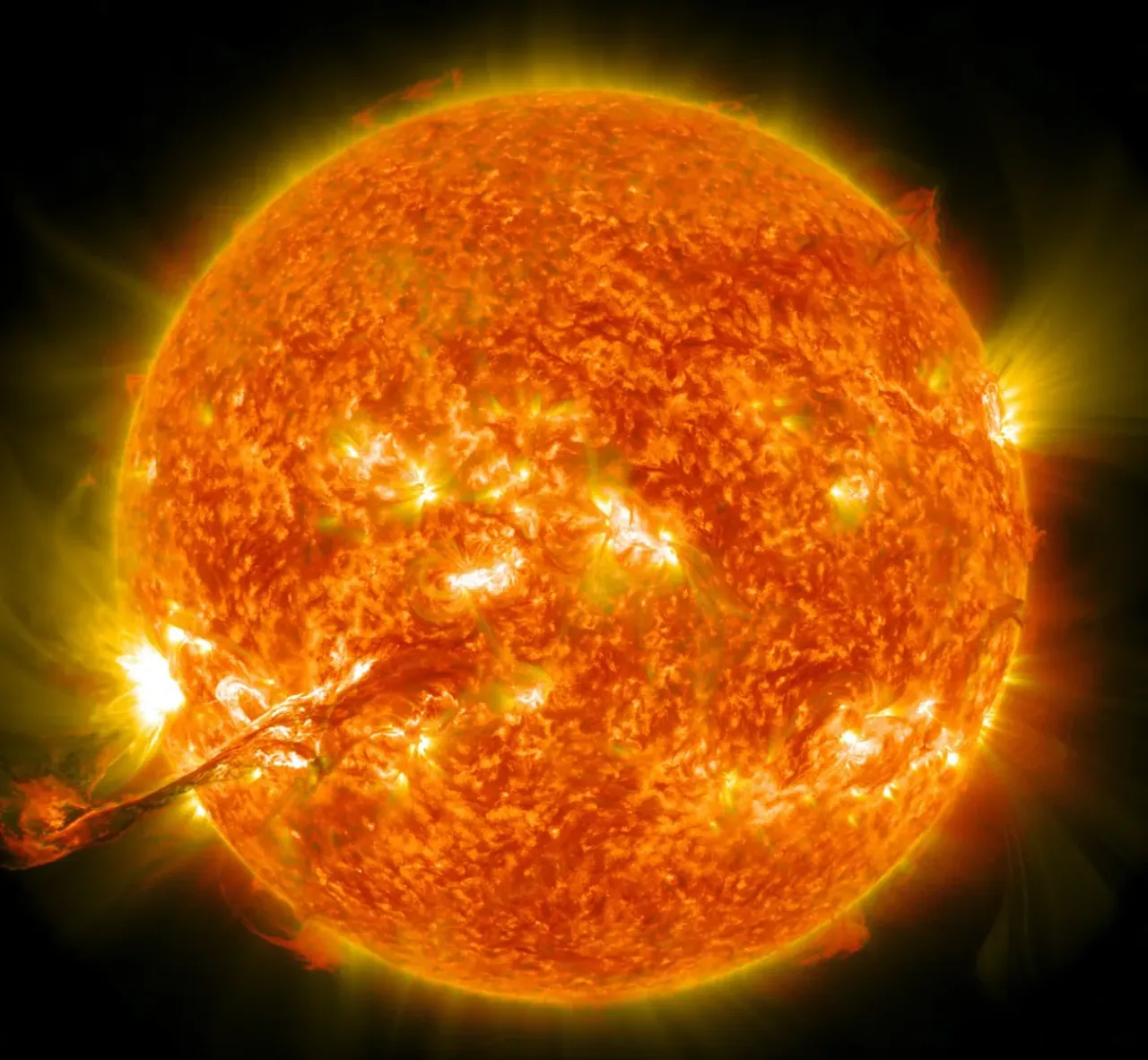
A record-breaking cosmic event has been recorded on the Sun. A massive prominence stretching 500,000 kilometers in length erupted from the star's surface. A cloud of hot plasma, several times larger than the diameter of Earth, detached from the solar corona and began moving through open space.
Scientists were able to observe this unique and formidable astronomical process in full using specialized orbital telescopes. The Solar Astronomy Laboratory of the Space Research Institute (IKI RAN) has provided official information regarding the observation results and potential consequences.
Scale of the explosion and trajectory direction
According to initial calculations, the dynamics of the event are as follows:
Record size: The plasma trail ejected from the Sun covered a distance of 500,000 kilometers, becoming one of the largest prominences in recent times;
Factor reducing impact risk: The explosion occurred exactly on the edge (side) of the Sun's visible disk. This factor significantly reduces the probability of the plasma cloud delivering a direct, massive frontal strike to Earth;
Glancing blow: Although the main mass is directed to the side, astrophysicists do not rule out the possibility of the edge of the plasma cloud striking Earth's magnetosphere in a glancing manner.
What awaits Earth: Communication disruptions and magnetic storms
If the periphery (outer layers) of the plasma cloud brushes against our planet's magnetic field, a series of geomagnetic events may be observed:
Moderate magnetic storm: Due to the disturbance of the magnetosphere, there is a possibility of moderate-intensity magnetic storms in the atmosphere;
Technological impacts: Such geomagnetic waves could cause short-term disruptions in high-precision navigation systems (GPS) and degrade the quality of radio communications at high latitudes;
A miracle in the sky — Aurora Borealis: The positive aspect of the event is that the collision with the upper layers of the atmosphere will create stunningly bright auroras (Aurora Borealis) in the night sky. Astronomers note that there may be an opportunity to see this beautiful spectacle even in relatively southern regions where such phenomena are not usually observed.
Astrophysicists continue to continuously monitor solar activity and changes in space weather.



Comments 0
…