


NASA Astronomers Discover "Cotton Candy" Soft Planets in Space
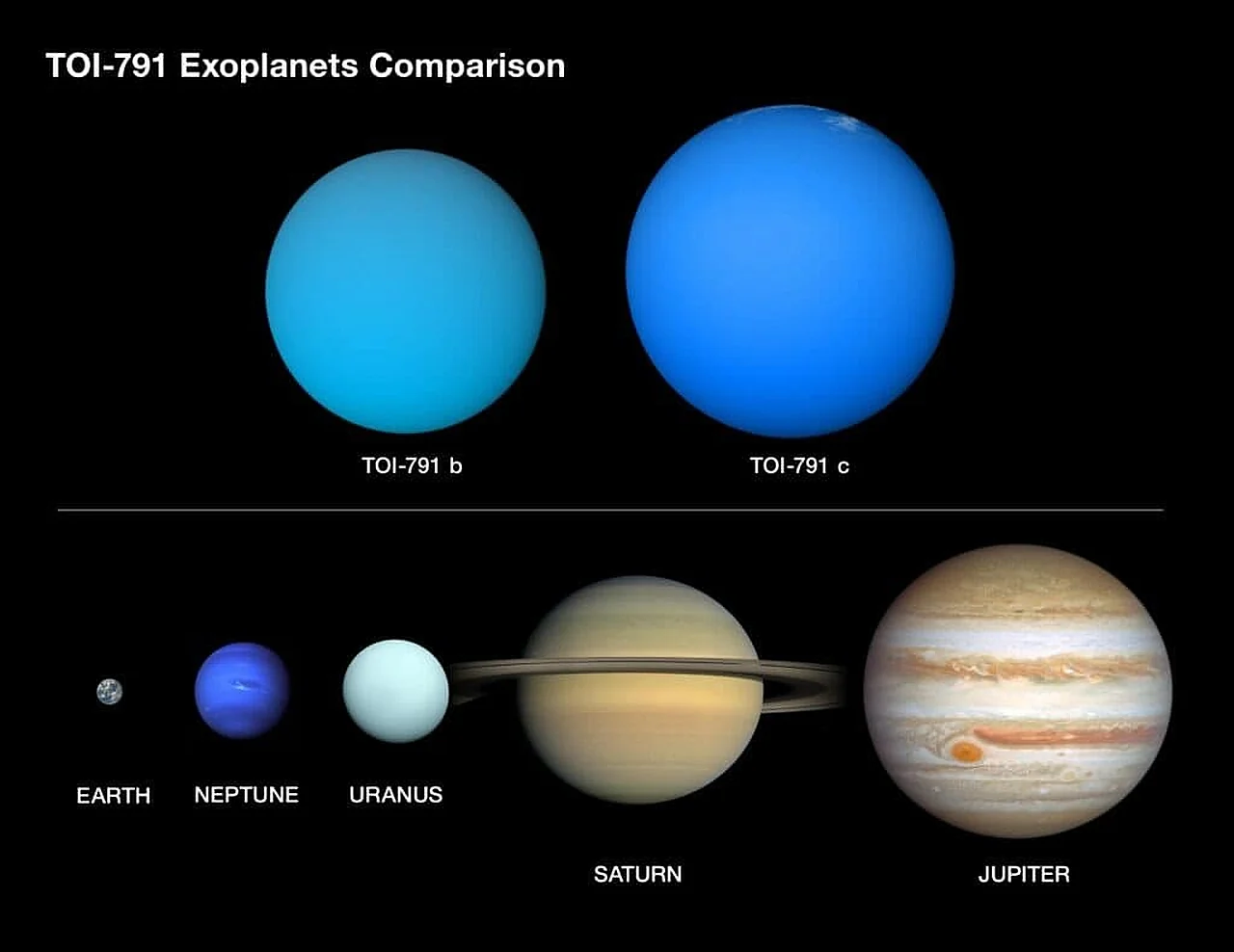
Research conducted using NASA's TESS (Transiting Exoplanet Survey Satellite) space telescope has identified two of the most unusual exoplanets known to science. Named TOI-791 b and TOI-791 c, these objects are astonishing scientists with their enormous size and extremely low density. It was found that their density is nearly equivalent to "cotton candy." This is reported by Ixbt.com news provides.
These unique planets orbit the Sun-like star TOI-791. This system is located approximately 1,113 light-years away from Earth. Initial data was obtained via the transit method, recording the dip in light as a planet passes in front of the stellar disk. Subsequent analyses showed that the physical properties of these objects could reshape our understanding of the universe.
Jupiter-sized "Air Balloons"
According to ixbt.com, planet TOI-791 b is nearly identical to Jupiter in size, yet its mass is only 3 percent of the largest planet in the Solar System. The second object, TOI-791 c, is even larger than Jupiter in diameter, but its mass is only 5.9 percent of Jupiter's mass. Such indicators place these planets among the "rarest" objects in modern astronomy.According to the NASA Ames Research Center, the existence of such objects contradicts existing theoretical models of planetary formation. Scientists are currently trying to explain how gas giants with such small masses can maintain an enormous atmosphere. This discovery proves that gas giants in the universe may be more diverse than we thought.
Gravitational Connection and Orbital Motion
The orbits of the planets are also peculiar: TOI-791 b completes an orbit around its star in 139 days, while TOI-791 c takes 232 days. Detecting such long-duration orbits is a complex process requiring continuous observation over a long period. Another noteworthy aspect of the system is that these two giants exert a strong gravitational influence on each other.George Dransfield, a researcher at Oxford University, noted that finding two "ultra-soft" planets around a single star simultaneously is a rare phenomenon. This system serves as a unique laboratory for studying planetary migration and evolution. In the future, it is planned to draw more precise conclusions about their origin by studying the chemical composition of their atmospheres.
Currently, scientists are revising the stability limits of gas giants through these strange objects in the TOI-791 system. This discovery raises new questions not only for astronomy but also regarding how general laws of physics manifest in exoplanetary environments.


Comments 0
…