


NASA's Dragonfly mission: Octocopter drone resistant to Titan's atmosphere is being prepared
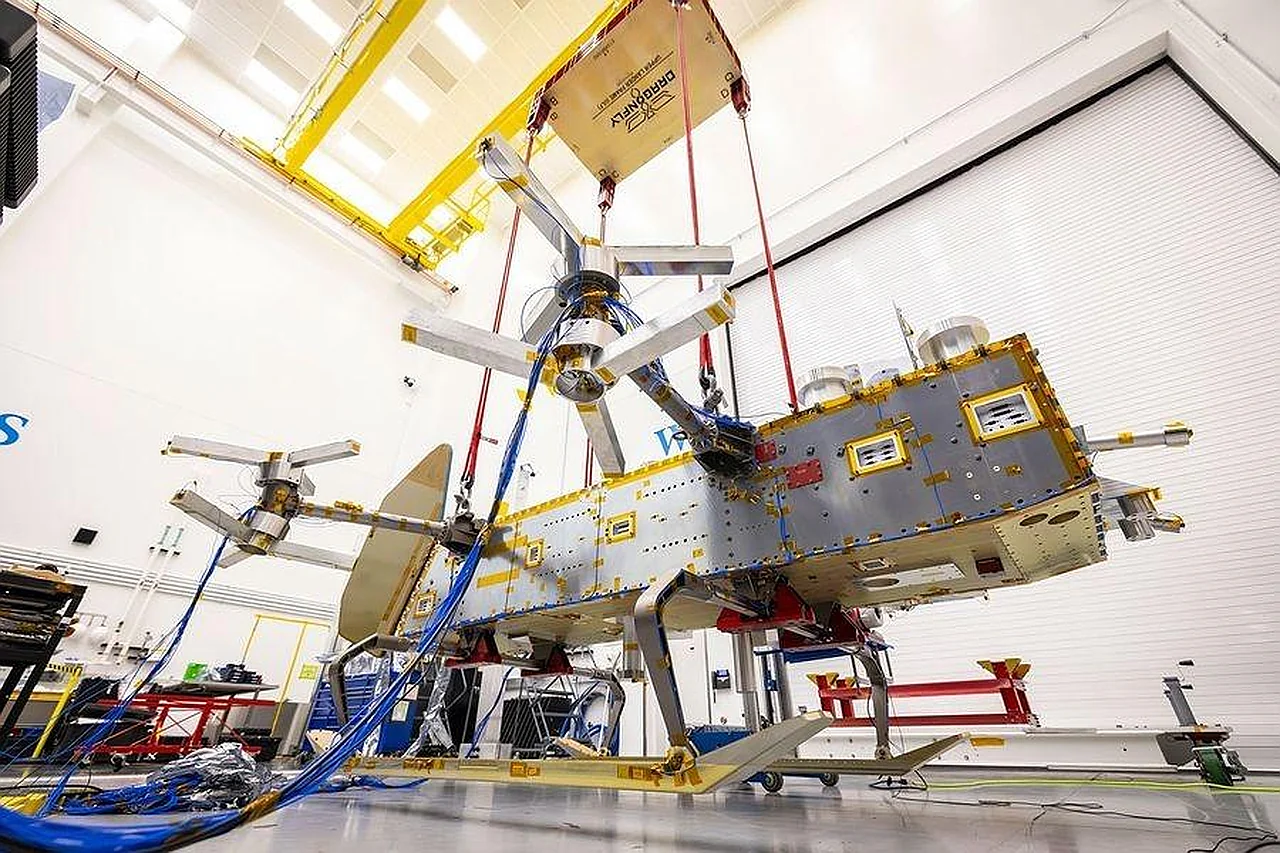
The US National Aeronautics and Space Administration (NASA) has taken a significant step forward in the Dragonfly mission, designed to explore Titan, Saturn's largest moon. Specialists at the Applied Physics Laboratory (APL) at Johns Hopkins University have completed key structural tests of the future rotorcraft ahead of schedule and moved it to the next assembly stage, as reported by ixbt.com. reports that.
Currently, engineers have begun installing onboard systems that will transform the frame into a fully functional research vehicle. The tests confirmed the structural integrity of the design. Dragonfly must withstand all loads during launch into Earth's orbit, years of space flight, and the process of entering and landing on the extremely dense atmosphere of Titan.
Resistance to methane storms and pressure
Engineers used special mass simulators instead of scientific instruments to test the frame for vibration loads. During the tests, the craft was suspended from elastic cables to model load distribution similar to real flight conditions. However, one of the most critical stages was the hermeticity (leak) test, a process rarely used for interplanetary spacecraft.The point is that, unlike most space missions, Dragonfly must operate in the dense atmosphere of Titan. Here, air pressure is 1.5 times higher than on Earth, and temperatures drop to −179 degrees. Air was pumped into the structure to check for even the smallest leaks, as any defect could negatively affect the craft's thermal regime. Experts noted that the results were even better than expected.
Technical equipment and communication system
Currently, power elements, cable harnesses, and electrical systems are being installed in the frame. Later, scientific instruments, avionics, and thermal insulation will be added. One of the most prominent parts of the craft is a high-gain antenna with a diameter of nearly 90 centimeters. It is through this equipment that collected scientific data will be transmitted to Earth.Notably, the antenna automatically folds into a protective position before each flight to prevent damage from vibrations. After landing, it is deployed again to establish communication with the control center. This system serves to ensure continuous data exchange in extremely difficult conditions.
Dragonfly will be the first multi-rotor flying craft (octocopter) in history to explore the surface of another celestial body. Due to Titan's dense atmosphere, it will be able to fly multiple times across various regions of the moon. The main goal of the mission is to study Titan's geology, chemical composition, and potential conditions for the emergence of life. The launch of this massive project is scheduled for 2028.


Comments 0
…