


Developer Piped Water Directly Over a GeForce RTX 2060 GPU
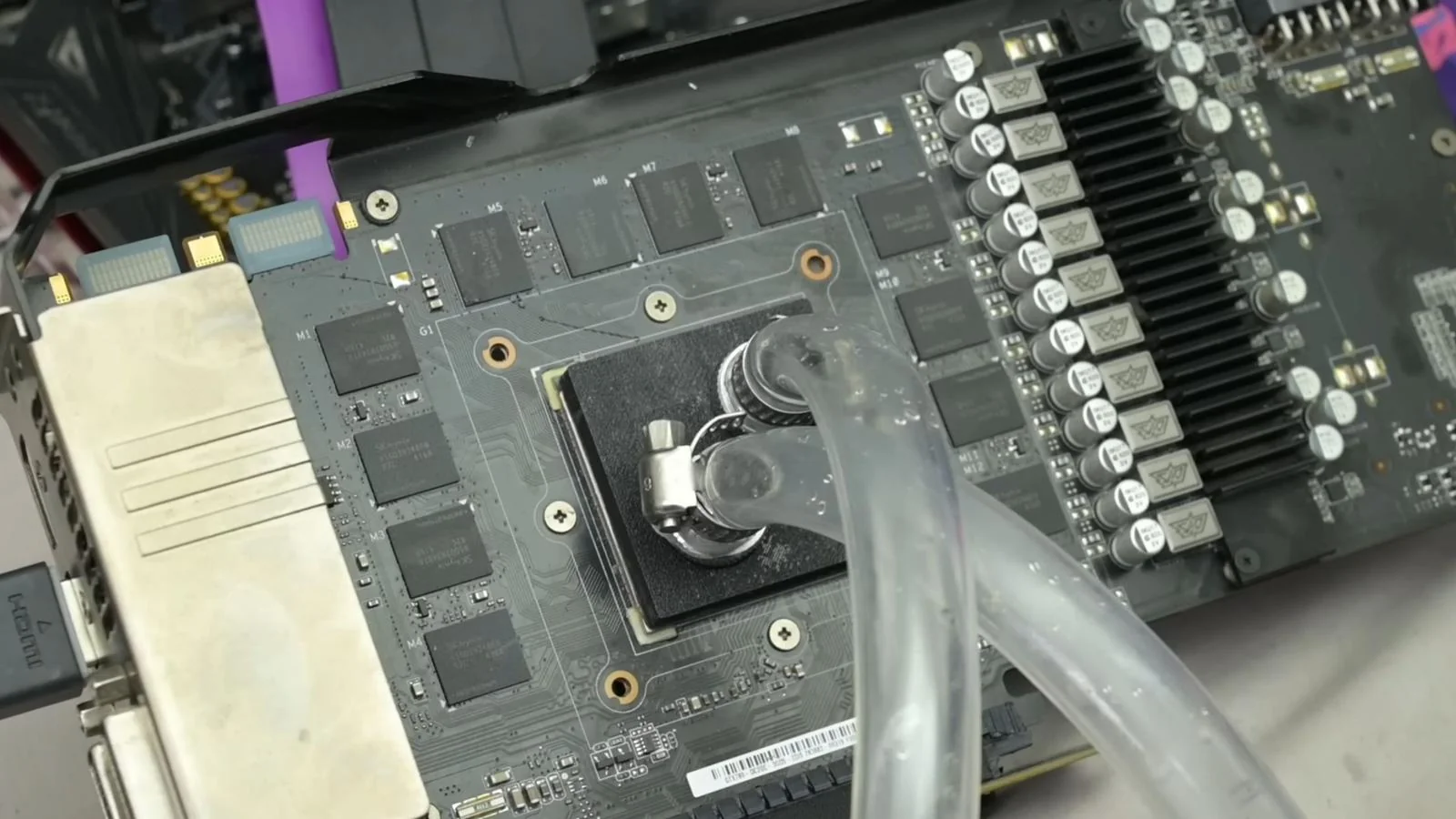
According to ixbt.com, a technology enthusiast known as TrashBench conducted an extremely risky and unusual experiment with a GeForce RTX 2060 graphics card. He abandoned the standard heatsink and conventional water block, directing coolant straight onto the surface of the operating GPU die and achieving a dramatic temperature reduction. Ixbt.com reports this.
The experiment was carried out in several stages. First, the modder tested the idea on a failed RTX 3060 board. A custom 3D-printed plastic block was installed around the exposed die, while the base surface was carefully sealed with epoxy adhesive.
During the initial stages, the structure developed leaks, so the sealing compound had to be reworked several times to solve the airtightness problem. After successful tests, a similar design was also tested on a GeForce GTX 980.
Experiment Results and Efficiency
The main and final tests were performed on a fully functional GeForce RTX 2060 graphics card, allowing the new method to be compared with conventional solutions. In the Unigine Heaven benchmark, the graphics card equipped with its standard factory heatsink reached approximately 70 degrees.Next, a conventional liquid cooling system with a 360-millimeter radiator was installed, reducing the temperature to 36 degrees. The radiator and standard water block were then removed entirely, and the pump was configured to direct water from the reservoir straight onto the surface of the operating GPU.
As a result, the core temperature fell to 28 degrees, while the hotspot temperature reached just 41 degrees. Thus, direct contact between the liquid and the die proved approximately 42 degrees more effective than standard cooling in terms of core temperature, and 8 degrees more effective than the system with a 360-millimeter radiator.
Tests on Other Devices and Risks
TrashBench also repeated a similar experiment with an Intel Core i5-7600K processor, but directly delivering water to the processor could not outperform a conventional liquid cooling system. This showed that the method’s effectiveness depends on the specific chip and the design used.Experts emphasize that such a setup is completely unsuitable for ordinary users. Because the liquid comes into direct contact with the die, substrate, memory, and other components, even the smallest failure or leak could instantly destroy the graphics card and the entire system.
Nevertheless, the experiment clearly demonstrated the limits of liquid cooling. It proved that the closer the liquid is to the heat source, the more efficiently energy can be removed from the silicon die.


Comments 0
…