


Mars Express captures purple cliffs at the Red Planet's south pole
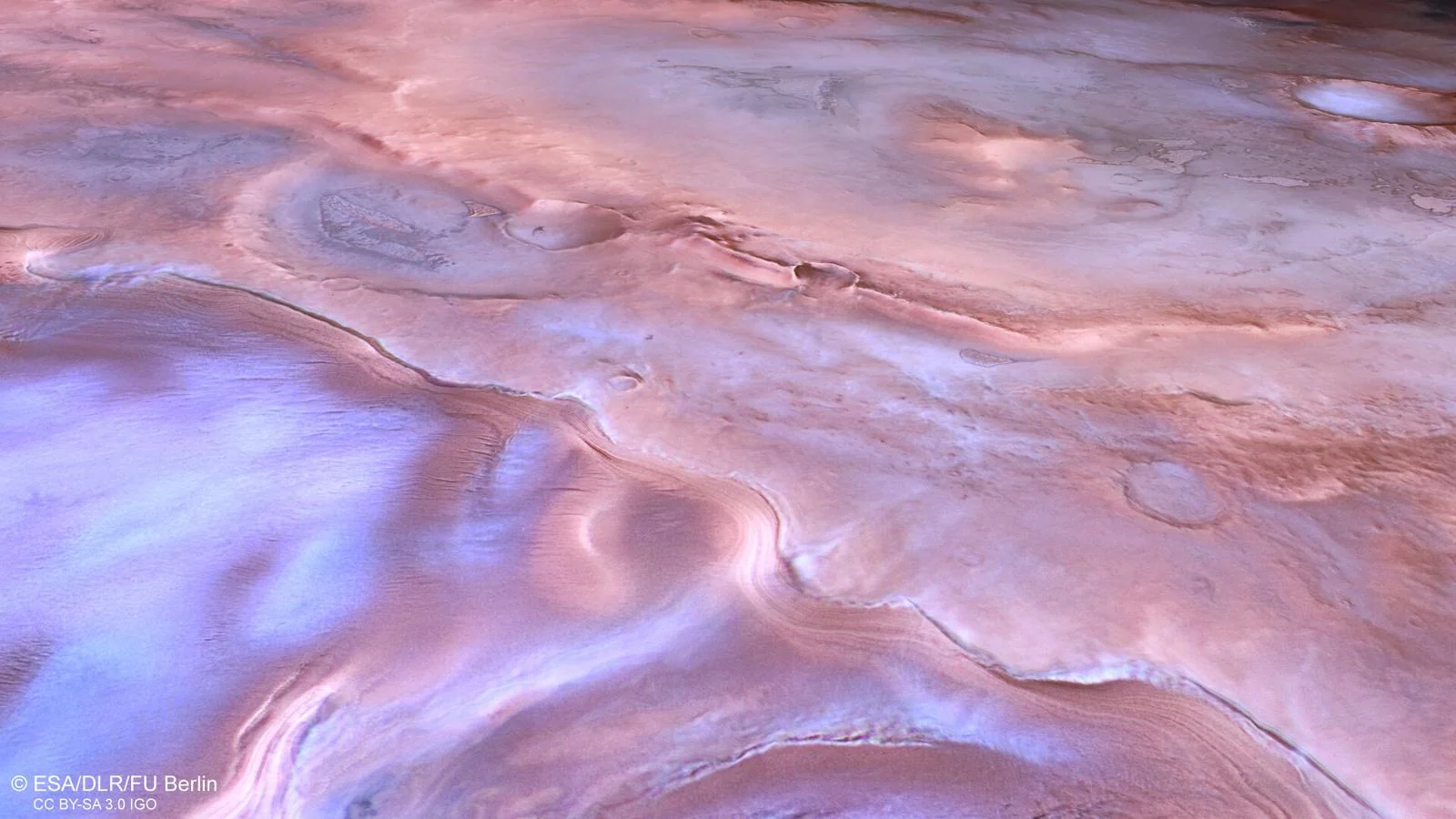
The High Resolution Stereo Camera (HRSC) on the European Space Agency's Mars Express orbiter has successfully captured images of a unique icy and rocky region near the south pole of Mars. According to ixbt.com, the cliffs in this area rise over a kilometer in height in some places, with massive stair-like ridges stretching for hundreds of kilometers. This is reported by news source.
In the captured frames, unusual purple and pink hues appear, contrasting with the planet's typical reddish-brown tones. Experts explain that these visual colors are not the surface's actual color, but an optical phenomenon resulting from the interplay of morning light, atmospheric dust particles, and frost on the ground.
The mysterious structure of the Thyles Rupes ridge
The dark areas and the colors of the Thyles Rupes ridge in the image are attributed to mafic minerals in the bedrock, specifically volcanic materials such as magnesium- and iron-rich olivine and pyroxene. The brighter parts are covered with solid carbon dioxide (dry ice) deposits, which persist even when spring arrives in the southern hemisphere.Such distinct light-blue sections are clearly visible on the peaks of sand dunes and inside craters. In the lower-left part of the frame, a massive glacier, which forms part of the Martian south polar ice cap, has been identified.
Structural and geological processes
According to scientific observations, the Thyles Rupes ridge may have a tectonic origin. It is hypothesized that as the Martian interior cooled and the planet contracted in the distant past, the crust deformed, causing certain blocks to uplift and form these folds. These processes occurred billions of years ago, and the modern Mars does not possess such active tectonic features.Additionally, several types of sand dunes formed by winds blowing in various directions can be seen in the images. Interestingly, the Mars Express orbiter has been successfully operating around the Red Planet since 2003.
This spacecraft has been mapping the planet's surface in color and 3D format. The HRSC camera has repeatedly proven how diverse the Martian surface is: in addition to typical iron oxides, volcanic sands, clays, sulfates, and ice layers coexist here.


Comments 0
…