


Curiosity Mars rover celebrates its 5000th sol
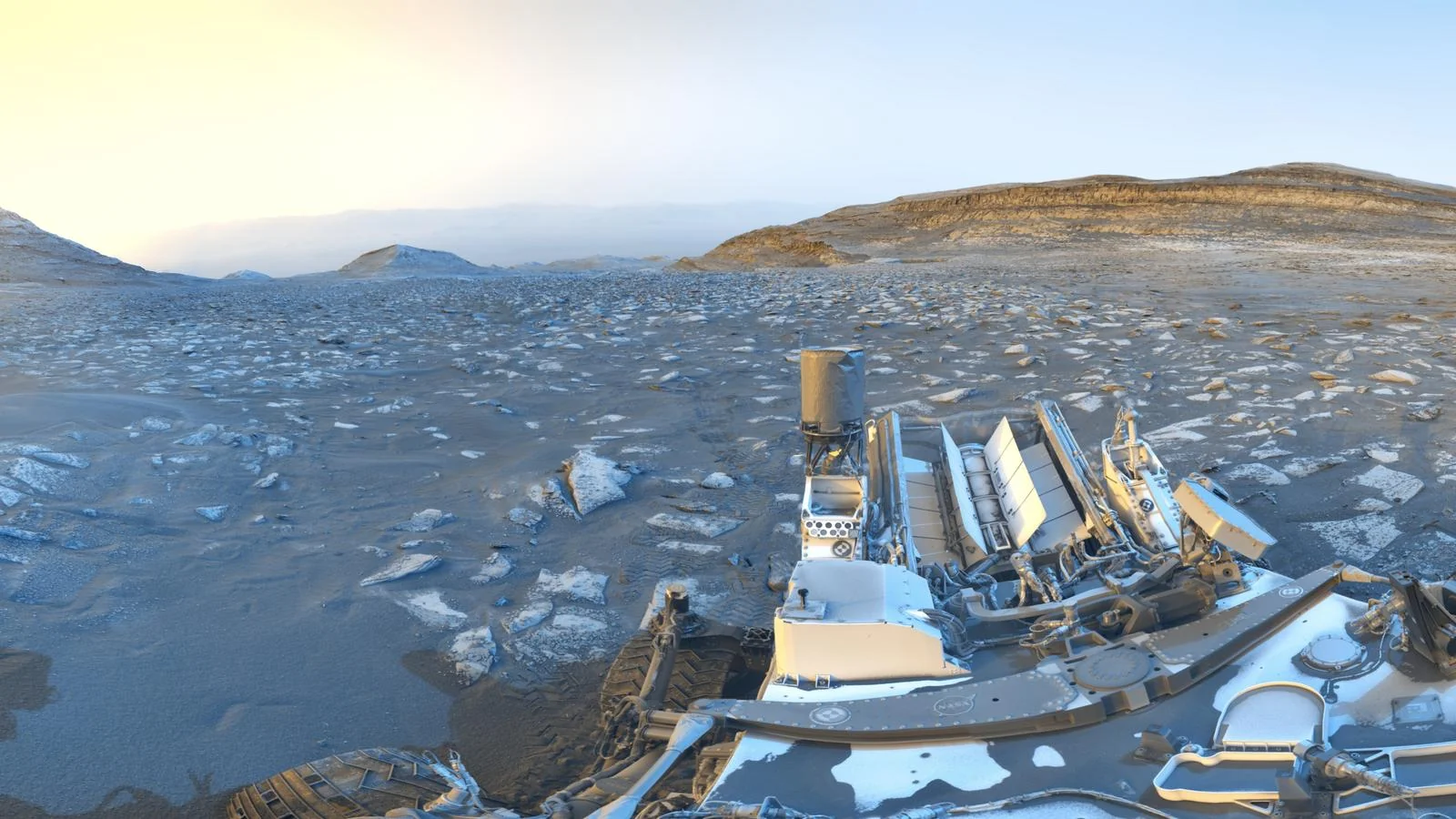
NASA's famous Curiosity Mars rover has successfully completed its 5000th sol (Martian day) on the surface of the Red Planet. To mark this milestone, the space agency released a special, uniquely decorated "postcard" captured by the rover itself, reports ixbt.com. This is reported by Ixbt.com reports.
According to the data, the commemorative image was taken from a single point near a ridge named "Chokolatal" using two black-and-white navigation cameras. The first frame was captured on the morning of August 30 of this year, and the second on the evening of September 2. Specialists combined these frames and hand-colored them: the blue hues reflect the morning time, while the yellow tones represent the afternoon light.
Details of the historic frame
The image clearly shows the equipment itself and the long path it has traveled. Specifically, the foreground features the rover itself—the UHF antenna designed for communication with satellites and the ribbed radioisotope thermoelectric generator that has been providing Curiosity with continuous energy for nearly 14 Earth years.The photo also captures the rover's wheel tracks stretching into the distance toward the lower slopes of Mount Sharp, a 5-kilometer-high peak in Gale Crater. The distant crater rim is visible, fading into the horizon. As a reminder, the mission team created a similar commemorative image in November 2021.
Continuation of the scientific mission
The apparatus, which set off for the Red Planet in August 2012, was initially designed for 1 Martian year (approximately 687 Earth days). However, it has operated far longer than planned, exceeding all expectations, and continues to actively conduct scientific research to this day.Currently, Curiosity is slowly climbing up the slopes of Mount Sharp. The layers of this mountain hold the secrets of Mars' climate transition from a wet period to a dry one. According to the experts' near-term plans, they intend to further study the sulfate-rich deposits that formed as water in the crater gradually disappeared.


Comments 0
…