


The “Invisible” Spy on the Ocean Floor: A “Doomsday Fish” Robot Created That Doesn’t Scare Sea Creatures
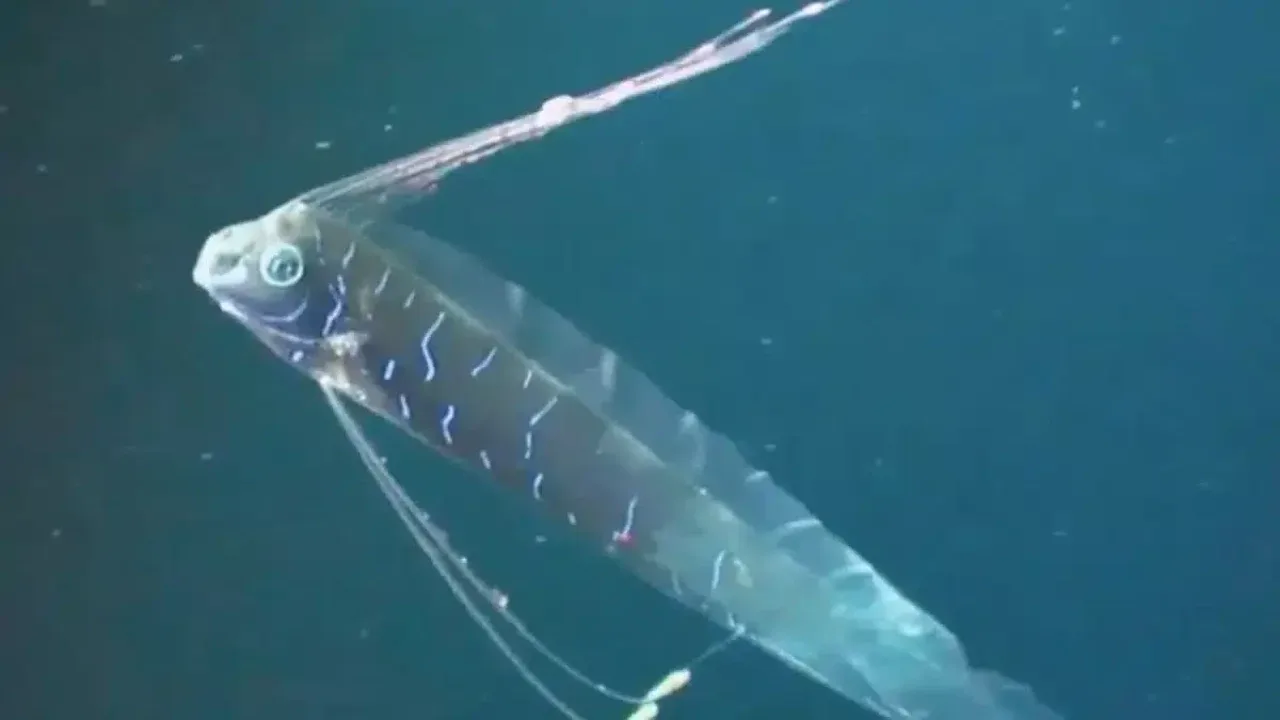
Commissioned by the US Office of Naval Research, scientists at the Cornell University Sibley School of Mechanical Engineering have set out to design a completely new type of underwater vehicle intended for exploring the ocean floor. Led by Professor Rob Sheperd, the team was tasked with creating a robot that is huge in size, yet capable of moving silently underwater without startling marine fauna in the slightest.
As a solution to this complex engineering problem, one of nature's most mysterious creatures was chosen — a deep-sea dwelling fish known popularly as the “Doomsday Fish”, or oarfish (ribbonfish).
The Skill of Swimming Without Moving the Body
Reaching up to nearly 8 meters in length, this giant fish possesses a unique biological feature for underwater movement:
Rigid Body: Instead of undulating and bending its entire body like an eel or other marine creatures, the oarfish keeps its body virtually steady, straight, and motionless while swimming;
Silent Fin: The main propulsive force is generated through its long, ribbon-like dorsal fin extending along its back;
Easy Control: Micro-waves generated in this fin allow the fish to move forward and backward without making the slightest noise and to perfectly control its direction.
Because the creature's body quickly breaks down into fragile fragments when removed from the water or upon death, the scientists — collaborating with former Cornell University ichthyologist William Bemis — utilized computed tomography, special X-rays from the Smithsonian Institution, and detailed anatomical modeling in their research.
Hundreds of “Joysticks” Under the Skin: What is the Secret of the Invention?
While studying the fish's anatomy, researchers discovered a complex kinematic structure hidden beneath the skin, proven for the first time in evolution:
Spherical Joints: Hundreds of thin bone-like rays supporting the dorsal fin are attached to special spherical joints that work like miniature “joysticks”;
Independent Control: Each ray is set in motion individually with the help of unique muscles and cartilage, allowing any part of the fin to independently twist in various directions;
Opposing Waves: The thin membrane connecting the rays is capable of transmitting motion waves in two opposite directions simultaneously. As a result, the giant fish instantly alters its speed and trajectory of movement without bending its body.
### Application in Robotics: An “Invisible” Observer for the Ocean
Copying this biomechanic, Rob Sheperd’s team is developing biomimetic underwater robots capable of high-precision maneuvering.
This invention will revolutionize not only naval strategic surveillance, but also the study of delicate ocean ecosystems that are extremely sensitive to human factors and machinery noise. The robots will make it possible to collect valuable data from the mysterious depths without startling the underwater animal world and without disturbing the ecological balance on the seabed.



Comments 0
…