


How are Iran's strengths and weaknesses manifested in the region?
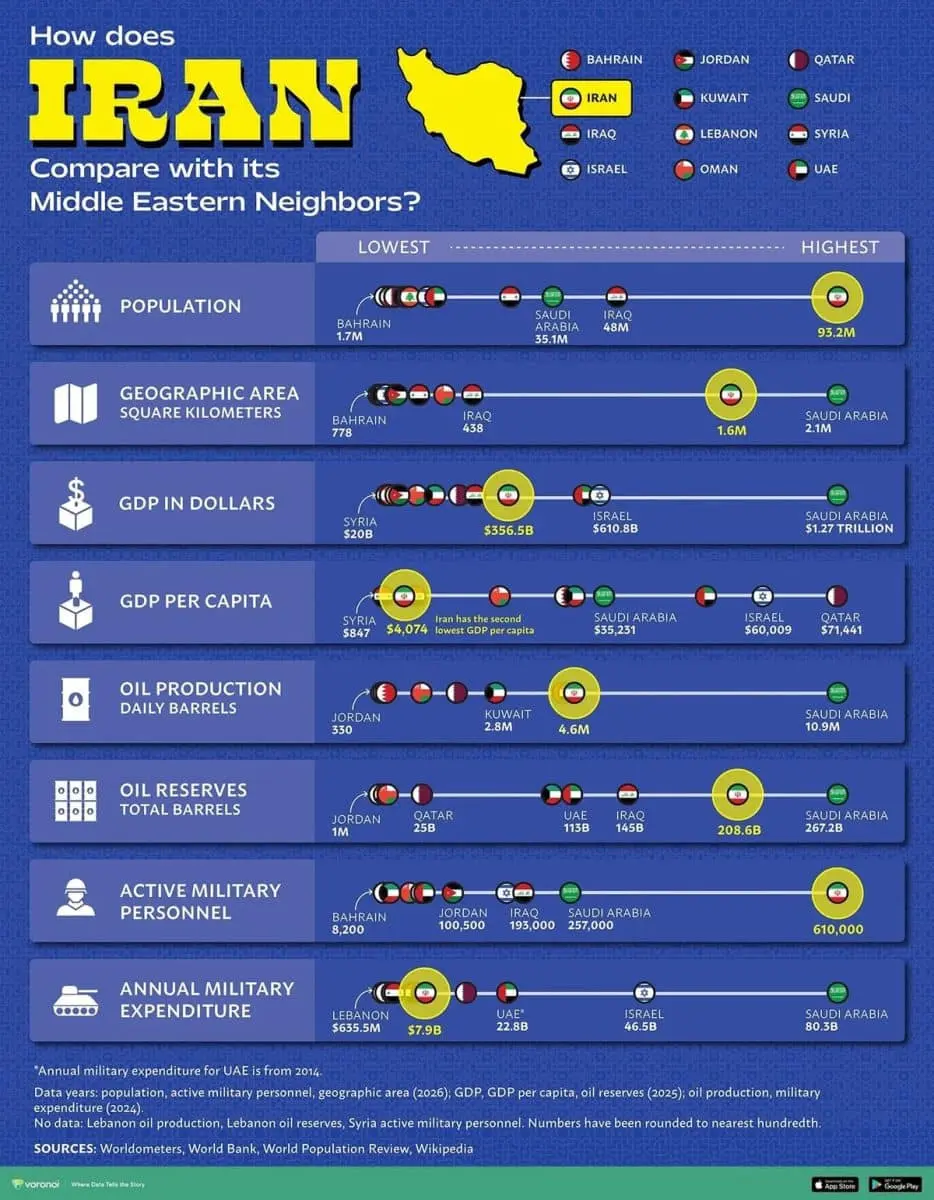
Iran is often cited as one of the main and influential states of the Middle East region. However, the extent to which a country's real capabilities are stronger or weaker compared to neighboring countries depends on many factors. New analysis and infographic data show that Iran is a leader in some areas and seriously lagging behind in others.
First of all, regarding the population, Iran is one of the largest countries in the region. The country has a population of approximately more than 93 million people, which is significantly higher than in many neighboring countries. However, having a large population doesn't always mean prosperity. On the contrary, per capita income in Iran remains relatively low.
From an economic point of view, the country's gross domestic product is estimated at about 356 billion dollars. This is, of course, a large number, but not enough compared to such economically strong countries in the region as Saudi Arabia and Israel. Thus, the gap between economic volume and the well-being of the population becomes clearly visible.
GDP per capita is slightly over $4,000. This means that production efficiency is much lower compared to small, but rich countries - for example, Qatar or Israel. In general, this is typical for the Middle East: although the Persian Gulf countries have a small population, they are characterized by a high income level, while in large countries this indicator is relatively low.
In the energy sector, Iran's position is quite strong. The country is one of the world leaders in oil reserves. Its total reserves are estimated at approximately 208 billion barrels, and its daily production is around 4.5-4.6 million barrels. These figures make Iran the second most important player after Saudi Arabia.
At the same time, international sanctions are having a serious impact on the country's economy. Due to limited oil exports and foreign investments, Iran is unable to fully realize its potential in this area. Currently, most of the exported oil is directed to the Chinese market.
As for military potential, Iran has one of the largest armed forces in the region. More than 600 thousand military personnel are involved in ensuring the security of the country. This figure is significantly higher than that of the Saudi Arabian army. However, the situation with the military budget is different: Iran spends about 7-8 billion dollars a year, which is significantly less than its competitors.
Israel is seen as a leading state in the field of technology and modern weapons. Therefore, in terms of military spending and innovation, it surpasses Iran.
In conclusion, Iran, as a country with a large population, rich resources, and a large army, occupies an important place in the region. However, in terms of economic efficiency, the well-being of the population, and military investments, it lags behind some of its rivals. Therefore, the real power of a country is not limited to its scale and capabilities, but also directly depends on external factors and internal reforms.



Comments 0
…