


Putin on the West: "The genie has been let out of the bottle"
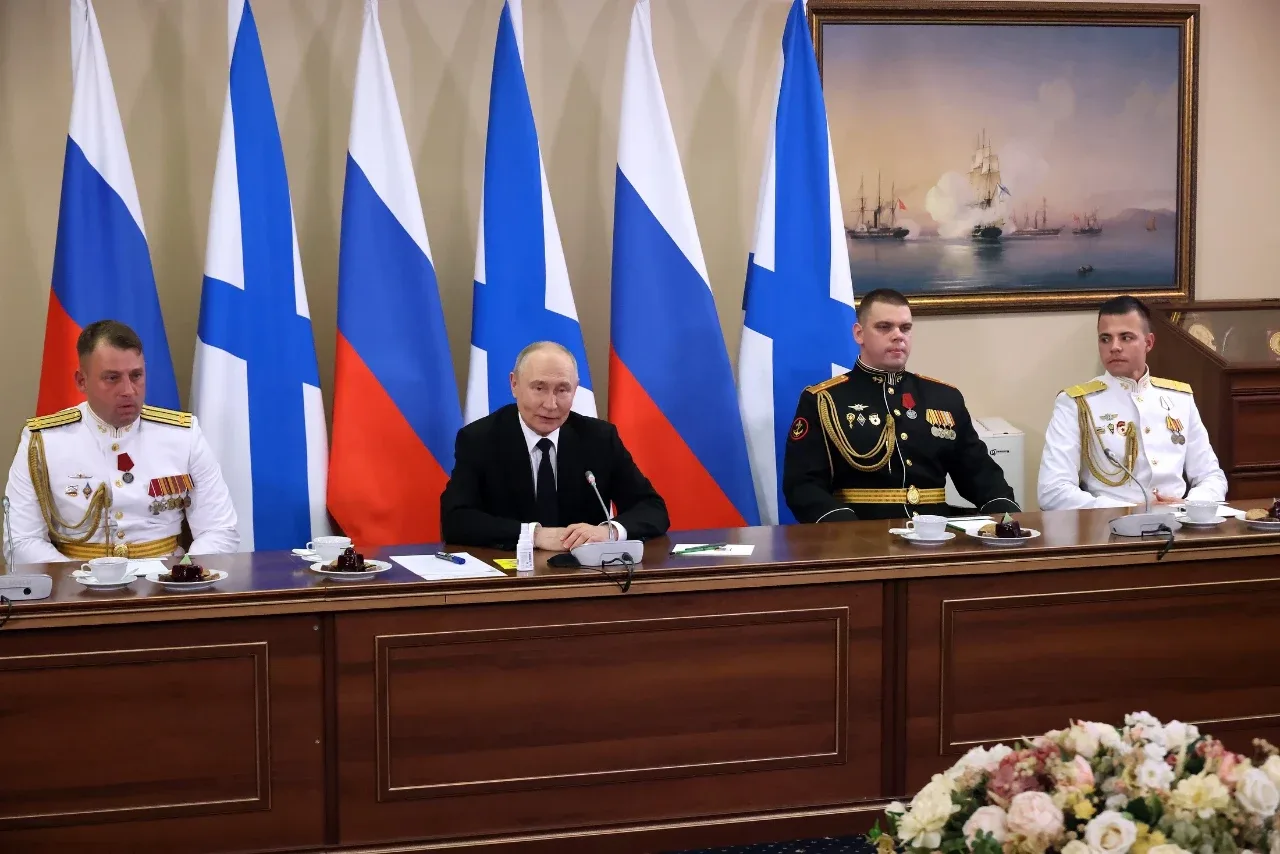
Russian President Vladimir Putin stated that after the collapse of the USSR, Western countries attempted to adapt the rules of international relations to suit their own interests. Using the decisions made in Yugoslavia as an example, he compared this process to "letting the genie out of the bottle."
However, this is the political and legal interpretation of the Russian leader. The events in Yugoslavia, particularly the question of the legality of NATO's 1999 military operation, remain one of the most controversial topics in international law.
What exactly did Putin say?
The statement was made on July 26, 2026, in St. Petersburg at a meeting with servicemen of the Russian Navy. Putin emphasized that the post-World War II international order was built on the basis of the UN Charter.
In his view, after the dissolution of the Soviet Union, Western countries, considering themselves the victors of the Cold War, set about reinterpreting the existing rules.
"Decisions were made that completely contradict the UN Charter. They simply let the genie out of the bottle," Putin said.
The Russian president pointed to the events in Yugoslavia and the division of the Serb people across various state territories as the most striking example of such decisions.
What was the USSR's role in the UN?
The Soviet Union was one of the founding members of the UN starting from October 24, 1945. It was among the five permanent members of the Security Council and held veto power.
After the collapse of the USSR, on December 24, 1991, Boris Yeltsin informed the UN Secretary-General that the membership of the Soviet Union in the organization, including in the Security Council, would be continued by the Russian Federation. This decision was supported by 11 CIS states.
Thus, Russia retained the USSR's seat in the UN, the status of a permanent member, and veto power. Putin's words do not imply that official rights were revoked; rather, they reflect a political argument that the West sought to reduce Russia's international influence.
Why was Yugoslavia cited as an example?
The Socialist Federal Republic of Yugoslavia was also one of the original members of the UN. When the country dissolved in the early 1990s, states such as Slovenia, Croatia, Bosnia and Herzegovina, Macedonia, and others emerged in its place.
Putin's criticism is mainly focused on the Kosovo conflict and the air operation launched by NATO against Yugoslavia in 1999.
NATO justified the military operation by the necessity to stop violence in Kosovo, prevent a humanitarian catastrophe, and achieve a political settlement. The alliance accused Serbian forces at the time of using excessive force against civilians.
Did the UN authorize NATO's operation?
The greatest legal debate has arisen precisely around this question.
When NATO launched air strikes in March 1999, no new UN Security Council resolution explicitly authorizing the use of military force had been adopted. NATO's Secretary-General at the time, Javier Solana, openly stated that obtaining approval there would have been impossible due to likely opposition in the Security Council.
After the 78-day air campaign ended, UN Security Council Resolution 1244 was adopted on June 11, 1999. It authorized the deployment of international security forces in Kosovo, including the NATO-led KFOR mission.
For this reason, there are two contrasting approaches to the event:
Russia and a number of legal experts emphasize that NATO strikes contradicted the UN Charter because they were carried out without a Security Council mandate;
while NATO countries justify the operation as an extraordinary measure necessary to stop a humanitarian disaster.
What does the UN Charter say about the use of force?
Article 2 of the UN Charter prohibits member states from using force or the threat of force against the territorial integrity or political independence of any other country.
The main legal grounds for the use of military force in international law are:
the exercise of the right of individual or collective self-defense when a state is subjected to an armed attack;
authorization by the UN Security Council of military measures to restore peace.
The right to self-defense is enshrined in Article 51 of the Charter. The Security Council, in turn, can apply enforcement measures under Chapter VII.
"Humanitarian intervention" is not explicitly and clearly stated as an independent basis in the UN Charter. Therefore, the Kosovo event became a controversial precedent interpreted differently by parties in subsequent military conflicts.
What does the phrase "The genie is out of the bottle" mean?
According to Putin's logic, if a group of states uses force bypassing common rules, other countries may also attempt to justify their actions in the exact same way in the future.
In other words, the "genie" is not a single military operation, but the habit of applying rules differently depending on the situation and interests.
This view has been expressed in Russian foreign policy rhetoric several times before. Aside from Yugoslavia, Putin has repeatedly linked Western operations in Iraq and Syria to the issue of Security Council authority.
Russia itself faces the same question
Putin accuses the West of selectively applying international law. However, critics of Moscow apply these exact same criteria to Russia's own military actions.
This demonstrates the fundamental contradiction in international relations: major powers claim they are defending the UN Charter, yet each strives to explain its own actions through distinct historical, security, or humanitarian reasons.
Therefore, the debate is not just about the question "Who broke the rule first?" The main issue is whether an exception created by one state can later serve as a legal basis for another state.
Why is the statement important now?
Putin's words show that the conflict between Russia and the West is not limited solely to Ukraine or sanctions. The parties hold opposing positions on how the entire international system formed after World War II should function.
Russia states that it advocates for a multipolar world and equal rules for all countries. Western countries, meanwhile, justify their actions by the necessity of security, human rights, and stopping humanitarian crises.
Putin's phrase "the genie is out of the bottle" expresses precisely this crisis of trust: states have stopped believing each other's legal arguments, and each side accuses its opponent of applying double standards.
Main conclusion
Putin assessed the events in Yugoslavia as the turning point where the West deviated from the international order based on the UN Charter.
The 1999 NATO strikes indeed began without a special UN Security Council resolution authorizing the use of force. However, NATO justified this decision by the necessity to stop the humanitarian crisis in Kosovo.
Therefore, Putin's statement contains events that serve as a basis for legal debate, but the conclusion that "the West completely destroyed international law" is considered a political interpretation.
In your opinion, is it permissible to use force without UN authorization to stop a humanitarian tragedy, or is a Security Council decision mandatory in any case?



Comments 0
…