


Scientists Detect a Mysterious Black Hole That Resembles a Star
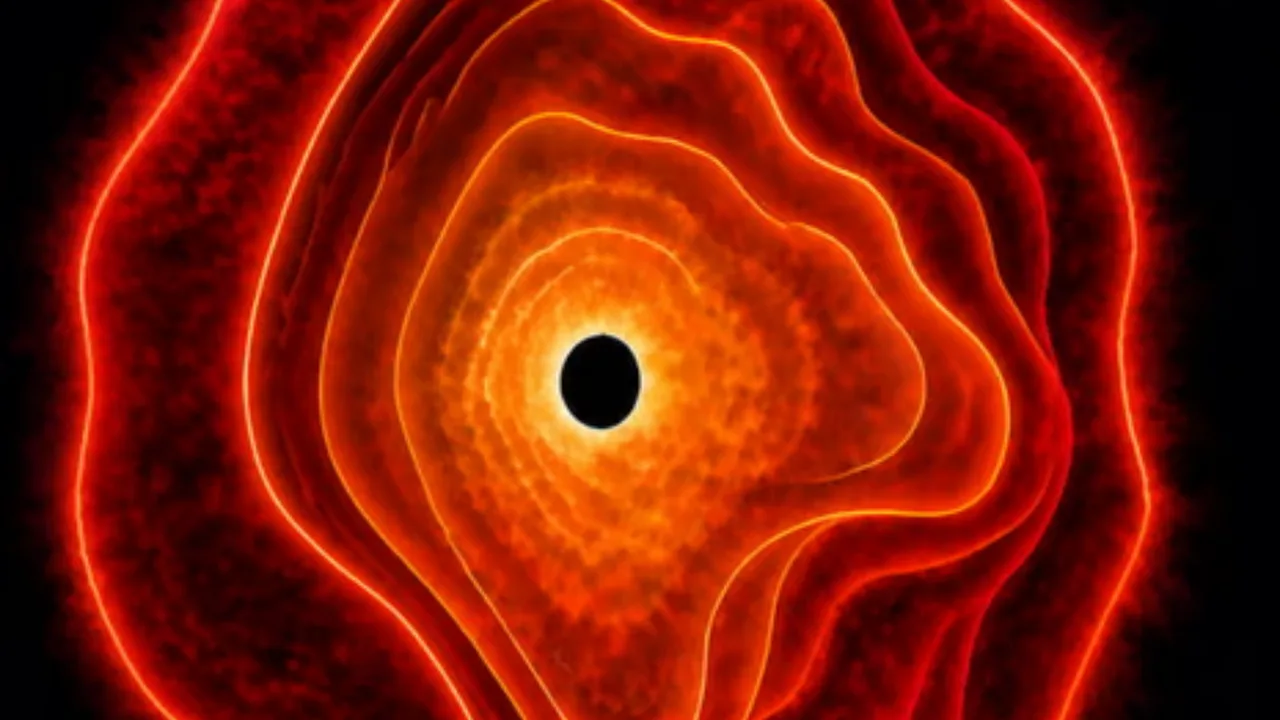
Astronomers have detected an unusual cosmic object that emits light like a star but has energy characteristic of black holes. “Black hole star” the object, which has been dubbed a “black hole star,” is about the size of the entire Solar System and is located billions of light-years from Earth. This was reported in a study by an international team of scientists published in Nature .
The scientists reportedly identified this mysterious object while studying images of the early Universe taken by NASA’s James Webb Space Telescope. MoM-BH-1* is located in the constellation Cetus. According to the scientists’ calculations, it formed about 660 million years after the Big Bang.
The researchers initially identified the object as a giant red star. However, its energy output did not match that assumption. Calculations showed that the object was emitting 100 billion times more energy than any known star. This indicated that it had characteristics typical of black holes.
“We have identified a new type of astrophysical object — a black hole star,” said Rohan Naidu, a scientist at the MIT Kavli Institute for Astrophysics and Space Research.
He noted that the object “is illuminated by energy usually associated with black holes, while also displaying features characteristic of classical stars.”
Computer modeling, however, showed that the object is not a giant star producing energy through nuclear fusion. The scientists hypothesize that MoM-BH-1 is a black hole surrounded by dense layers of gas*, causing its radiation to resemble that of an ordinary star.
The researchers also noted that the light from MoM-BH*-1 is almost entirely red and disappears sharply beyond a specific wavelength. Naidu said that comparing this feature with other known cosmic objects is very difficult.
According to the astronomers, if the findings are confirmed by further observations, many other mysterious “Little Red Dots” identified in images from the James Webb Space Telescope could also be black hole stars.
The researchers suggest that such objects may have played an important role in galaxy evolution. In particular, they may have been early forms of the supermassive black holes now found at the centers of galaxies.
According to Rohan Naidu, “black hole stars” may represent an early stage in the formation of nearly every supermassive black hole and may also have significantly influenced star formation and the subsequent development of galaxies.


Comments 0
…