


SpaceX Rocket Expected to Crash Into the Moon Today: What Will Happen?
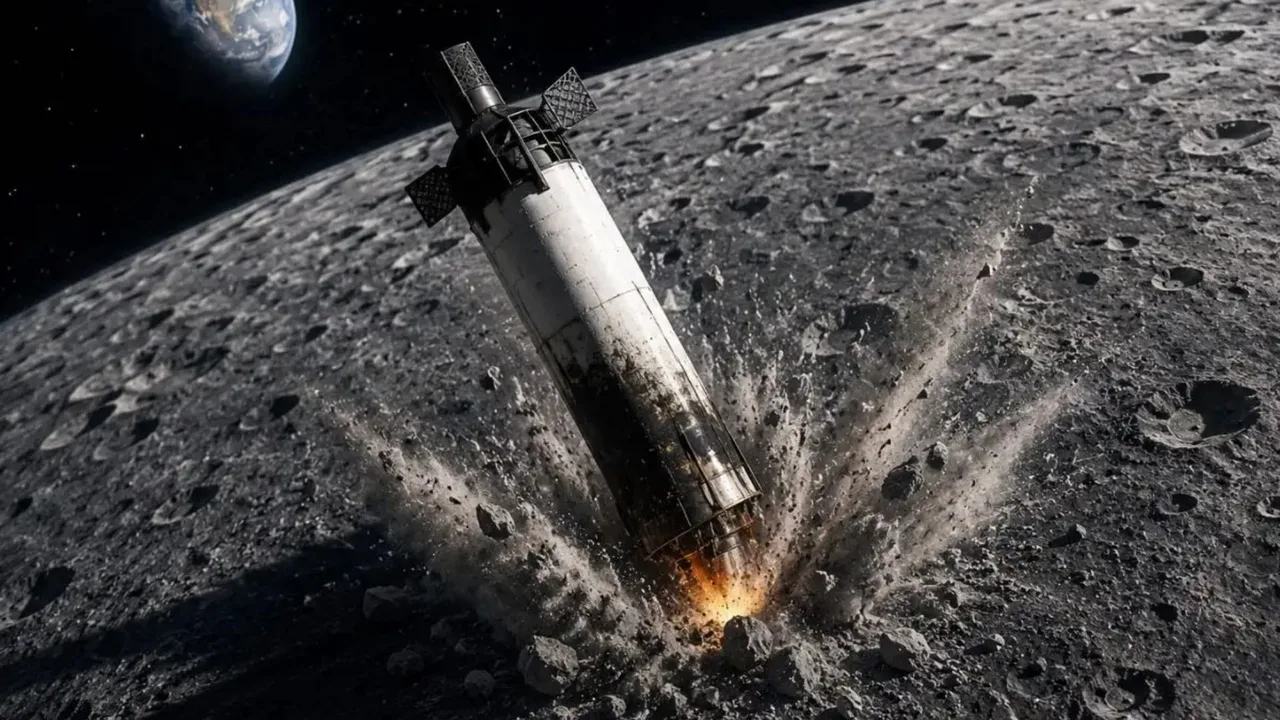
A piece of a SpaceX rocket that has been traveling through space since last year is expected to hit the Moon’s surface at high speed today, August 5. This was reported by Reuters news agency.
The object, reportedly about the size of a school bus, is the second stage of the SpaceX Falcon 9 rocket that carried Firefly Aerospace’s lunar lander into space in January 2025.
According to experts, the rocket fragment, weighing nearly 4 tons, is expected to hit the Moon’s surface at approximately 2:35 a.m. Eastern Time (06:35 GMT) at a speed of about 8,690 kilometers per hour. The impact could send a large amount of dust up from the lunar surface. This dust may be illuminated by sunlight, but it will be extremely difficult to observe from Earth with the naked eye.
SpaceX representatives said the collision was not planned in advance. The rocket fragment is expected to crash in the area of the Einstein crater, located on the western side of the Moon. This region is not clearly visible from Earth, so the ability to observe the event directly is limited.
During ordinary missions, the rocket’s second stage returns to Earth’s atmosphere and burns up or is directed into the ocean after delivering its payload to the designated orbit. This time, however, the mission was directed toward the Moon, which required considerably more energy, leaving the rocket’s second stage stranded in space.
Astronomers determined only at the beginning of this year that the rocket fragment, which had run out of fuel and lost its ability to maneuver, had entered an orbit intersecting the Moon’s path.
According to Julianna Scheiman, SpaceX’s director of NASA science programs and the Dragon project, the combined effects of solar activity and gravity gradually steered the rocket fragment toward the Moon.
According to astronomer and software developer Bill Gray, the event poses no serious threat to humanity. However, it highlights the need to pay greater attention to monitoring space debris and disposing of it safely.
Impacts of space debris on the Moon are very rarely observed. For example, in 2022, one of China’s rocket fragments crashed into the lunar surface. In 2009, NASA scientists deliberately directed a rocket component toward the Moon to study lunar dust and its internal structure.
In recent years, a number of space missions aimed at soft landings on the Moon have also ended unsuccessfully. These include Russia’s Luna-25 spacecraft in 2023, as well as India’s Chandrayaan-2 and Israel’s Beresheet missions, which crashed onto the lunar surface in 2019.
Experts believe that events like this will make the management of space debris an even more pressing issue for future missions to the Moon and deep space.


Comments 0
…