


Panic in Almaty: Did the roof of the Palace of Students collapse, or was it a planned dismantling?
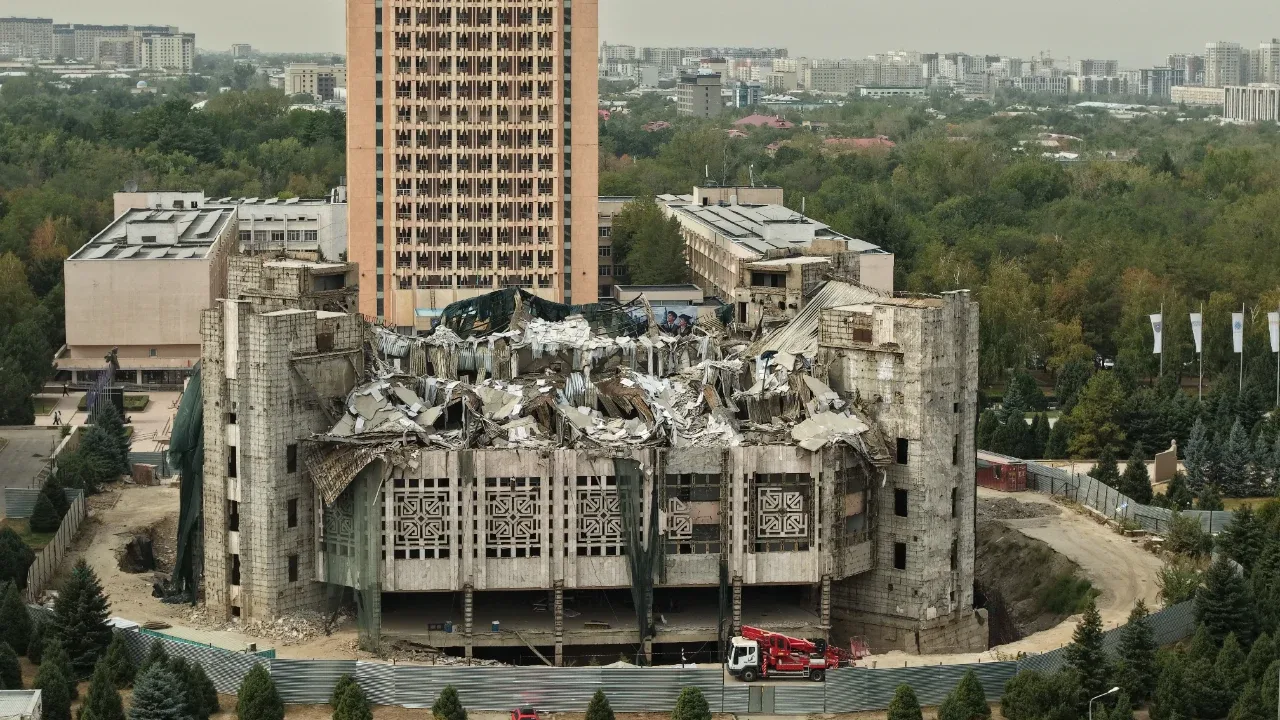
On the morning of September 24, an unexpected incident caused serious concern among the residents of Almaty and students of the Kazakh National University (KazNU). According to information published by the influential Kazakh publication Tengrinews, images appeared showing concrete fragments and huge collapsed metal structures in place of the roof of the famous Umirbek Zholdasbekov Palace of Students in the city, which sparked alarming reports on social media claiming that "the roof of the building collapsed on its own." To clarify the situation, the university's press service issued an urgent official statement and firmly rejected assumptions about the "sudden collapse" of the building.
It was reported that on the night of September 23, 2026, planned roof dismantling (demolition) work was carried out on this building as part of a large-scale capital reconstruction program. In order to ensure the safety of students and faculty and not to interfere with the daytime educational process, all heavy engineering work was specially organized at night, the contractor fully complied with all safety measures, and no one was injured. Built between 1985 and 1998, this major cultural facility has not undergone a major overhaul for nearly 30 years. A technical expertise conducted by an accredited independent organization revealed corrosion in the building's load-bearing columns, a lack of concrete beams, damage to nodal joints, and dangerously deformed roof structures.
So, how did the 30-year-old building come to the brink of disaster, why did the night dismantling cause panic among the public, and what will the renewed Palace of Students look like when it rises again?
"Night dismantling, 30-year decay, and KazNU's statement": 5 key points of the incident in Almaty
The most important facts regarding the situation at the Kazakh National University:
Not a "sudden collapse," but planned work: The university administration denied rumors about the sudden collapse of the roof, stating that it was a project dismantling;
Safety measures on the night of September 23: The roof demolition was carried out during special night hours so as not to disrupt the educational process and student movement;
No casualties: The contracting organization strictly followed safety regulations, and no injuries were reported;
A facility without repairs for 30 years: Built in 1985–1998, this magnificent palace has not undergone major reconstruction over the past thirty years;
Severe conclusion of the expertise: Inspections revealed deep corrosion, deformation, and a dangerous condition of concrete beams in the columns, requiring immediate reconstruction.
Palace of Students facility: Comparison of network rumors and official real situation
Comparative analysis of the panic caused by the incident in Almaty and the actual truth:
Criteria and indicators | Initial concerns on social media | Official conclusion of the university and expertise |
Nature of the incident | "The roof of the building is old and collapsed on its own" | Planned dismantling as part of capital reconstruction |
Time of execution | Alarming images spread on the morning of September 24 | The night from September 23 to September 24, specially selected time |
Safety and injuries | Suspected threat to the lives of students and people around | Fully secured zone, absolutely no casualties |
Construction history of the building | Commissioned in 1985–1998 | A building not majorly repaired for nearly 30 years |
Technical condition and expertise | Considered as normal wear and tear | Column corrosion, joint destruction, and roof displacement |
Next plan and goal | Risk of halting the building's operations | Transforming into a modern, seismic-resistant, and safe complex |
Engineering and safety expertise: Why was dismantling the roof an unavoidable measure?
Conclusions of construction engineers, seismologists, and technical inspectors:
"Hidden danger" — 30 years of metal fatigue: The Palace of Students is a venue where thousands of young people, concerts, and major events are held; the corrosion and beam deformation identified by the expertise could have caused a real mass tragedy during major conferences; noticing the problem in advance and embarking on a radical renewal of the roof was a correct and responsible preventive step;
Why was the night time chosen? During the day, there is a flow of tens of thousands of students, transport, and pedestrians in the KazNU campus; dismantling metal and concrete structures using heavy machinery specifically at night, with barriers installed along the perimeter, fully complies with engineering ethics;
The factor of Almaty's seismic zone: Almaty is located in a high-seismic zone; any weakened load-bearing structure may not withstand even a moderate earthquake; therefore, renewing the roof and columns of the palace will extend the building's life by decades;
The effect of delayed information delivery: The lack of advance public notice about the night dismantling created a false impression and panic among passers-by in the morning; this situation once again demonstrated the importance of the culture of warning the population about such noisy and dangerous work in large cities.
This planned reconstruction at the Kazakh National University will serve to ensure that the historic palace, beloved by thousands of students, acquires an even safer, more durable, and modern appearance.
In your opinion, should the university administration have officially warned the population in advance about the night dismantling work? How do you personally assess the condition of public buildings that have not been repaired for 30 years and the preventive decision of the KazNU management? Leave your personal thoughts in the comments and share this analysis of the event in our neighboring fraternal country with all students and friends!



Comments 0
…