


Unique Ice-Resistant Floating Solar Power Plant Created in Canada
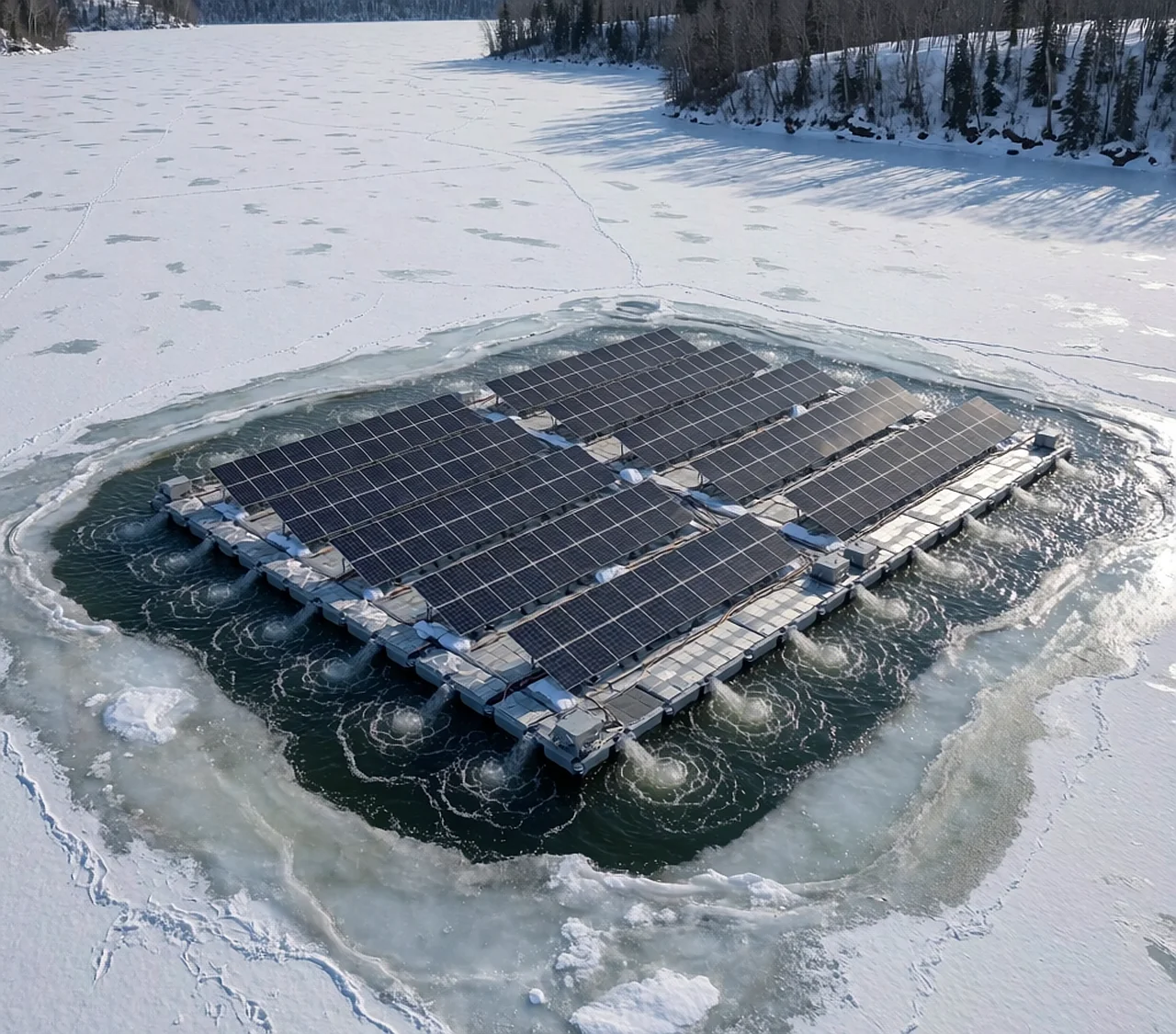
Canadian researchers have developed an unusual floating solar power plant capable of operating continuously even in extreme cold and freezing water bodies. This technology allows for the efficient use of renewable energy sources even in the northernmost regions. According to Ixbt.com, reports .
For traditional floating solar panels, the ice layer during the winter season is the greatest risk. The expansion and movement of ice can quickly destroy plastic platforms. To solve this problem, Canadian engineers used a waterproof flexible foam material and a system of air bubbles.
Anti-ice bubble technology
The core of the system is an aeration pump installed at the bottom of the water. According to ixbt.com, the pump drives air to the bottom, and the rising bubbles bring the lower warm layers of water to the surface. As a result, an open water area that does not freeze even in severe cold is maintained around the station.Tests conducted in the province of Ontario showed that the energy consumed for the pump's operation is very low — it accounts for only 0.02 percent of the total power produced by the panels. The experimental device successfully produced 7.7 MW·h of electricity over one year.
The new design is distinguished not only by its durability but also by its efficiency. According to the researchers' calculations, the efficiency of this system is 2.7 percent higher than that of traditional floating platforms. This is explained by the panels' close proximity to the water and natural cooling.
Water conservation and future prospects
In addition to electricity production, this technology is also environmentally beneficial. The panels block sunlight and wind from the water surface, significantly reducing evaporation. Scientists note that by covering half of a small pond's surface with such panels, hundreds of cubic meters of water can be saved annually.Such technologies could be relevant in the future for regions with sharply changing climates and limited water resources, such as Uzbekistan. This solution would be particularly useful for generating electricity in reservoirs that freeze in winter and preventing evaporation in summer.
The next phase of the project is currently being planned. Researchers aim to test the technology in larger water bodies and commercial facilities. If the tests are successful, the scope of solar energy use in northern countries is expected to expand sharply.


Comments 0
…