


Major breakthrough in quantum physics: Scientists create exotic superpositions
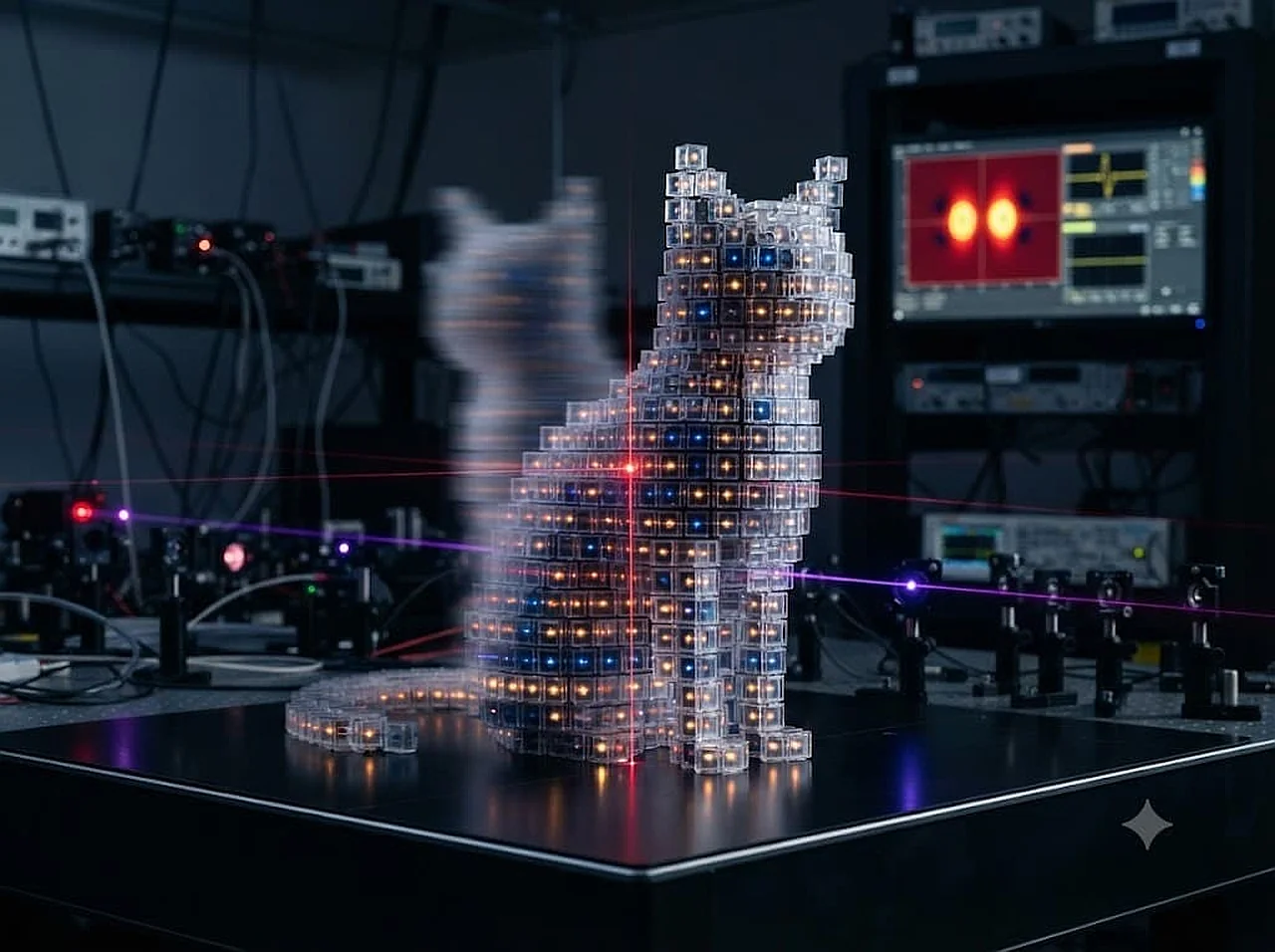
Physicists at the University of Oxford have successfully carried out a highly complex experiment, opening a new chapter in quantum mechanics. According to ixbt.com, for the first time in history, researchers have practically generated arbitrary superpositions from non-classical and "squeezed" states of a quantum harmonic oscillator. Until now, such exotic combinations had been described only theoretically, and practical work was limited to standard "Schrödinger's cat" states. This is reported by Ixbt.com reports .
To achieve this result, the scientists used a single strontium-88 ion placed in a Paul trap. Here, the internal electronic states of the ion acted as a qubit, while mechanical vibrations played the role of a quantum harmonic oscillator. Specialists managed to entangle the ion's motion with its spin state using spin-dependent nonlinear interactions of various orders.
New approach and precise control
The hybrid scheme used during the experiment made it possible to bring the oscillator into the desired superposition, including even or odd combinations of squeezed packets. By introducing a spin-dependent displacement, the authors separated these packets in phase space. As a result, "cat" analogs assembled directly from non-classical and uneven blocks, rather than traditional blocks, were obtained.Specialists mapped the state in phase space and recorded a clear interference pattern with depths extending into the negative region. In classical physics, probability cannot be negative, but here this exact condition became the key factor demonstrating that a true quantum superposition, rather than a mere set of classical probabilities, had been formed.
New opportunities for quantum engineering
The match between the obtained results and the digital model exceeded 90 percent. Most importantly, the non-classicality measure of the new superpositions turned out to be higher at the same level of vibrational energy than that of Fock states or traditional Schrödinger's cats. This means that the created object is more difficult to simulate on a classical computer, and for quantum computations, it serves as a more powerful resource.The universality of this method allows it to be transferred to any systems featuring spin-oscillator coupling: superconducting circuits, atoms in optical resonators, and nanoparticles in traps. As a result, complex non-classical states are transitioning from simple mathematical exercises into tools for quantum engineering. Specialists and theorists continue working on quantitatively evaluating the "quantumness" of the created states.


Comments 0
…