


Cosmic Mystery: Rare 'Blue Eye' pulsar awakens after a decade of silence
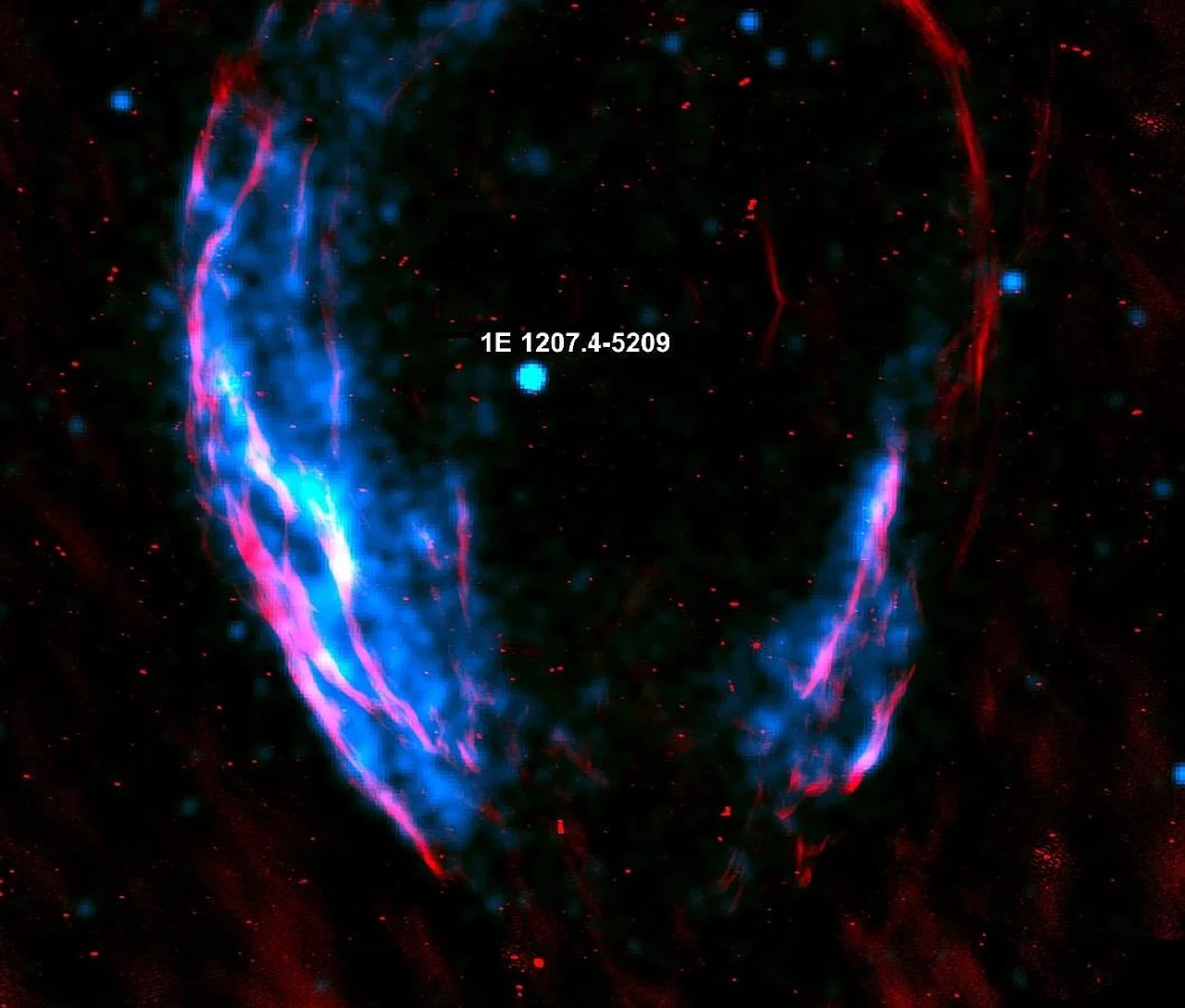
Astronomers have successfully detected weak radio waves for the first time from one of the rarest neutron stars—a Central Compact Object (CCO)—that had been in a 'radio-silent' state for decades. This discovery suggests that stellar remnants in the universe previously considered dead may actually be active. This is reported by Ixbt.com reports .
An international team led by Zhang Lei of the National Astronomical Observatories of the Chinese Academy of Sciences identified pulses from the object 1E 1207.4-5209 using the MeerKAT radio telescope in South Africa. According to Ixbt.com, this object is located in the Milky Way galaxy, approximately 10,000 light-years from Earth, at the center of a remnant left behind by a supernova explosion.
The unexpected activity of the 'Blue Eye'
Due to the combination of its X-ray emission and newly discovered radio waves, this neutron star has been informally named the 'Blue Eye'. In the captured images, the star's bright X-ray emission resembles a blue pupil in the center of a cosmic cloud. MeerKAT observations showed that the object emits very weak pulses repeating every 424 milliseconds.Scientists believe the emergence of this radio signal may be linked to a 'spin glitch' event that occurred in 2015. At that time, the rotation speed of the neutron star increased sharply for a short period. Such a process is caused by the movement of ultra-dense matter inside the star, which may have strengthened the object's magnetic field or altered its orientation.
Scientific significance of the discovery
This finding provides several important conclusions for modern astronomy:- Many neutron stars previously considered 'dead' may actually be very weak radio pulsars;
- The probability of a vast population of active but undetected pulsars in our galaxy has increased;
- This phenomenon may explain why radio signals have not yet been found in famous supernova remnants like SN 1987A.
Astronomers are currently continuing to observe the 'Blue Eye'. The main question is whether this weak radio signal is permanent or just a temporary consequence of the internal disturbance in 2015. If the signal persists, the chapters on neutron stars in textbooks will need to be rewritten.


Comments 0
…