


NASA Psyche spacecraft sends unique images of the Martian surface to Earth
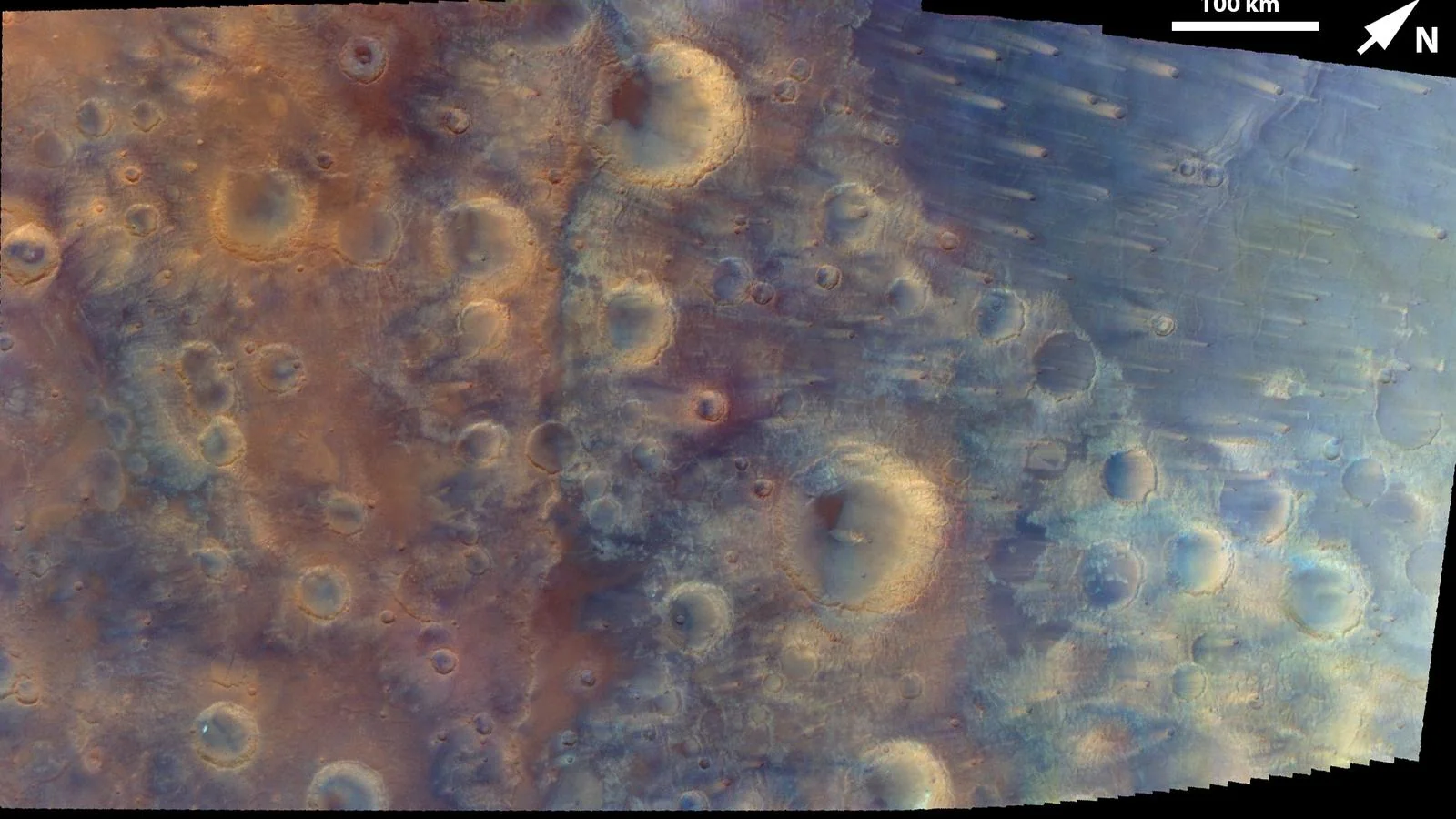
During its deep space journey, NASA's Psyche spacecraft captured high-resolution images of the Martian surface as it flew past the planet. While Mars was not the primary target of the mission, the flyby provided an opportunity to test the spacecraft's scientific instruments and gain a fresh perspective on the Red Planet's geology. This is reported by Ixbt.com reports .
According to ixbt.com, the images were taken on May 15, 2026, using the spacecraft's multispectral camera and later combined into a color mosaic. The images clearly show the unique features of Mars' southern highlands, particularly the region known as Iapygia. The Psyche spacecraft moved from the northeast to the southwest of the planet's disk, capturing the entire process in just 6 minutes.
The spatial resolution of the acquired data ranges from 381 to 440 meters per pixel. The camera used near-infrared, green, and blue filters to reveal differences between various parts of the surface. This helps scientists study the composition of large craters, ridges, wind-blown features, and volcanic plains on the Martian surface in greater detail.
New facets of Martian geology
Slightly below the center of the imaged area lies the Fournier impact crater, which is approximately 114 kilometers in diameter. Additionally, a massive system of cliffs known as Oenotria Scopuli is visible on the left side of the frame. This geological feature is associated with the large Isidis basin to the northeast and is significant for studying the formation history and impact era of the Martian surface.Such successful maneuvers by the Psyche mission are not only technically significant but also demonstrate the vast scale of space exploration to youth in countries with a high interest in astronomy. Obtaining such high-precision data from millions of kilometers away using modern technology is a testament to the level of human intellectual potential.
The main goal — a mysterious metal asteroid
NASA launched this probe to study the Psyche asteroid, which has a unique metallic composition and is located in the main asteroid belt between the orbits of Mars and Jupiter. Scientists believe this asteroid may be the core of a planetesimal — the "building blocks" that participated in the formation of ancient planets. The flyby of Mars served to provide the necessary gravitational acceleration and trajectory correction for the spacecraft.According to the plan, the gravity of the Psyche asteroid will capture the spacecraft in late July 2029. The main scientific program will begin in August. The spacecraft will remain in orbit around the asteroid for approximately two years, studying its composition, structure, and the secrets of its origin. These studies will help us understand how terrestrial planets with solid surfaces were formed.


Comments 0
…